
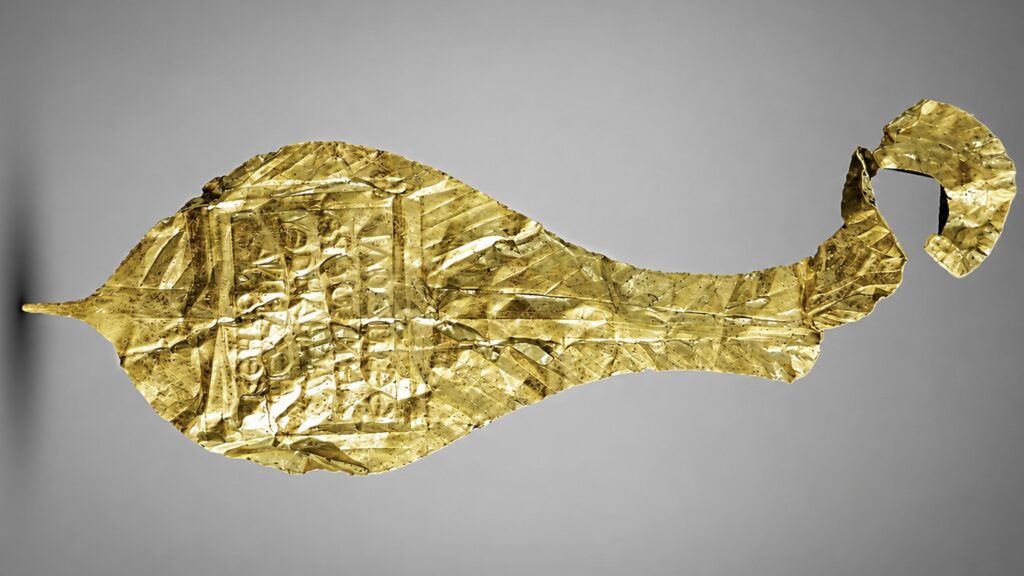
A gold plaque discovered at a Roman fortress in Georgia may have belonged to a wealthy merchant from Crimea who supplied Roman legions nearly 2,000 years ago.
A wealthy merchant may have followed Roman soldiers across the Black Sea, supplying military garrisons while building a commercial network that stretched between distant ports. His name was Thrasymedes, and archaeologists believe a small gold plaque discovered at a Roman fortress in Georgia could preserve evidence of his travels. The inscription has raised the possibility that a merchant already known from ancient records in Crimea was doing business with one of Rome’s most established legions.
The gold plaque was discovered at Apsaros, a Roman fortress near Batumi, during excavations conducted by a Polish-Georgian archaeological expedition. Its Greek inscription records an offering to Jupiter Dolichenus, a deity particularly popular among Roman soldiers, and identifies the donor as Thrasymedes. Researchers from the University of Warsaw and their Georgian colleagues published their analysis in Zeitschrift für Papyrologie und Epigraphik, opening a new line of investigation into the people who supported Roman military operations along the Black Sea.
A Merchant Whose Name Appears Across the Black Sea
Thrasymedes was an uncommon name in the ancient Black Sea region, making its appearance on the gold plaque particularly interesting. Researchers recognized the name from inscriptions at Chersonesus, a Greek city on the Crimean Peninsula near modern-day Sevastopol. There, a man named Thrasymedes had earned the recognition of the city’s authorities and received the privilege of conducting maritime trade without paying customs duties.
Such privileges were valuable in a region where merchants transported goods between Greek cities, Roman military installations, and settlements along the coast. According to archaeologist Radosław Karasiewicz-Szczypiorski of the University of Warsaw, the Thrasymedes known from Chersonesus was a prosperous trader who imported and exported goods. His commercial standing suggests that he operated on a considerable scale, although the surviving evidence does not establish the full extent of his business.
Karasiewicz-Szczypiorski has proposed that the merchant might also have supplied the Roman army, particularly units associated with Legio V Macedonica, the Fifth Macedonian Legion. If the individual commemorated in Chersonesus was indeed the donor named on the Apsaros plaque, his business activities may have taken him from Crimea to the eastern shores of the Black Sea. The identification remains hypothetical, but the military history of the two locations makes the possibility worth investigating.
The Roman Legion Connecting Two Distant Ports
The Fifth Macedonian Legion provides an important connection between Chersonesus and Apsaros. Roman military units associated with the legion operated in the Black Sea region, and stamped roof tiles discovered at Apsaros document its presence at the fortress during the second century AD. These archaeological traces demonstrate that soldiers belonging to the same military organization were active in the wider region where Thrasymedes may have conducted his business.
Maintaining Roman garrisons required reliable supplies of food, equipment, building materials, and other necessities. Military logistics depended on organized distribution systems, but civilian merchants and maritime transport networks could also contribute to meeting the needs of soldiers stationed far from major administrative centers. A prosperous trader with access to Black Sea ports would have been well positioned to participate in this commercial environment.
Excavations at Apsaros have also revealed evidence of economic activity beyond the fortress walls, including installations associated with pottery production and wine-making. Amphorae manufactured in the region could be used to transport agricultural products to other settlements and military installations. Although there is no direct evidence connecting Thrasymedes to these particular industries, the discoveries illustrate the economic infrastructure that supported Roman military life on the eastern Black Sea coast.
Why Did a Merchant Honor a Roman Soldier’s God?
The gold plaque is significant not only because of the name it preserves but also because of the deity to whom it was dedicated. Fashioned from a thin sheet of gold, the object bears a Greek inscription addressed to the “Dolichenian God,” identified with Jupiter Dolichenus. Such votive offerings were expressions of religious devotion and could commemorate a personal request or a promise made to a deity.
The cult of Jupiter Dolichenus originated in Doliche, in what is now southeastern Türkiye, and became integrated into the religious world of the Roman Empire. The god was commonly portrayed as an armed figure standing upon a bull, often carrying a thunderbolt and a double-headed axe. His worship developed a particularly strong association with Roman military communities and eventually reached distant frontier regions, including Britain.
For a merchant maintaining commercial relationships with soldiers, devotion to the same deity could have created an additional point of social and religious connection. Thrasymedes’ possible involvement with the Roman army offers one explanation for his dedication to Jupiter Dolichenus, whose cult was particularly popular among military communities. Nevertheless, the inscription reveals nothing about the donor’s personal beliefs, and the suggestion that he adopted the cult because of his military customers remains unproven.
A Lost Sanctuary at the Roman Fortress
The gold plaque was not the only object associated with Jupiter Dolichenus discovered at Apsaros. Archaeologists also recovered a small bronze figurine depicting an eagle on a bull, imagery closely connected with the deity’s religious symbolism. Together, the finds suggest that a place of worship dedicated to Jupiter Dolichenus may once have existed at or near the fortress.
The Polish-Georgian expedition has investigated Apsaros since 2014, gradually reconstructing the military, economic, and religious life of the Roman settlement. According to the researchers, evidence associated with Jupiter Dolichenus may date to an early stage in the expansion of the cult, before it became more widespread during the later second century AD. The discoveries could therefore contribute to understanding how Roman soldiers helped carry religious traditions between the eastern Mediterranean and distant imperial frontiers.
The sanctuary itself has not been conclusively identified, and the identity of the person who left the gold offering remains an open question. Thrasymedes may have been a soldier, a civilian connected with the garrison, or the wealthy merchant honored at Chersonesus. What makes the final possibility particularly compelling is the combination of a distinctive personal name, documented military movements, and the commercial connections linking the Black Sea’s shores.
