
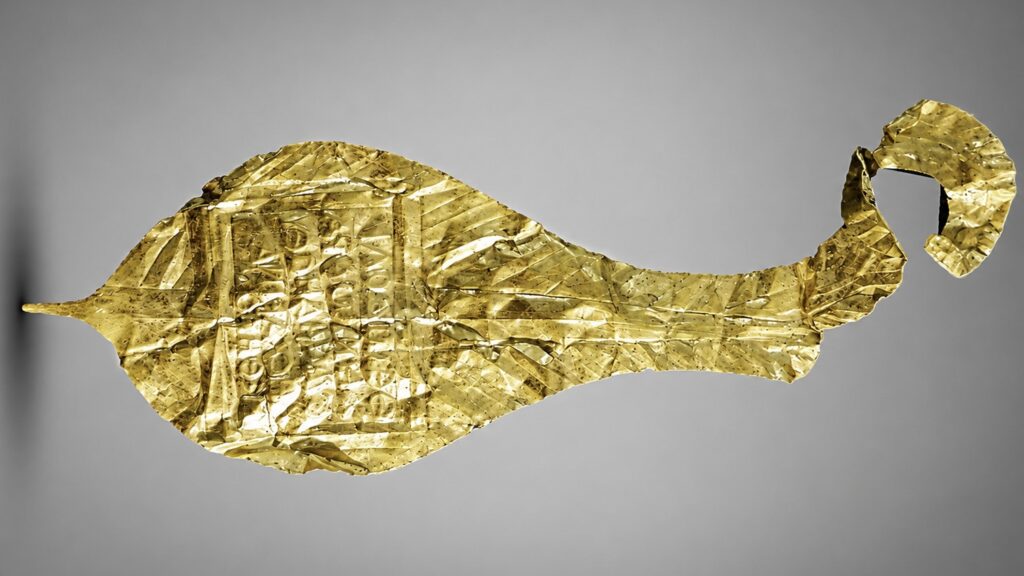
A small inscribed gold plaque discovered at the Roman fort of Apsaros in Georgia has provided the first direct epigraphic evidence that Jupiter Dolichenus was worshipped at the military settlement. Found during the 2024 season of the Polish-Georgian Archaeological Expedition, the object carries a Greek inscription naming both the deity and the person who dedicated the offering.
The plaque was examined in a recently published study in Zeitschrift für Papyrologie und Epigraphik. Although objects associated with Jupiter Dolichenus had previously been recovered at Apsaros, the inscription is the first written evidence directly identifying his cult at the fort.
A gift to the “Dolichenian God”
Made from gold and shaped like a stylized leaf, the plaque was produced using repoussé, a technique in which a design is formed by working the metal from the reverse. Its Greek inscription records that a man named Thrasymedes dedicated the object to the “Dolichenian God.”
This wording refers to Jupiter Dolichenus, a Roman deity whose cult developed from the storm-god tradition associated with Doliche, an ancient city in Commagene near present-day Gaziantep in southeastern Türkiye. In Roman imagery, the deity was usually shown in military dress, standing on a bull and holding a thunderbolt and double axe.
The cult spread across the Roman Empire during the second and third centuries AD and became particularly prominent within military networks. Dedications have been found at forts and settlements across several Roman provinces, although evidence from the empire’s eastern regions remains comparatively limited.
The Apsaros plaque is therefore significant not simply because it was made from gold. Its inscription securely connects the Black Sea garrison with the worship of a specific deity whose followers included many members of the Roman military.
The donor’s name also gives the discovery a rare personal dimension. Thrasymedes was an uncommon name during the Roman period, and researchers cannot yet determine his origin, military rank or position at Apsaros. The inscription nevertheless records the religious act of an individual who had the means and motivation to commission a costly votive gift.
Evidence for a possible sanctuary
The plaque was not discovered in isolation. Archaeologists also recovered a bronze figurine depicting an eagle seated on a bull near the findspot. Both animals appear in imagery connected with Jupiter Dolichenus, who was commonly represented standing on the back of a bull and was sometimes accompanied by an eagle.
Together, the objects raise the possibility that a shrine or designated worship area dedicated to Jupiter Dolichenus once existed within the fort. Researchers remain cautious, however, because no temple associated with the deity has yet been conclusively identified at Apsaros.
Apsaros, now known as Gonio, stands near the mouth of the Chorokhi River on Georgia’s Black Sea coast, around 15 kilometers south of Batumi. The Roman fort was established during the first century AD to control a strategic route connecting the coast with inland regions of the Caucasus.
When the Roman governor Arrian visited Apsaros during the second century, he reported that five cohorts were stationed there. He also described inspecting the soldiers, weapons, defensive walls, supplies, and condition of the garrison.
Nearly 2,000 years after the dedication was made, the gold plaque gives that military community a recognizable individual voice. Thrasymedes’ offering now provides direct written evidence that the cult of Jupiter Dolichenus had reached one of Rome’s important eastern Black Sea forts.
Polish Centre of Mediterranean Archaeology, University of Warsaw
Karasiewicz-Szczypiorski, R., Aslanishvili, L., Gizińska, A., Lockley, N., Łukaszewicz, A. (2026). Votive Inscription to Jupiter Dolichenus from the Roman fort of Apsaros (Gonio, Georgia). Zeitschrift für Papyrologie und Epigraphik, 237, 145–150.
Cover Image Credit: Polish Centre of Mediterranean Archaeology, University of Warsaw
