
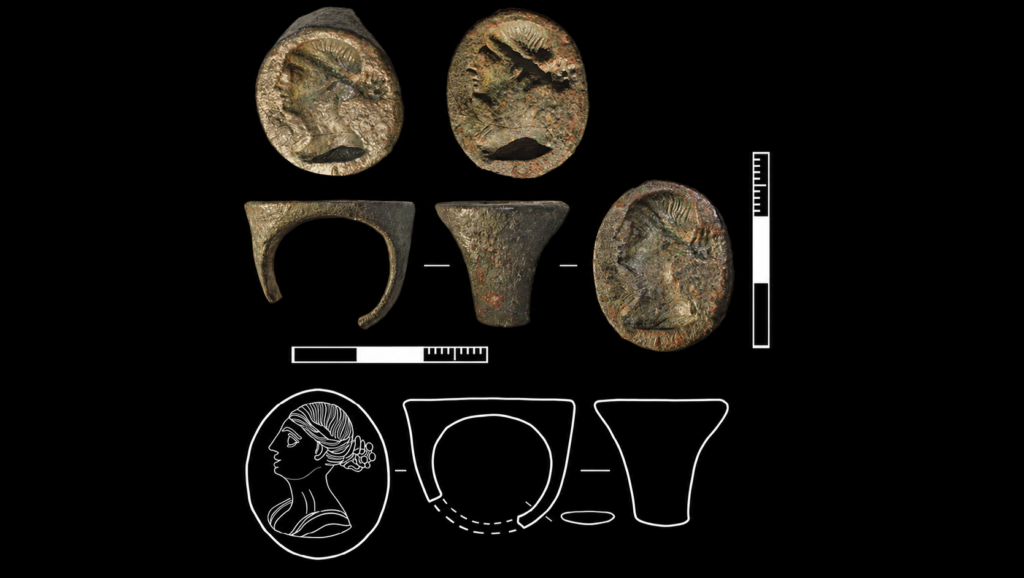
Archaeologists working near Anapa, on Russia’s northern Black Sea coast, have identified a bronze ring engraved with the portrait of Arsinoe III, one of the queens of Ptolemaic Egypt.
The ring was found at the Hellenistic-period estate group known as Voskresenskoye 6, a site located about 500 meters northwest of Anapa’s railway station. In antiquity, this coastal region belonged to the orbit of Gorgippia, an important Bosporan settlement that connected the Black Sea with wider Mediterranean trade routes.
The find was published by Mikhail Yu. Treister, Irina V. Rukavishnikova, and Denis V. Beylin in Problemy istorii, filologii, kul’tury. The authors identify the engraved female profile as Arsinoe III, who ruled as queen of Ptolemaic Egypt from 220 to 204 BC.
A Queen’s Profile Far from Egypt
The ring is a massive cast bronze piece with an oval bezel and a broad shank, part of a group known as “Ptolemaic-type” rings. These objects are known across the northern Black Sea region, especially in the Bosporan Kingdom, where they circulated during the Hellenistic period.
Their bezels usually show female royal portraits. In different examples, researchers have identified Ptolemaic queens such as Arsinoe II, Berenice II, and Arsinoe III. The Anapa ring belongs to this same visual world, where royal imagery from Egypt traveled far beyond the Nile Valley.
The portrait on the newly published ring shows a woman in profile facing left. The details are small, but they matter: the hairstyle has a narrow band along the edge, long curved locks running down from the crown, and a rounded bun at the back of the head. That bun is tied at its base and decorated with small rounded elements, possibly curls, hairpins, or bead-like ornaments.
These features led the researchers to connect the image with Arsinoe III. Only a small number of comparable rings are known.
Found in a Hellenistic Household Pit
The ring was not an isolated surface find. It came from the filling of Pit 4 at Voskresenskoye 6, during excavations carried out in 2024 by the Institute of Archaeology of the Russian Academy of Sciences.
The same pit contained 112 ceramic fragments, including amphora pieces, tableware, kitchen vessels, and building ceramics. Amphora fragments from Heraclea Pontica, Chios, Colchis, Knidos, and other Mediterranean production centers point to the movement of goods through the region during the 4th and 3rd centuries BC.
That ceramic context helps anchor the ring in time. The objects from the pit fit broadly within the Hellenistic period, and the proposed identification of Arsinoe III gives the ring a narrower possible date: no earlier than 220 BC and no later than 204 BC, the years of her reign.
Gorgippia and the Bosporan Connection
The area around Anapa was not a remote frontier cut off from the Mediterranean world. Ancient Gorgippia stood on the Asian side of the Bosporan Kingdom, a region where Greek, local, and steppe traditions met through trade, settlement, and political contact.
Other rings with comparable portraits have been found in the Bosporan region and in Maeotian burial grounds of the Trans-Kuban area. The newly published ring adds another piece to this pattern. It strengthens the concentration of such finds around Gorgippia and nearby territories.
The object does not suggest that Arsinoe III herself had any direct link to Anapa. It also does not require an Egyptian owner. Royal images could move through trade, fashion, political symbolism, or personal taste. In this case, a small bronze object carries the image of a Ptolemaic queen into a Black Sea household context more than 2,200 years ago.
A Rare Match of Image and Date
The most striking part of the discovery is the alignment between the portrait, the archaeological context, and the historical reign of Arsinoe III.
If the portrait attribution is correct, the ring belongs to a narrow span of just sixteen years. For Hellenistic archaeology, that kind of dating is unusually precise, especially for a personal object found outside the major royal centers of the eastern Mediterranean.
Metal analysis also places the ring within the wider Ptolemaic-type group. According to the study, it was cast from leaded tin bronze, a composition also recorded in comparable rings from the Bosporus and Chersonesus.
The ring from Voskresenskoye 6 is therefore more than a decorated ornament. It is evidence for how royal Ptolemaic imagery reached the northern Black Sea and became part of the material culture of communities living far from Egypt, but not beyond the reach of the Hellenistic world.
Treister, M. Yu., Rukavishnikova, I. V., & Beylin, D. V. (2026). A bronze ring with a portrait of Arsinoe III from the excavations at the “Voskresenskoye 6” Estate in the Anapa Region. Problemy istorii, filologii, kul’tury, 1, 161–173. https://doi.org/10.18503/1992-0431-2026-1-91-161–173
