
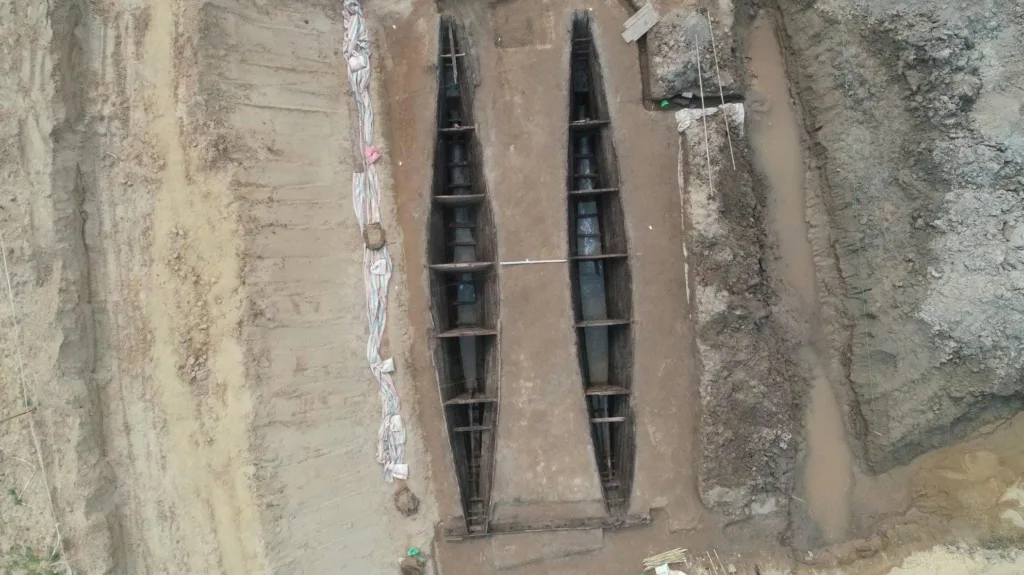
More than 5,000 seed and fruit fragments were recovered from two approximately 2,000-year-old wooden boats discovered in Bac Ninh Province, northern Vietnam. The remarkably preserved remains include a variety of fruits, nuts, and other plant material, offering rare evidence of the plants found within the ancient wooden structures.
Archaeologists examining two ancient wooden boats discovered in Vietnam’s Bac Ninh Province have identified an extraordinary collection of plant remains, including thousands of unidentified seed and fruit fragments and specimens representing at least 20 plant taxa. Some of the fruits survived with their stalks intact, preserved for nearly two millennia beneath layers of waterlogged mud.
The boats were discovered in a low-lying river landscape, yet some of the preserved plants are associated with forests and upland environments. Their presence suggests that the vessels may have carried agricultural produce and forest products between different ecological regions of northern Vietnam, although researchers caution that some material could have accumulated naturally.
Two Ancient Wooden Hulls Beneath a Fish Pond
The Ha Man boats were discovered during work to renovate a fish pond in the Cong Ha area of Bac Ninh Province in early 2025. Emergency excavations began in March 2025, revealing two closely associated wooden hulls, each more than 16 meters long and approximately two meters wide.
Their construction was unusual. Wooden planks were joined using mortise-and-tenon joints, wedges and wooden pegs rather than metal nails. The two hulls were connected, leading specialists to investigate whether they formed part of a double-hulled vessel supporting a larger wooden platform.
The dating of the remains also produced a surprise. Initial assessments based on construction techniques had suggested a medieval origin, possibly between the 11th and 14th centuries. However, radiocarbon analysis of wood samples, reported by archaeologist Nguyen Quang Mien in November 2025, indicated a date around the second century AD, placing the structure in the late Đông Sơn period.
Three pottery fragments recovered from the wooden structures also show similarities to ceramics from the Đường Mây archaeological site at Cổ Loa, a settlement associated with the late Đông Sơn culture and dated to approximately 2,500–2,200 years ago.
Pottery traditions from this region included light-colored vessels with distinctive cord-impressed decorations, although these features have not been confirmed on the newly recovered fragments. The resemblance provides an additional archaeological connection, but does not independently establish the age of the boats.
The new archaeobotanical findings were presented in connection with Vietnam’s 61st National Archaeology Conference, held in Hanoi on October 15–16, 2026.
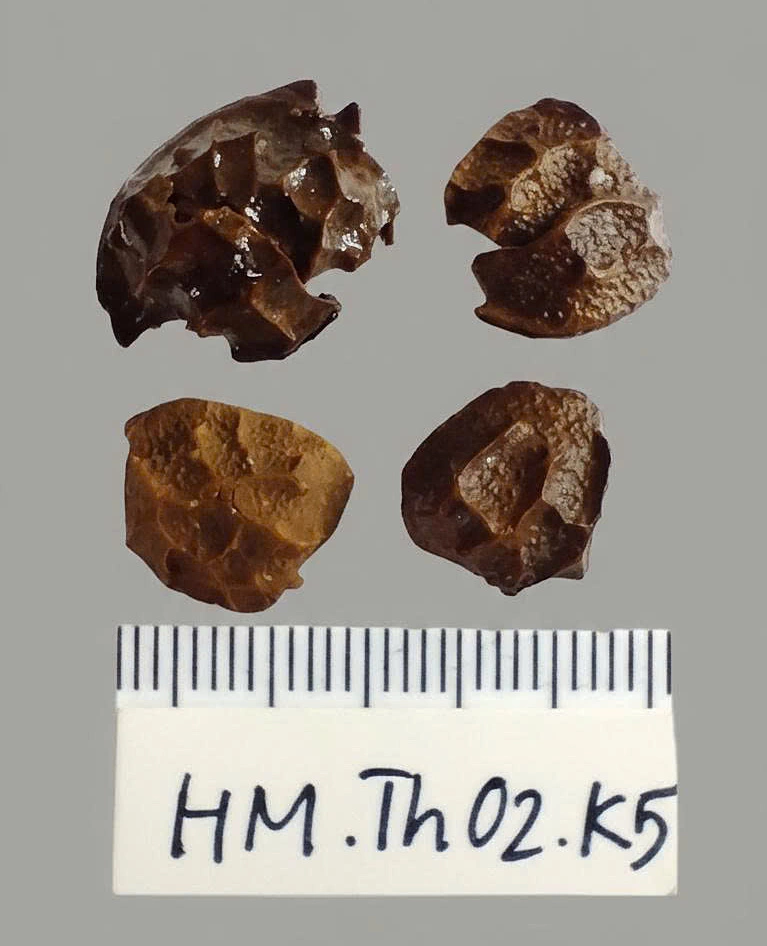
More Than 5,000 Unidentified Seeds and Fruit Fragments
The plant analysis was conducted by a team including Dr. Nguyen Thi Mai Huong of the Institute of Archaeology, part of the Vietnam Academy of Social Sciences. Researchers examined sediment collected from inside and around the two wooden structures, including material from 12 compartments.
The samples were processed through wet sieving using meshes measuring approximately 2–4 millimeters. The recovered material included seeds, fruit stones, stalks, fragments of fruit shells, and pieces of wood. Researchers then compared their shapes and structures with known botanical specimens to establish preliminary identifications.
The investigation recorded 5,084 unidentified seed and fruit fragments, in addition to hundreds of identifiable or partially identifiable botanical specimens representing at least 20 taxa.
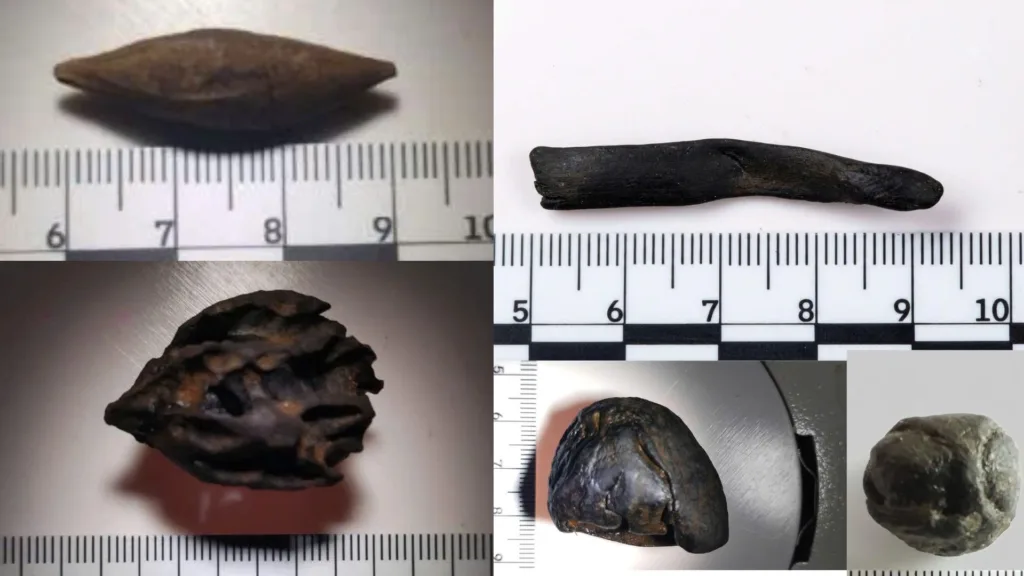
Among the identified material were 171 apricot and plum specimens, 129 specimens of Dracontomelon (sấu), 53 chinaberry specimens, 43 legume specimens, 31 Canarium specimens and 30 jujube specimens. Other finds included chestnut fruit stalks, gac seeds, screw pine remains, Chinese honeysuckle, and mango.
Several fruits were preserved in remarkable detail. Some Dracontomelon fruits still had their stalks attached, while Chinese honeysuckle fruits retained their distinctive three-winged shape.
According to Huong, the exceptional preservation resulted from two processes: charring and prolonged waterlogging in oxygen-poor conditions. Layers of clay and mud protected the organic material from the decomposition that would normally destroy such fragile remains.
Evidence of Possible Trade Between Mountains and Lowlands
The botanical material was not distributed evenly throughout the two structures. Concentrations generally increased toward the compartments interpreted as the rear of the first hull, while the second contained a greater diversity and quantity of plant remains.
One compartment in the second structure yielded more than 1,700 seed and fruit fragments, together with 255 unidentified wood fragments. Certain plants, including gac, screw pine, and Chinese honeysuckle, were recorded only in the second structure.
These differences may be significant because they suggest that the plants did not accumulate uniformly. Researchers are investigating whether particular compartments were used to store or transport goods.
The presence of chestnut and Canarium remains is especially interesting. These plants may be associated with upland and foothill environments, whereas the boats were found in the lowlands of the Thai Binh River basin.
The research team considers Canarium, chestnut fruit stalks, Chinese honeysuckle and gac among the remains that could represent transported products. If confirmed, their presence would support the possibility of exchanges between mountainous communities and settlements along northern Vietnam’s waterways.
However, the researchers have not classified every specimen as cargo. Silk-cotton tree thorns, vines and unidentified wood fragments may have entered the structures through natural deposition. Other remains, including apricot, plum, jujube and legumes, could represent transported produce, food consumed by people using the vessels, or material introduced by the surrounding environment
An Ancient Boat or a Floating Platform?
The purpose of the wooden structure remains disputed. Shipbuilding specialist Do Thai Binh interprets the remains as two connected hulls that may once have supported a substantial platform, potentially exceeding 100 square meters. He suggests the structure could have operated in sheltered river waters, propelled by poles or oars.
Archaeologist Nguyen Viet, director of the Southeast Asian Prehistory Centre, has questioned whether the remains represent a conventional boat. The relatively flat bottoms, approximately 10-degree inclination and absence of clearly identified propulsion equipment have led him to suggest that the structure may instead have been a floating installation attached to a riverbank.
A possible ceremonial function has also been proposed, although the available archaeological evidence does not establish that interpretation.
These competing explanations matter for the botanical findings. If the structure was used for transportation, some of the plants might represent cargo moving through an ancient river network. If it remained stationary, the deposits could instead reflect food preparation, storage, human activity, or vegetation accumulating around a riverside installation.
Further Analysis Could Establish the Origins of the Plants
The researchers plan to identify more of the thousands of unidentified fragments and investigate whether the plant remains belong to the same period as the wooden structures.
Proposed work includes direct accelerator mass spectrometry (AMS) radiocarbon dating of suitable botanical samples, stable isotope analysis, pollen studies and comparisons with other archaeological plant collections.
Dating the seeds and fruits themselves is particularly important. Although radiocarbon analysis places the wooden structures around the second century AD, the botanical remains have not yet been independently demonstrated to be contemporary with their construction or use.
