
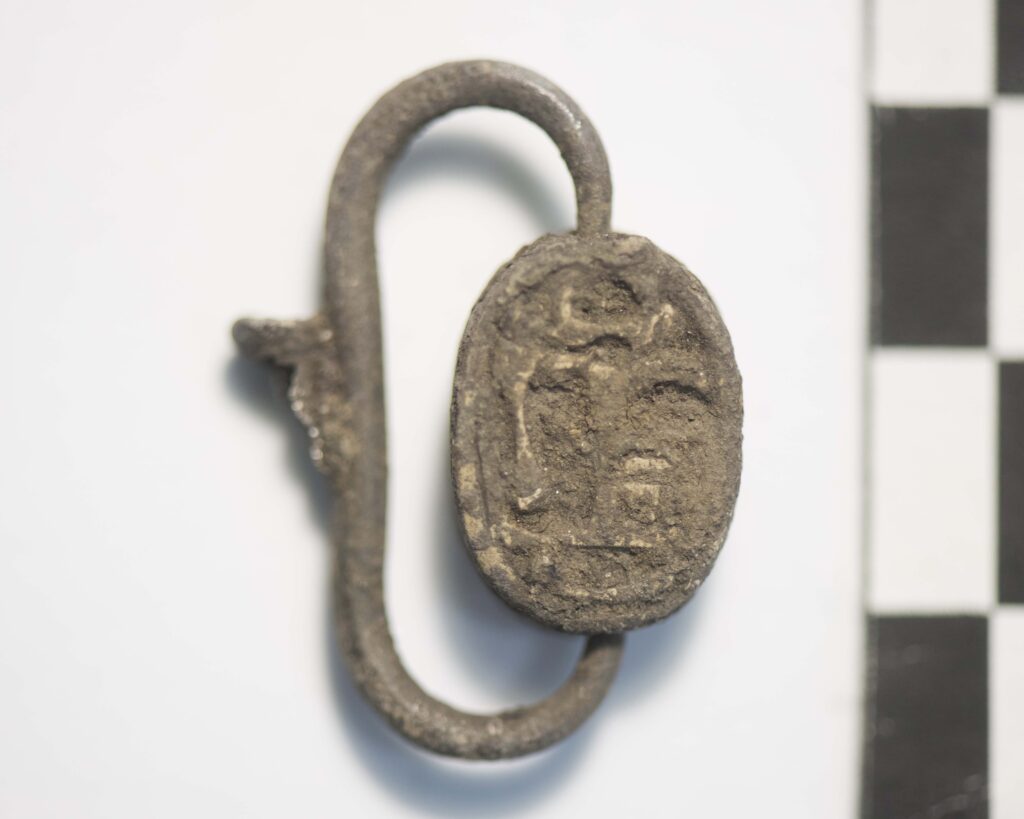
Archaeologists excavating the Nuragic complex of Ruinas in central-eastern Sardinia have uncovered an extraordinary artifact: a Phoenician scarab carved in steatite, dating to the Iron Age. The discovery offers compelling new evidence of long-distance cultural and commercial connections between the indigenous Nuragic civilization and the seafaring peoples of the eastern Mediterranean more than 3,000 years ago.
The scarab was found within the village area adjacent to the main nuraghe, near a sacred well, during ongoing archaeological investigations in the mountainous territory of Arzana, in the Ogliastra region. Experts have identified the object as a seal-amulet of Phoenician origin, most likely produced in the Levant, in present-day Lebanon.
A Rare and Symbolic Object
Scarab seals were widespread in the ancient Near East and the Mediterranean, serving both practical and symbolic purposes. Typically worn around the neck as protective amulets, they were also used as personal seals to mark ownership or authority by impressing their unique designs into clay or wax.
The Ruinas scarab is made of steatite, a soft yet durable stone commonly used in Phoenician glyptic art. Its flat base bears finely incised hieroglyphic-style symbols, the precise meaning of which will be studied in detail once conservation work is completed. Each scarab was individually carved, making every example unique—an important factor that enhances the archaeological value of the find.
Currently, the artifact is undergoing careful conservation and non-invasive diagnostic analysis at the Restoration and Conservation Center of Li Punti, under the supervision of the Archaeological Superintendency of Sassari and Nuoro. Scholars hope that microscopic examination and imaging techniques will reveal clues about its use, wear, and inscription.
The Nuragic Complex of Ruinas
The Nuragic complex of Ruinas occupies a dominant strategic position typical of Nuragic settlements. Located between 670 and 800 meters above sea level at the foot of Monte Idolo (1,241 m), the site consists of a monumental nuraghe surrounded by a village of stone-built structures, reflecting a highly organized and resilient community.
Ruinas lies in the historical subregion of Barbagia di Ollolai, an inland area traditionally associated with the Ilienses, one of the most prominent Nuragic tribes. Classical authors such as Pomponius Mela described the Ilienses as among the oldest peoples of Sardinia, inhabiting the island’s central regions since the Bronze Age.
The Ilienses and Long-Distance Trade
During the second millennium BC, the Ilienses controlled a vast territory stretching from the Campidano plain to the Tirso River. Their society was organized into numerous tribes led by local chiefs, likely residing in large, complex nuraghes. As Phoenician, Punic, and later Roman powers expanded along the coasts, the Ilienses retreated into Sardinia’s mountainous interior, preserving their cultural identity.
Archaeology, however, reveals that these communities were far from isolated. Mycenaean and Aegean pottery fragments found at sites such as Nuraghe Antigori and Nuraghe Arrubiu, along with oxhide-shaped copper ingots believed to originate from Cyprus, attest to extensive trade networks across the Mediterranean.
The Phoenician scarab from Ruinas fits squarely within this broader pattern. Similar finds have been documented at Nuraghe Nurdole, between Orani and Nuoro, and at S’Arcu ’e is Forros in Villagrande Strisaili, located just eight kilometers away, suggesting that this inland region played a key role in intercultural exchange.
Phoenicians in Sardinia
The Phoenicians were among the greatest maritime traders of antiquity, establishing colonies and trading posts across the Mediterranean from the Levant to Iberia between the 9th and 6th centuries BC. In Sardinia, they founded important coastal settlements such as Tharros, Sulky (Sant’Antioco), and Nora, acting as intermediaries in the exchange of metals, luxury goods, and ideas.
The presence of a Phoenician scarab deep in Sardinia’s interior demonstrates that their influence extended well beyond the coast. It suggests not only trade but also the movement of individuals—merchants, artisans, or emissaries—who bridged cultural worlds.
A Discovery with Far-Reaching Implications
More than a simple artifact, the Ruinas scarab is a tangible symbol of interconnected ancient societies. Having traveled over 2,000 kilometers from the eastern Mediterranean to a Nuragic mountain village, it embodies the complex web of economic, social, and symbolic relationships that shaped Iron Age Sardinia.
Once conservation and research are complete, the scarab will be officially presented to the public, and its future exhibition location will be determined. For now, it stands as a powerful reminder that even the most remote communities of the ancient world were part of a shared Mediterranean history.
Soprintendenza Archeologia, Belle Arti e Paesaggio di Cagliari
Cover Image Credit: Soprintendenza Archeologia, Belle Arti e Paesaggio di Cagliari via Facebook
