
23 June 2026 The Future is the Product of the Past

Archaeologists found a noble woman buried beside her ‘husband’ 1,000 years ago with the top of her face hollowed out

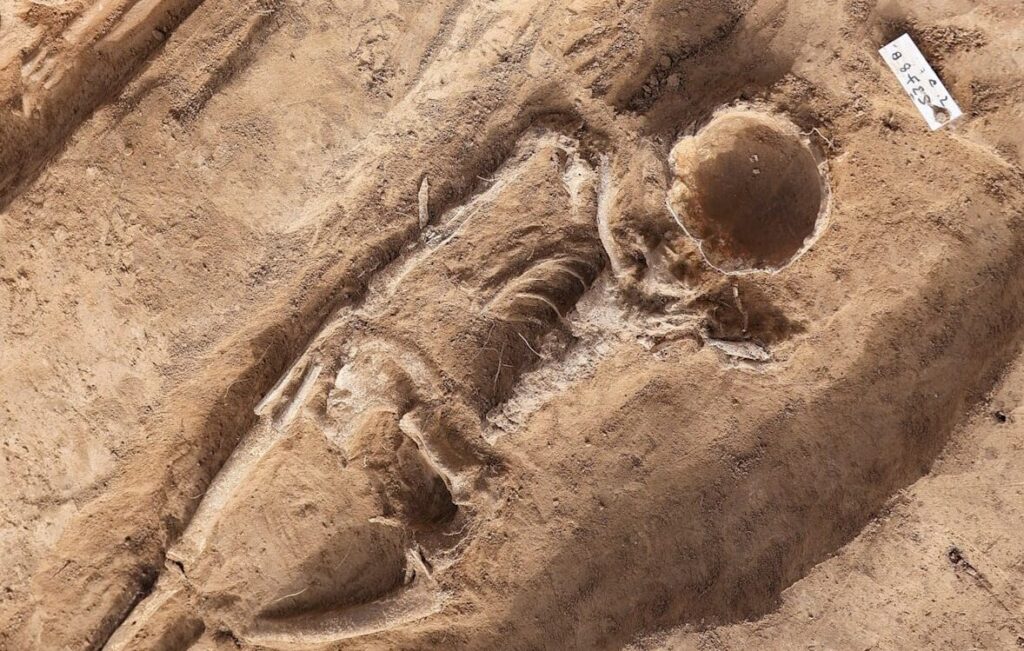
Archaeologists unearthed the 1,000-year-old remains of a woman with her face and head hollowed out buried next to her husband near the town of Eisleben in Germany’s Saxony-Anhalt state.

Archaeologists assume that the petite woman (around 1.55 meters tall) and her slightly taller husband lived in the 9th century. Their remains were excavated at the former royal palace of Helfta – a place where the emperors Otto the Great and Otto II resided.

It is unclear how or when the couple died, but what was most unusual was that the wife was missing all of the bones in her face while her husband’s countenance was still intact.

It is not currently known if they died together or separately, or why the wife’s facial bones are missing.

Archaeologists are currently examining the remains at the lab to try and crack this 1,000-year-old cold case file.


📣 Our WhatsApp channel is now LIVE! Stay up-to-date with the latest news and updates, just click here to follow us on WhatsApp and never miss a thing!!


Archaeologists believe that it was likely the husband was a dignitary of some kind.
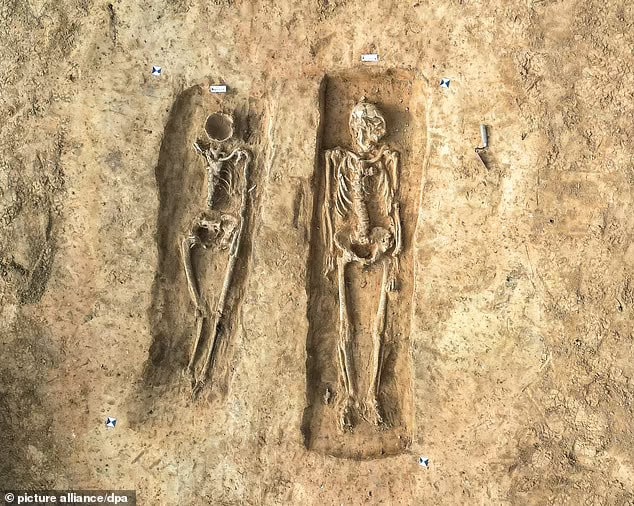
The pair are believed to have been wealthy individuals when they were alive. Photo: Jan Woitas/dpa

“Among other things, they found a knife, a belt set and the fittings for a so-called official staff, such as those carried by generals, on him,” archaeologist Felix Biermann from the Saxony-Anhalt State Office for Monument Preservation and Archeology told the German newspaper Bild, per the Daily Mail.

It is therefore likely that the dead man was the manager of a castle. According to the archaeologists, the woman may have consciously expressed her wish to be buried without the grave goods that were common at the time, such as jewelry. This suggests that she thought in a much more modern way than her husband.

“The fact that there was nothing with her is very unusual,” says Biermann. “Maybe she was already Christian, but the man was even more traditional. In Christianity, these kinds of additions were avoided.”

The couple’s bones are now being examined in a laboratory to determine how they died.

Cover Photo: Jan Woitas/dpa

Related Articles

New Evidence Shows Arabia Was Not Only the Incense Highway—But an Ancient Scent Capital

16 November 2025

16 November 2025

For centuries, historians described Arabia as the famous “incense highway,” a vast trade artery that carried frankincense and myrrh from...

Researchers excavating the burial site along Caleta Vítor Bay in northern Chile found an Inka Tunic or unku

15 February 2023

15 February 2023

A recently published study, co-authored by a research professor at George Washington University, looks at the Inka Empire’s (also known...

Oldest Direct Evidence for Honey Collecting in Africa

18 April 2021

18 April 2021

Honey is an important food source that has been considered a very important healing source in the history of civilizations....

Homo erectus May Have Used Fire in South African Cave More Than 1.7 Million Years Ago

18 June 2026

18 June 2026

Ancient bones hidden deep inside Wonderwerk Cave in South Africa are giving researchers new evidence that early humans were using...

Zeugma of the Black Sea to be will Restore

8 February 2021

8 February 2021

Hadrianaupolis Antique City is located 3 km west of Eskiyapar district of Karabük. This ancient city has been known as...

Iron Age Ingenuity: Unique Dacian Stonemasons’ Tools Discovered in Romania

10 May 2025

10 May 2025

An extraordinary discovery in a Romanian forest near the hill of Măgura Călanului has unveiled a unique set of 15...

1700-year-old weaving workshop discovered in southeast Turkey

4 December 2021

4 December 2021

Excavations carried out in the ancient city of Perre in the southeastern province of Adıyaman have unearthed a 1,700-year-old weaving...

A 2,000-year-old monumental Roman villa Found Under a Seaside May Be Pliny the Elder’s house

23 January 2024

23 January 2024

Researchers have discovered the remnants of a massive Roman villa thought to have ties to Pliny the Elder while working...

Archaeologists Discovered a Luxury Roman Village in Southeastern Sicily

17 October 2024

17 October 2024

In the province of Catania, archaeologists have excavated the remains of a Roman house with a mosaic floor dating from...

1400-year-old gold foil figures found in pagan temple

19 September 2023

19 September 2023

Archaeologists have discovered a votive gold hoard during road development works in Vingrom, south of Lillehammer on the shores of...

An Unprecedented Discovery: Archaeologists Found a Viking Age Vulva Stone -A Counterpart to Phallic Symbols?

25 September 2025

25 September 2025

Archaeologists in Norway may have uncovered the first known vulva stone from the Viking Age. The find could reshape our...

The sword, thought to be a replica, turned out to be an authentic 3000-year-old Bronze Age sword

22 January 2023

22 January 2023

A sword in Chicago’s Field Museum that was previously thought to be a replica has been revealed to be an...

Google Earth Helped Archaeologists Make İmportant Discoveries in Leicestershire

26 April 2021

26 April 2021

After Google Earth revealed traces of underground structures, archaeologists digging at a Roman settlement in Leicestershire say they have made...

Oldest footprints of pre-humans identified in Crete

11 October 2021

11 October 2021

Six million-year-old fossilized footprints on the island show the human foot had begun to develop. The oldest known footprints of...

Rare Funeral Pyre at Sizewell C Reveals a Prehistoric Cremation Ritual on England’s Suffolk Coast

13 May 2026

13 May 2026

A rare funeral pyre at Sizewell C is giving archaeologists an unusual glimpse into how ancient communities on England’s Suffolk...