
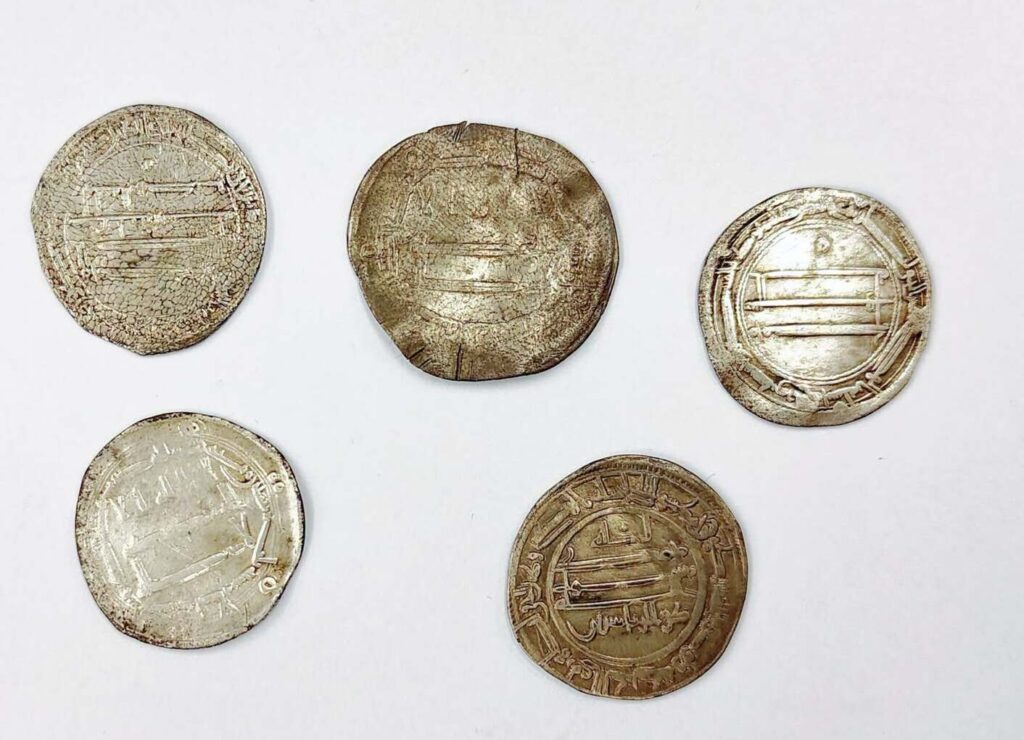
A small group of silver coins found in a forest in northern Poland may offer another glimpse into the extraordinary trade networks that connected the Viking-age Baltic with the Islamic world more than 1,100 years ago.
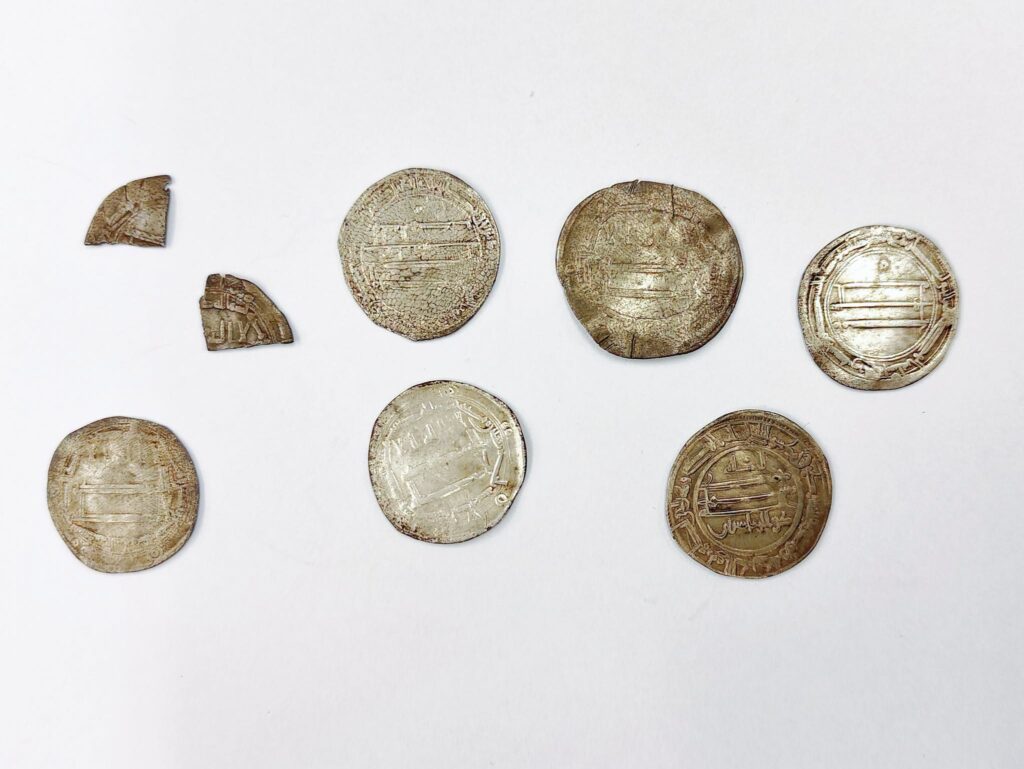
The discovery consists of six early medieval Arab dirhams and two fragments of silver coins found during a legal search in the Młynary Forest District, near Elbląg. Specialists date the coins to the first half of the ninth century, placing them within the period when the nearby trading settlement of Truso was developing into one of the Baltic region’s major commercial centres.
The Archaeological and Historical Museum in Elbląg has now received the coins and plans to conserve and study them. Museum archaeologists also intend to examine the place where they were discovered.
Their location is particularly intriguing because Truso, a Scandinavian trading settlement on the shores of Lake Druzno, has sometimes been compared to Troy or Atlantis: for centuries, people knew its name from an ancient account but could not find the city itself.
Silver from thousands of kilometres away
Jakub Jagodziński of the Archaeological and Historical Museum in Elbląg said the coins could have remained in circulation long after they were originally minted, perhaps until the turn of the tenth and eleventh centuries, when activity at Truso was coming to an end.
He connects the discovery with the settlement’s commercial network. One possibility is that merchants travelling toward Truso carried the silver. Another is that the coins belonged to Prussian guards who collected tolls along routes leading toward the trading centre.
The individual coins have not yet undergone specialist numismatic analysis, so their exact mints and rulers remain unknown. Their broader context, however, is familiar.
Arab silver travelled in enormous quantities into northern and eastern Europe during the Viking Age. Earlier finds associated with Truso include objects imported from the Arab Caliphate alongside material from England and the Rhineland, showing how far the settlement’s commercial connections reached.
Many dirhams that reached the Baltic during the ninth century originated in the Abbasid world. Such coins could pass through several hands and travel thousands of kilometres before arriving in Scandinavian and Baltic trading centres. By the time a dirham reached Truso, its value lay as much in its silver as in the authority that had originally minted it.
The newly found coins may eventually reveal whether they followed the same pattern. Conservators and early medieval numismatists will examine them before the museum presents them publicly.
Why Truso became the “Viking Atlantis”
For centuries, Truso existed more clearly in written history than on the map.
Around the end of the ninth century, the Anglo-Saxon traveller Wulfstan sailed from Hedeby, in what is now northern Germany, to Truso near the mouth of the Vistula. His description of the journey later entered the geographical work prepared at the court of Alfred the Great.
But the settlement itself disappeared.
When Richard Hakluyt published Wulfstan’s account in 1598, historians and antiquarians began trying to locate the lost trading centre. The search continued for almost 400 years. With its location unknown and its reputation growing, Truso gradually acquired the character of a legendary lost city — a Baltic counterpart to Troy or Atlantis, as the Elbląg museum itself has described it.
The mystery finally began to unravel in 1981, when archaeologist Marek F. Jagodziński identified the remains of the settlement near Janów Pomorski on the eastern shore of Lake Druzno. Decades of excavation later showed that Scandinavians played a major role in establishing and inhabiting the settlement, leaving behind houses, workshops, jewellery, weapons, gaming pieces and objects connected with religious life.
Truso had been found.
A few coins on a much larger trade map
That history gives the new silver find significance beyond the eight pieces themselves.
Truso belonged to a chain of Viking-age trading centres that included places such as Hedeby, Birka and Staraya Ladoga. Goods, people and silver moved between the Baltic, western Europe and routes stretching deep into Eurasia. Arab dirhams found in northern Europe remain some of the clearest material evidence of those connections.
For now, the Młynary coins still hold several unanswered questions. Specialists have yet to determine exactly where they were minted, whose names appear on them, and how long each piece remained in circulation.
The museum’s next step may provide another clue. Its archaeologists plan to visit the discovery site, while the coins themselves will undergo conservation and specialist analysis before eventually going on display in Elbląg.
Whether they belonged to a travelling merchant, a local toll collector or someone else entirely may never be known. But their presence near Truso adds another small piece to the story of a trading city that vanished for centuries — and of the long-distance routes that once carried Arab silver all the way to the Baltic.
Muzeum Archeologiczno-Historyczne w Elblągu (Archaeological and Historical Museum in Elbląg)
