
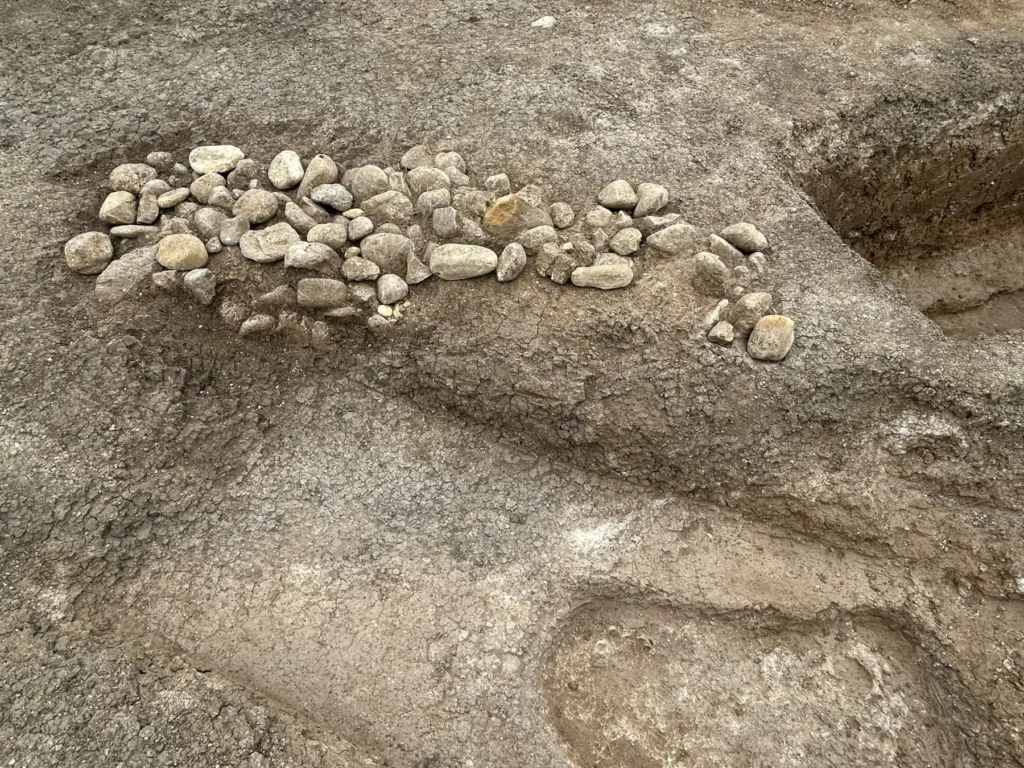
A Vasto necropolis dating back more than 2,300 years has been discovered during preliminary works for a photovoltaic plant in the Punta Penna industrial area, revealing a large pre-Roman burial ground tied to the Italic communities of southern Abruzzo.
The discovery, announced by the Soprintendenza Archeologia, Belle Arti e Paesaggio for the provinces of Chieti and Pescara, emerged during preventive archaeological investigations required before construction work could proceed. What began as a modern energy project has now opened an unexpected window onto the centuries before Rome fully absorbed this stretch of the Adriatic coast.
The burial area has been preliminarily dated between the 5th and 4th centuries BC, a period when central and southern Italy were home to a mosaic of Italic peoples, local elites, coastal settlements and inland communities connected through trade, warfare and ritual. In Vasto, those layers of history are rarely far below the surface. This time, they appeared beneath an active construction site.
A burial ground beneath an industrial landscape
The necropolis was found at Punta Penna, in the northern part of the municipality of Vasto, in the province of Chieti. The area today is shaped by industry, roads and the nearby Adriatic coastline, but in antiquity it belonged to a strategic landscape overlooking maritime routes and inland connections.
According to the Soprintendenza, the excavation identified a large funerary nucleus made up of numerous burials. The graves were documented under the scientific direction of the heritage authority, which remained present on site throughout the operation. The works were financed by the company proposing the photovoltaic project, as required under Italy’s preventive archaeology procedures.
The setting is part of what makes the find compelling. Archaeology here did not emerge from a planned research excavation in an open field, but from the friction between infrastructure, renewable energy and heritage protection. Without the preliminary checks, the necropolis might have remained unknown, or worse, damaged before scholars could record it.
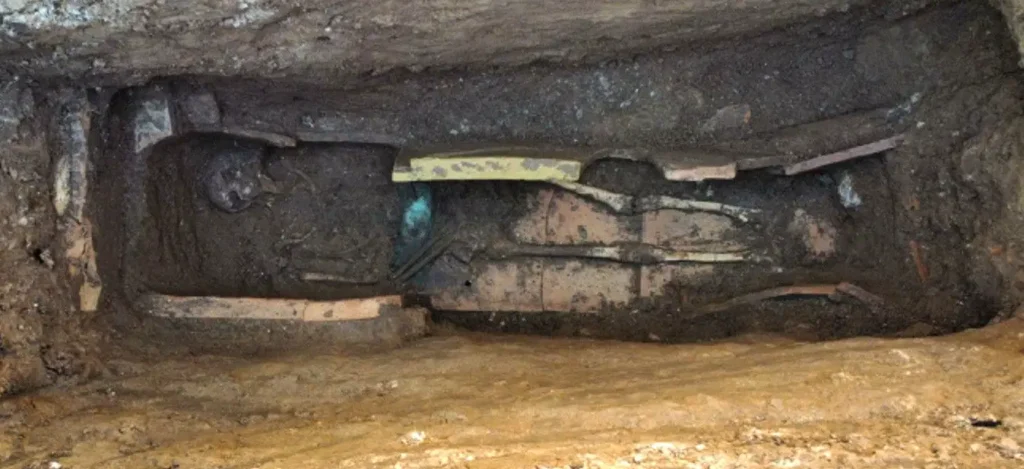
Graves with stone fills, tile beds and funerary goods
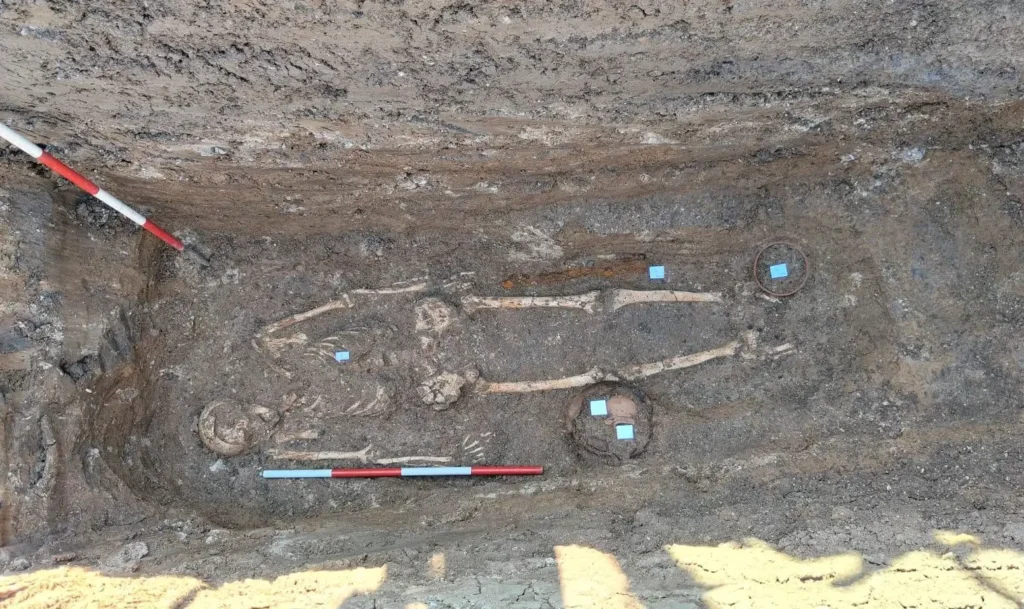
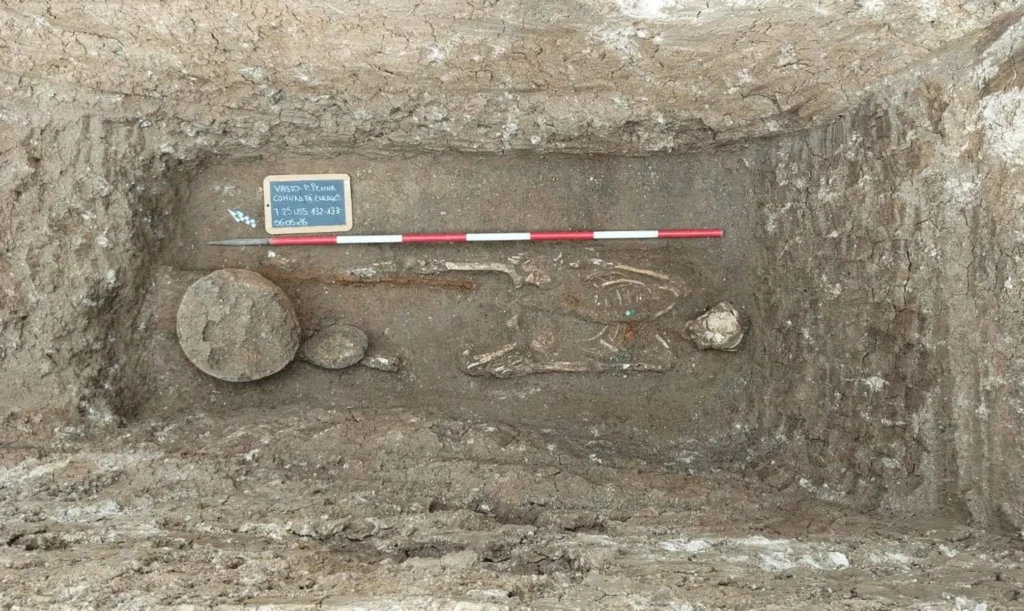
Early documentation suggests that the burial area preserves different grave forms and depositional practices. Ministry of Culture photo captions describe stone-filled grave pits, burials laid on tile beds, a tile-cist burial with a bronze belt, and simple pit graves containing personal ornaments, iron and bronze elements, ceramic vessels and other objects associated with funerary rites.
These grave goods matter because they can help archaeologists reconstruct age, gender, social identity and cultural affiliation. Weapons, ornaments, belts, ceramics and organic traces, where preserved, are not only objects. They are clues to how a community represented the dead and how families used burial to express status, memory and belonging.
The human remains may also become central to future research. If preserved well enough, osteological study could provide information about age at death, diet, trauma, disease and burial treatment. For now, the Soprintendenza has been cautious, stressing that the study is still at an early stage.
A structure still waiting for interpretation
The excavation also revealed a structure whose function and date have not yet been clearly established. Officials have not offered a final interpretation, noting that the available data remain insufficient.
Surface material, however, suggests that the area may have continued to be frequented in the Hellenistic-Roman period. That detail is important. It may indicate that Punta Penna was not a single-phase funerary zone, but part of a longer-lived ancient landscape whose use changed over time.
Such continuity would fit Vasto’s deeper history. The ancient city was known as Histonium and is identified by Treccani as one of the most important settlements of the Frentani, an Italic people of the central Adriatic area. After the Social War, Histonium became a Roman municipium, but the newly found necropolis belongs to an earlier world, before Roman civic structures fully reshaped the region.
Vasto before Rome
The discovery adds weight to the idea that the Vasto area held real importance before Romanization. The 5th and 4th centuries BC were centuries of contact and competition across the Italian peninsula. Italic communities were not isolated groups living at the edge of history. They built networks, adopted and adapted material culture, and developed burial customs that reflected local identities as well as wider Mediterranean influences.
In southern Abruzzo, the Frentani occupied a key position between the Adriatic and the interior. Their settlements and cemeteries help scholars understand how communities negotiated power before Rome became dominant. A large necropolis at Punta Penna may therefore contribute to a more detailed map of pre-Roman life along this part of the coast.
The find is also significant because cemeteries often preserve social information that settlements do not. Houses may be rebuilt, robbed or erased by later activity. Graves, when intact or partly intact, can preserve carefully arranged evidence of belief, hierarchy and personal identity.
Protection before publicity
The Soprintendenza said the work had been kept confidential for reasons of site protection and artifact security. The area remains inside an active construction zone, with access and operational restrictions. Officials also noted that premature press coverage could undermine precautions taken to protect the archaeological context.
This caution is understandable. Newly discovered burial sites are vulnerable to damage, curiosity-driven intrusion and illicit collecting. Once the location and character of a site become public, preservation becomes more difficult unless security, documentation and conservation measures are already in place.
The excavation and documentation phase has recently concluded, but the work is far from over. Further investigation campaigns are expected with direct funding from Italy’s Ministry of Culture. These future studies aim to define the necropolis more precisely, including its extent, chronology and internal organization.
From excavation to museum
Restoration work is also planned for the grave goods recovered from the burials. These objects will need cleaning, stabilization, cataloguing and specialist analysis before they can be fully interpreted or displayed.
A selection of the most important finds is expected to be exhibited in the new museum route planned for Palazzo d’Avalos in Vasto. That decision is more than practical. Keeping the materials close to their place of origin allows the discovery to remain part of the local story rather than disappearing into distant storage.
For Vasto, the Punta Penna necropolis is not simply another archaeological find. It is a reminder that the modern city stands above a much older landscape, one shaped by Italic communities long before Roman Histonium entered the written record. Beneath a future solar plant, archaeologists have found the dead of a pre-Roman world still capable of changing how the region’s past is understood.
Cover Image Credit: Ministero della Cultura (MiC)
