
Archaeologists in Ponso, northern Italy, have uncovered an ancient Veneti sanctuary with Venetic and Latin inscriptions, temple foundations, and evidence of cult continuity into the Roman period.
An ancient sanctuary uncovered during roadworks in northern Italy is opening a rare window onto the religious world of the Veneti, the pre-Roman people who lived in the Veneto region before the full rise of Roman power.
The discovery was made in Ponso, in the Province of Padua, during work connected to the new SR10 “Padana Inferiore” regional road between Borgo Veneto and Carceri. What began as a modern infrastructure project soon turned into one of the most significant archaeological finds recently reported in the area: a cult site with Venetic and Latin inscriptions, temple foundations, reused sacred stones, and evidence of religious activity lasting from the pre-Roman period into the Roman age.
The site is being investigated under the scientific direction of the ABAP Superintendency for the provinces of Padua, Treviso and Belluno. The first traces appeared during wartime ordnance clearance, when unusual stone elements prompted archaeologists to begin deeper stratigraphic checks.
A sanctuary linked to the ancient Veneti
Preliminary dating places part of the sanctuary’s earliest phase between the 5th and 4th centuries BC. This was the world of the ancient Veneti, an Italic people who occupied northeastern Italy before and during the expansion of Rome.
The Veneti were not Romans, although they later became deeply integrated into the Roman political and cultural system. They had their own language, written in a local script, and their inscriptions are crucial for understanding identity, worship, and social life in the region before Romanization.
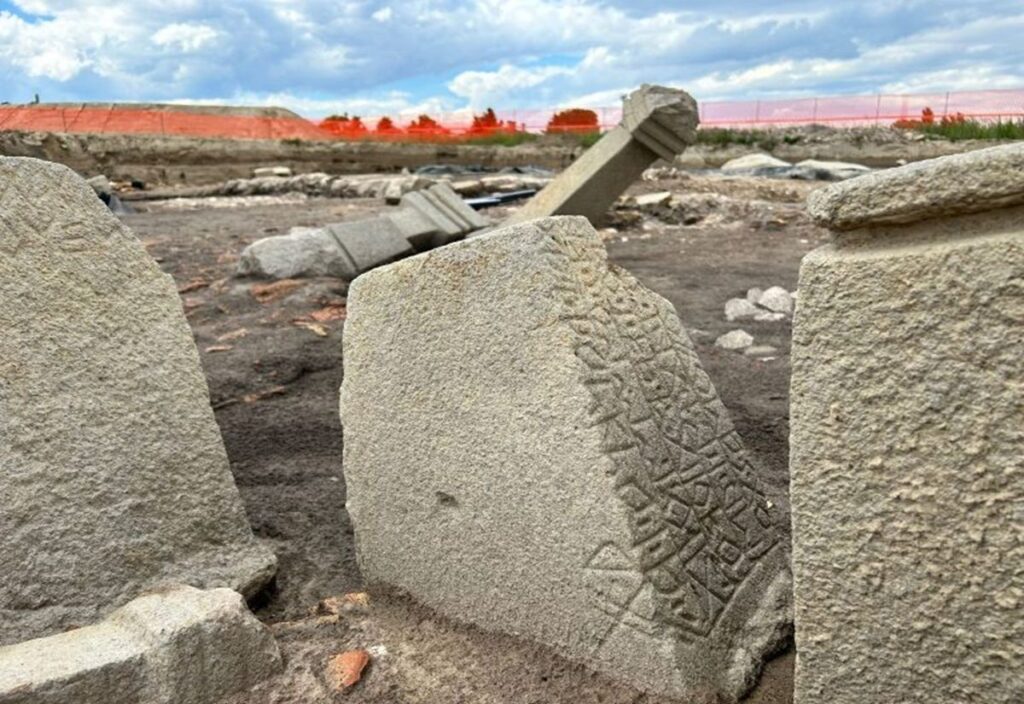
That is what makes the Ponso discovery especially valuable. Archaeologists have found numerous stone objects, known as cippi, bearing inscriptions mainly in Venetic characters and, in smaller numbers, Latin. Many of these stones appear to have had a votive function, meaning they were likely dedicated as offerings to a deity.
Some inscriptions were carved on more than one side of the stones, in certain cases on three faces. This detail suggests that the objects were not casual markers but carefully prepared ritual items, designed to be seen and read within a sacred setting.
Sacred stones reused in the Roman period
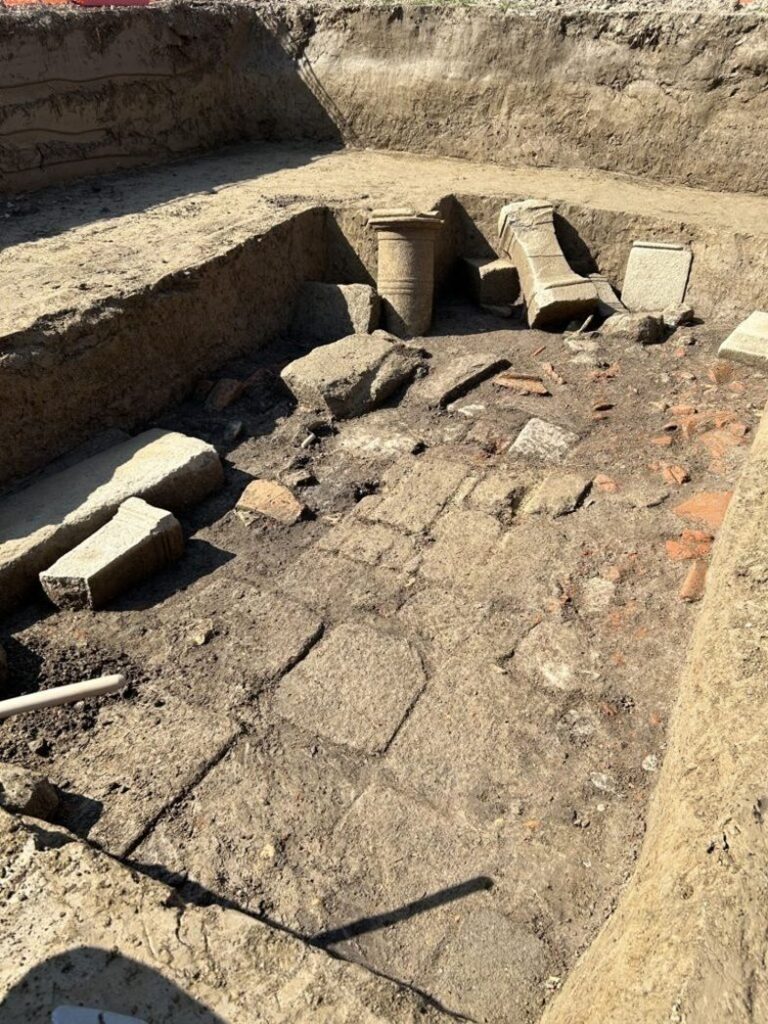
One of the most intriguing aspects of the site is the reuse of older inscribed stones in a paved surface believed, on preliminary evidence, to date to the 1st century AD. The exact purpose of this pavement remains uncertain, but its construction reused earlier sacred material while some cippi were still found in their original positions.
This does not point to a simple abandonment of the sanctuary. Instead, the evidence suggests continuity, transformation, and adaptation. A place that began as a Venetic cult area seems to have remained meaningful after Roman influence reshaped the region.
The shift from Venetic to Latin inscriptions is especially important. It reflects a wider cultural process in northern Italy, where local communities did not necessarily erase older traditions when Roman customs arrived. In many cases, they absorbed, reinterpreted, and preserved elements of earlier ritual life within new political and architectural forms.
Temples, columns, and a monumental cult complex
As excavation continued, archaeologists uncovered larger rectangular foundation structures interpreted as temples. One of them appears to show the characteristics of a peripteral temple, a building surrounded by a row of columns along its sides.
Italian reporting indicates that the complex may extend across at least 1,500 square meters, with three buildings already recognized and a possible fourth element still under study. If confirmed, this would suggest not a small rural shrine but a substantial cult area that developed over time into a more monumental religious center.
The architectural changes are likely significant. The earliest phase may have belonged to a local Venetic religious tradition, while later phases show stronger Roman architectural language. The sanctuary therefore preserves, in the same place, the passage from local pre-Roman worship to a Romanized sacred landscape.
Buried and preserved by the Adige River
The sanctuary was later covered by a powerful flood of the nearby Adige River, which in antiquity flowed through this area. Layers of mud, gravel, and alluvial sediment sealed parts of the complex, hiding it for centuries but also helping preserve its ancient surfaces, stones, and foundations.
For archaeologists, this is a rare advantage. Flood destruction often damages ancient sites, but in Ponso it also created a protective layer. The result is a buried religious landscape where inscriptions, architecture, and ritual reuse can be studied together.
The identity of the deity worshipped at the sanctuary has not yet been firmly established. Further epigraphic analysis may clarify whether the votive stones name a divinity, donors, or specific ritual formulas. For now, the greatest importance of the discovery lies in its concentration of inscribed material and its long sequence of use.
The Ponso sanctuary shows that Romanization in northern Italy was not a clean break. It was a gradual process in which older sacred places could survive, change, and continue to matter. Beneath a modern road project, archaeologists have found not only temples and inscriptions, but a record of how a local community carried its religious memory into a new historical world.
Soprintendenza archeologia, belle arti e paesaggio per le province di Padova, Treviso e Belluno
Cover Image Credit: Soprintendenza ABAP per le province di Padova, Treviso e Belluno
