
Ancient iron slags from Paleopolis on Andros are revealing a hidden industry from the age after Alexander the Great, when Greek islands, mines, and ports became part of Macedonian power.
The discovery is not a sword or an inscription celebrating victory. It is slag, the dark waste left when metalworkers heated iron in furnaces and hearths. Yet for archaeologists, slag can speak with unusual precision. It records the ore used, the minerals formed in the fire and the kind of metalworking that took place.
A new archaeometallurgical study of material from Paleopolis, the ancient capital of Andros in the Cyclades, shows that the island supported an active iron-working industry in the 4th and 3rd centuries BC. The evidence points not to copper production, but to the refining and smithing of locally produced iron. Blacksmiths in the heart of the city were working iron into objects, repairing them, and possibly supplying the practical needs of the Hellenistic world.
A workshop zone in the agora
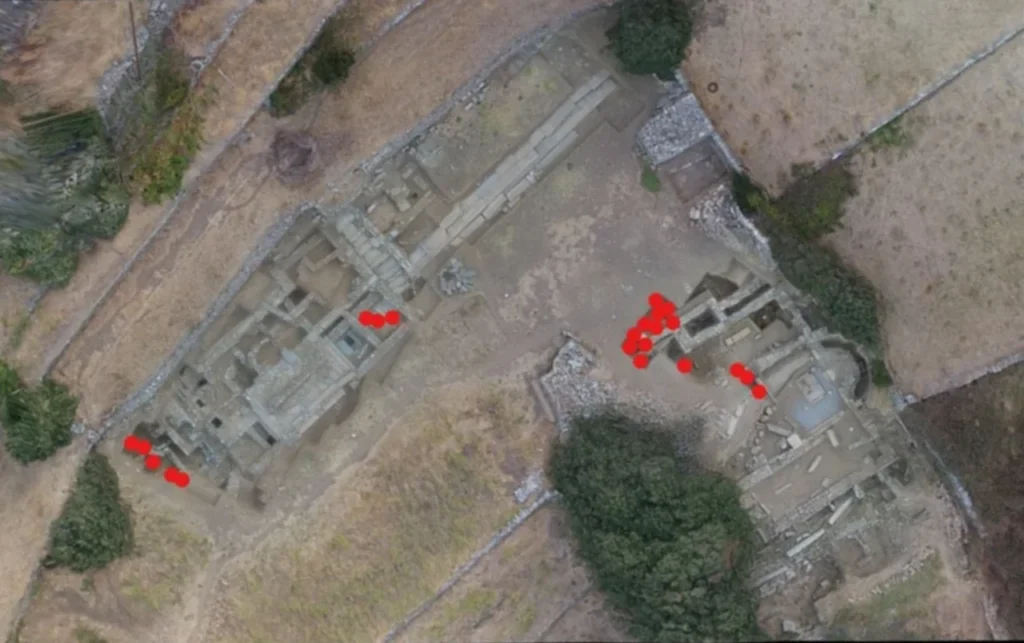
Paleopolis stood on the west coast of Andros. East of the ancient city is an area called Skouria, a name linked to the Greek word for slag. Large quantities of metallurgical waste have been found around the site, and excavations in the agora revealed a workshop environment active when Andros came under Macedonian control.
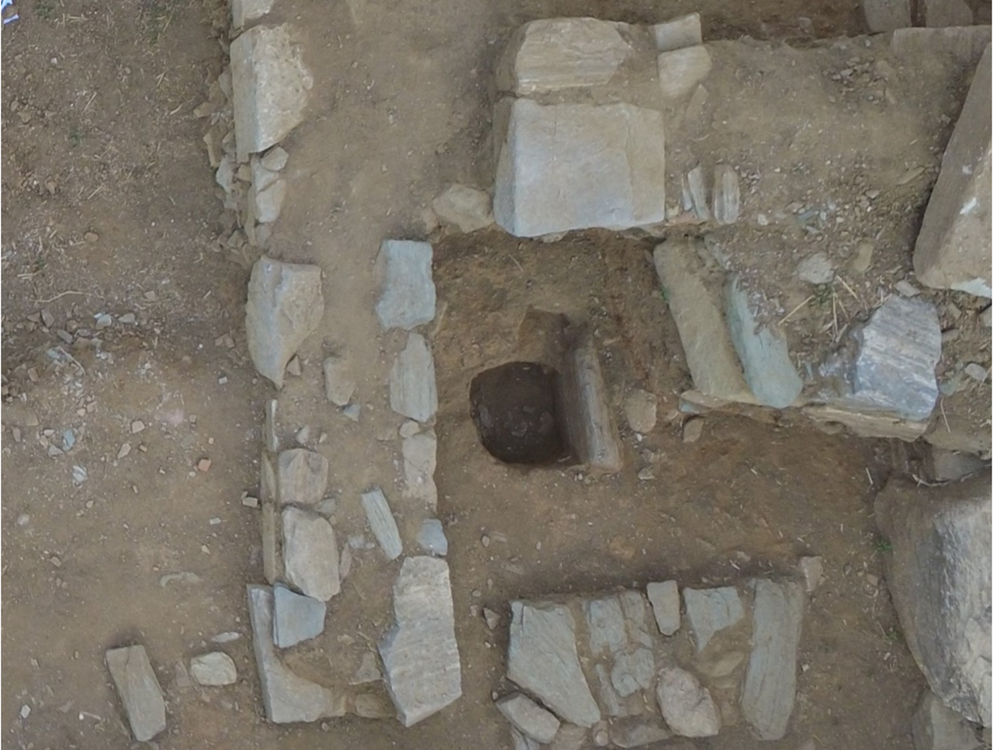
The agora was not only a political or commercial space. Excavations directed by Lydia Palaiokrassa-Kopitsa uncovered 4th-century BC metallurgical hearths, furnace remains, three casting pits, burned mudbrick layers, charcoal, slag, iron and bronze particles, lead fragments, and clay molds. A plaster model of a squat lekythos, used for making molds, was also found in the same area.
This urban setting is central to the interpretation. Primary smelting usually took place closer to mines, where ore was first reduced. Smithing and refining were more likely to occur inside settlements, where craftspeople turned semi-finished iron into usable objects or repaired damaged ones.
The chemistry of fire
The research team analyzed 22 slag samples from Paleopolis and five iron ore samples from the Agios Petros mines, about ten kilometers northwest of the ancient city. Using X-ray diffraction, X-ray fluorescence and electron microscopy, they identified the minerals and trace elements preserved in the slag.
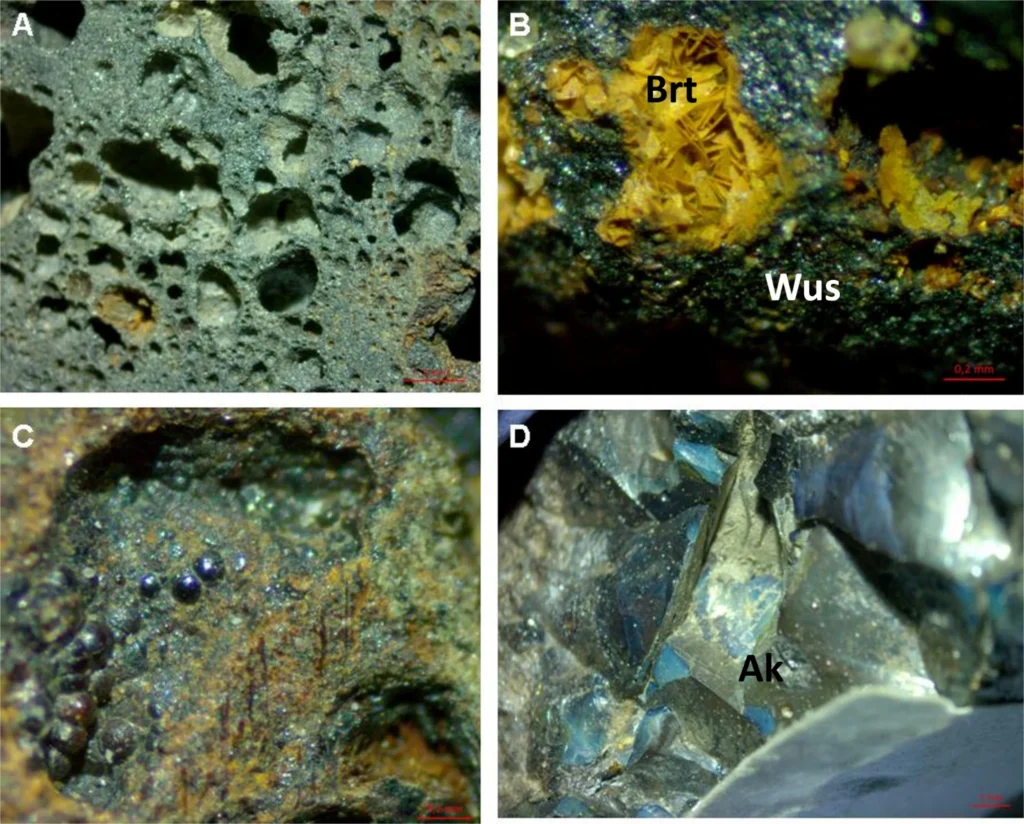
The results point strongly to iron metallurgy. The slags were dominated by wüstite, an iron oxide common in bloomery ironworking, along with fayalite, bustamite, tephroite and other high-temperature minerals. Tiny metallic iron prills were also detected in several samples. Copper, lead, zinc and other metals appeared only in trace amounts, making copper production unlikely as the main process.
The chemical pattern also helped resolve an important question. The slags were not simply the waste of primary smelting. Their composition and urban findspot indicate refining and smithing, the stages in which iron was cleaned, reheated, and worked into artifacts. That makes Paleopolis a rare window into tools, fittings, fasteners, and perhaps weapons passing through the hands of island blacksmiths.
Andros’ unusual ore
The ore itself gave the study its most distinctive character. Andros has iron deposits near Paleopolis and around Agios Petros and Mpatsi. These ores include goethite, hematite, siderite, and limonite, but they also contain notable amounts of manganese and barium.
Those elements mattered. Manganese and barium-rich minerals can act as natural fluxes, helping lower melting temperatures and making the furnace process easier. The island’s geology may have offered ancient smiths a useful advantage. They were working with iron ore whose chemistry helped the metal separate in the fire.
A surprising trace of the sea
The slag also preserved an unexpected geochemical signature: very high thallium levels. Some samples contained concentrations far beyond ordinary expectations. The study links this to the origin of the Andros ore itself.
The Aegean is shaped by tectonic and volcanic activity, and submarine hydrothermal systems can concentrate metals in unusual ways. Similar thallium-rich iron oxides are known from volcanic and hydrothermal settings in the region. The ore used at Paleopolis may therefore carry a deep geological memory, formed in marine conditions influenced by volcanic fluids long before it entered a blacksmith’s hearth.
War-era industry, not simple proof of an arms factory
The timing is what makes the Andros workshops so compelling. After Alexander’s death in 323 BC, his generals and successors fought for control of territory, fleets, cities and resources. Andros was under Macedonian domination during this broad period, and the study suggests the metallurgical activity may relate to that political and military climate.
But the evidence needs restraint. The slags do not prove that Paleopolis was an arms factory, norcan they be tied to a specific battle or campaign. What they do show is that an island city had the capacity to refine and work iron locally during an age when metal, transport and guarded resources were essential to power.
Near the Agios Petros mines stand Hellenistic stone towers, one well preserved. Similar towers appear on other Cycladic islands near mining areas, where they likely helped protect valuable mineral resources. On Andros, they hint at the strategic importance of iron ore in a defended economic zone.
What remains from Paleopolis is not a shining weapon, but industrial waste with a memory. Under the microscope, slag becomes a record of local ore, furnace chemistry, blacksmithing skill and the pressures of a world remade after Alexander. In the hills and ruins of Andros, the hard material life of the Hellenistic age is still waiting in the ashes.
Stamatakis, G., Palaiokrassa-Kopitsa, L. & Stamatakis, M.G. The ancient slags of Palaeopolis, Andros Island, Greece. Geochemical and mineralogical characterization and archaeometallurgical implications. Archaeol Anthropol Sci 18, 102 (2026). https://doi.org/10.1007/s12520-026-02463-z
Cover Image Credit: Remnants of a characteristic furnace found inside agora of ancient Andros (Palaeopolis) (from: Palaiokrassa-Kopitsa 2012). Credit: G. Stamatakis et al. 2026
