
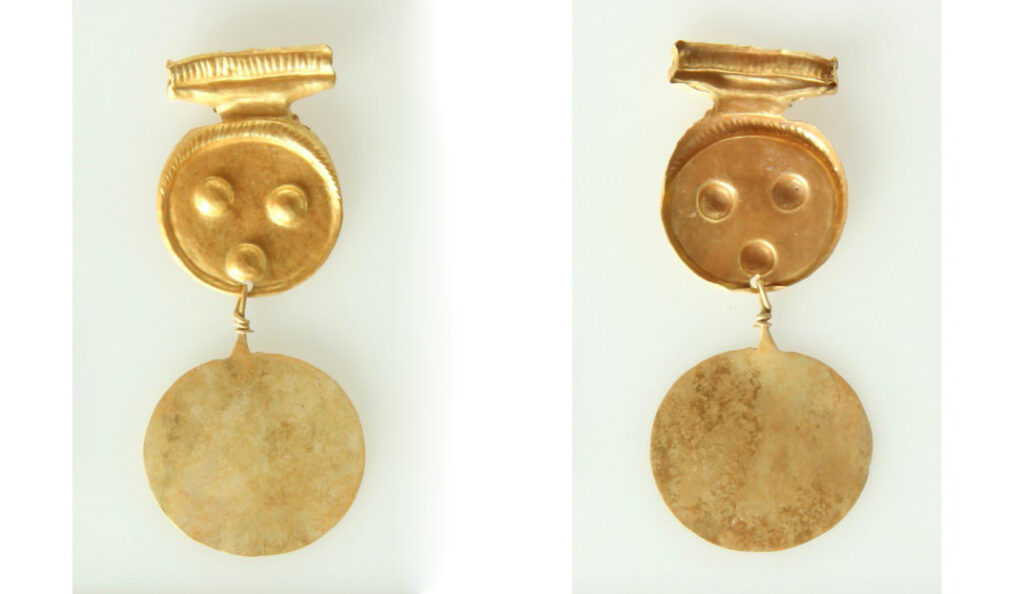
A remarkable Bronze Age gold jewelry discovery at Kolona on the island of Aegina is offering new insight into elite identity, trade networks, and burial customs in the ancient Aegean. Announced by the Greek Ministry of Culture, the find dates to the first half of the second millennium BCE and may be linked stylistically to one of the most debated prehistoric hoards in Europe.
The discovery was made during the 2025 excavation season led by the University of Salzburg in cooperation with the Austrian Archaeological Institute, under the direction of Alexander Sokolicek and supervised by Greek antiquities authorities.
A Coherent Jewelry Set Emerges from a Disturbed Context
The artifacts were uncovered inside a large stone-built structure located beside the defensive wall of a Middle Bronze Age settlement expansion, often described as the “inner suburb.” Although the stratigraphy had been disturbed at an unknown time, the objects form a strikingly consistent group.
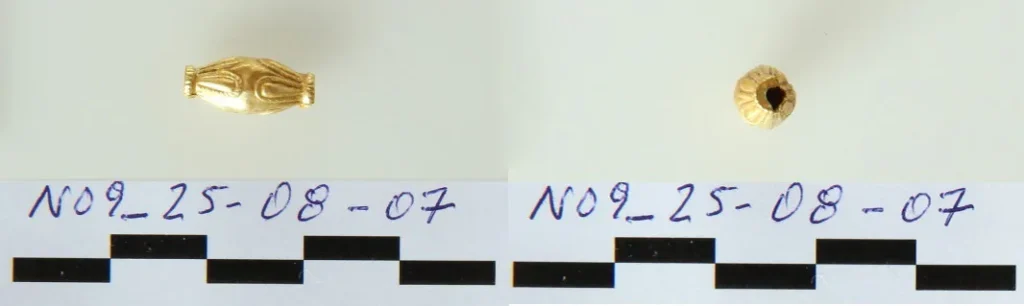
Archaeologists recovered gold pendants, beads, and delicate sheet ornaments alongside carnelian beads, all likely belonging to a single necklace or suspended ornament. The preservation state is exceptional, suggesting the assemblage was rapidly buried and remained largely undisturbed until recent excavation.
Fragments of copper tools and a metal pin were also found, hinting at a broader depositional context that may once have included additional grave goods.
The Missing Burial Problem
Despite strong indicators, no intact tomb has yet been identified. This absence is not unusual in Aegean archaeology, where later disturbances or ancient looting often erase direct burial evidence.
Researchers consider it plausible that the jewelry originally formed part of a Middle Bronze Age funerary deposit, intended to accompany a high-status individual. The lack of a preserved burial, however, introduces interpretive caution. Without skeletal remains or a clear tomb structure, the objects must be understood through comparison and context rather than direct association.
Strong Parallels with a Controversial Treasure
The discovery has renewed attention around the Aegina Treasure, a collection of prehistoric ornaments believed to originate from the same island and now housed in the British Museum.
The formal similarities, especially in the disc-shaped pendants, suggest a shared artistic and symbolic tradition. These parallels strengthen the view that Aegina played a central role in Aegean exchange systems, rather than acting as a peripheral settlement.
Gold and carnelian were not local materials. Their presence indicates long-distance acquisition routes, likely linking the island to networks stretching across mainland Greece, the Cyclades, and Minoan Crete.
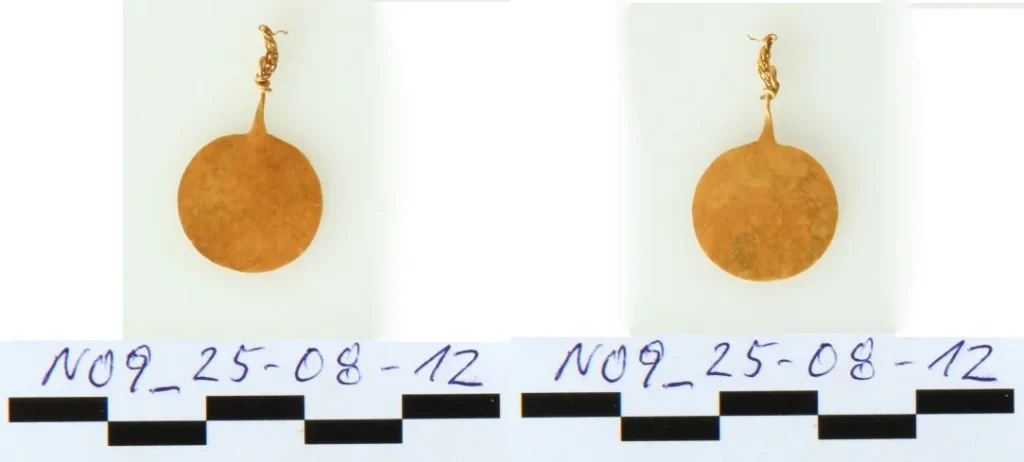
Gold disc earring found in the archaeological site of Kolona. Credit: Greek Ministry of Culture
Kolona’s Long Archaeological Timeline
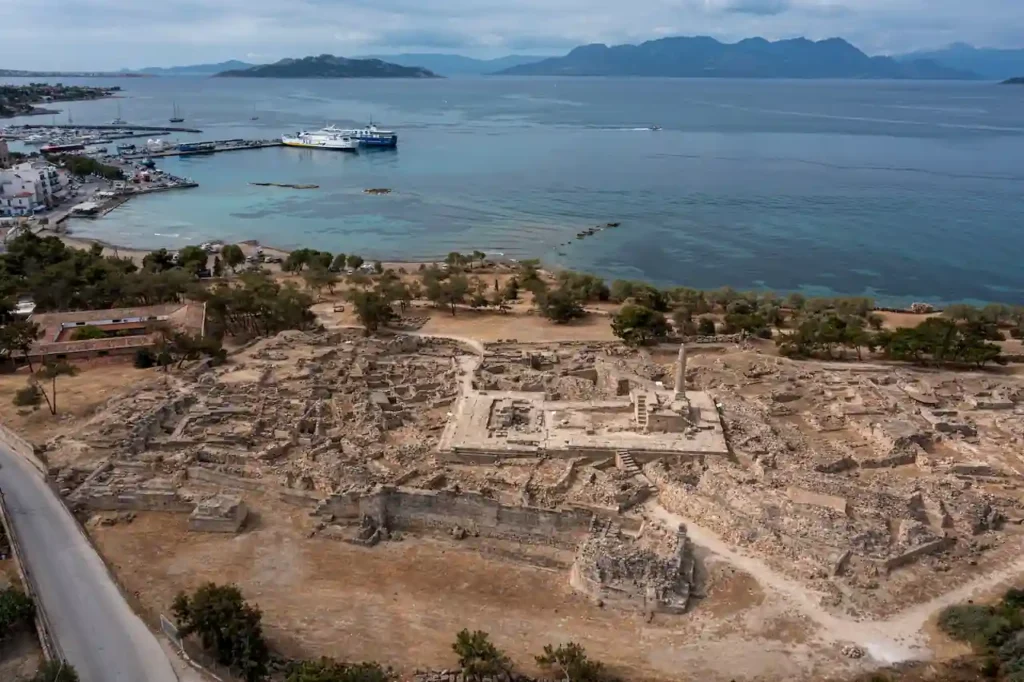
The site of Kolona, located on the northwestern coast of Aegina, is best known for the remains of a temple dedicated to Apollo. Yet its significance extends far beyond the classical period.
Excavations have revealed a multi-layered settlement history, including a prehistoric community, a sanctuary during historical times, the acropolis of the ancient city, and later Byzantine occupation. This continuity makes Kolona a key reference point for understanding long-term habitation patterns in the Saronic Gulf.
The latest discovery confirms that even extensively studied sites can still produce finds that challenge established interpretations.
Scientific Work Now Underway
Rather than transferring the objects immediately to a museum, authorities have chosen to keep them on Aegina to support detailed local study. This decision allows researchers to apply a full range of analytical methods under controlled conditions.
Planned studies include metallurgical analysis of the gold, isotopic examination of the carnelian, and microscopic investigation aimed at detecting traces of organic materials. Such analysis may reveal remnants of fibers or cordage associated with the necklace’s original assembly, offering rare insight into how the piece was constructed and worn.
These results will help establish a more precise chronology for the ornaments and enable closer comparison with finds from Mycenaean grave circles, Cretan ritual contexts, and Cycladic assemblages.
Renewed Focus on the Surrounding Area
The excavation team has also signaled a shift in strategy. Future work will concentrate more intensively on the areas surrounding the stone structure where the jewelry was discovered.
The goal is to identify any surviving traces of the original burial context, which may have been displaced or looted in antiquity. Even fragmentary evidence could significantly improve understanding of the assemblage’s function and social meaning.
Aegean Connectivity and Social Meaning
Beyond its immediate archaeological value, the discovery contributes to a broader picture of Aegean connectivity during the Middle Bronze Age. Objects like these were not merely decorative. They carried social and symbolic weight, marking identity, status, and possibly ritual roles.
The craftsmanship and material choices suggest a society already deeply embedded in regional exchange networks, where ideas and styles moved alongside goods.
A Site That Still Holds Answers
As the Greek Ministry of Culture noted in its official statement, Kolona remains far from fully understood. More than a century of excavation has revealed only part of its story.
The newly discovered jewelry, despite its incomplete context, adds a significant chapter. It also underscores a familiar archaeological reality: the most important finds often raise as many questions as they answer.
For Kolona, those questions are now sharper, more focused, and waiting just beneath the surface.
Cover Image Credit: Greek Ministry of Culture
