
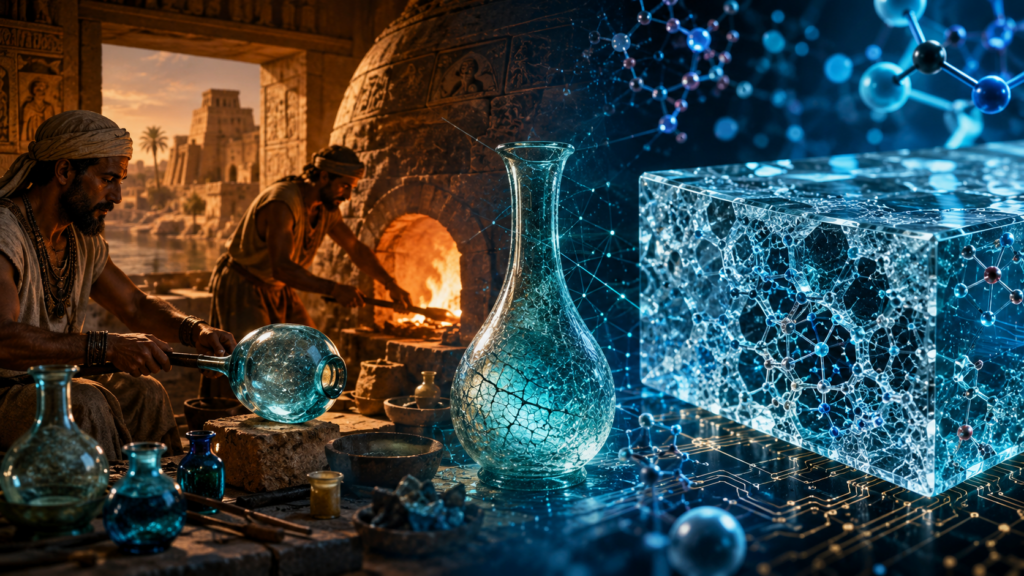
The story of future materials may begin not in a modern cleanroom, but in the workshops of ancient glassmakers.
Thousands of years ago, artisans in Egypt and Mesopotamia learned that glass could be transformed by adding the right ingredients. Metal compounds changed its color, lowered its melting temperature, and made it easier to shape. The blue and green glass objects that moved across ancient trade routes were not only luxury goods. They were also early evidence of a deep practical knowledge: glass could be engineered.
Now, a team of researchers in Germany and the United Kingdom has taken that old idea into one of the most advanced areas of materials science. In a new study published in Nature Chemistry, scientists show that principles familiar from traditional glassmaking can be used to create a new generation of metal-organic framework glasses, or MOF glasses, with potential uses in electronics, sensors, gas separation, catalysis, and carbon capture.
Ancient glassmaking meets modern materials science
For archaeology readers, the link is striking. Ancient glassmakers did not understand atomic structures in modern terms, but they knew that additives could change the behavior of molten glass. In traditional silicate glass, substances such as sodium or calcium compounds act as modifiers. They disrupt the rigid silica network, reduce processing temperatures, and make the material easier to melt and shape.
The new study applies a comparable logic to a very different class of glass.
Instead of ordinary silica-based glass, the researchers worked with ZIF-62, a zeolitic imidazolate framework. ZIFs belong to the wider family of metal-organic frameworks, materials built from metal ions connected by organic molecules. Unlike everyday window glass, these materials can contain microscopic pores, giving them unusual chemical and physical properties.
That porosity is what makes MOF glasses especially interesting. Their internal spaces can potentially trap gases such as carbon dioxide, separate molecules, support catalysts, or function in optical and electronic devices. But there has been a major obstacle: they are difficult to process. Many MOF glasses only become workable at high temperatures, sometimes close to the point where the material begins to degrade.
A glass with microscopic rooms inside
The researchers tested whether the ancient principle of glass modification could solve this problem. They added lithium and sodium benzimidazolate compounds to ZIF-62, using them as glass modifiers in a way conceptually similar to modifiers in ancient and modern silicate glassmaking.
The result was a clear shift in the material’s behavior. As the amount of sodium-based modifier increased, the glass transition temperature dropped sharply. In one case, the temperature at which the glass softened fell from 294°C to 161°C.
That change matters. Lowering the glass transition temperature could make MOF glasses easier to process, shape, and integrate into future devices. The modified glasses also became more fluid at elevated temperatures, a useful property for manufacturing.
At the atomic level, the study found that sodium was not simply sitting inside the pores. It became incorporated into the glass framework itself. In doing so, it weakened parts of the metal-organic network and created a more disordered structure. This mirrors, in broad terms, what happens when traditional glass modifiers disrupt the silica network in conventional glass.
Porosity could support carbon capture technologies
The most important result may be what happened after the modified glass was treated with water.
The researchers showed that part of the sodium-based modifier could be removed through a leaching process. This is reminiscent of the Vycor process, a 20th-century method used to create porous silicate glasses by selectively dissolving parts of the material.
After leaching, the MOF glass became more porous. Measurements showed that the treated material recovered accessible microporosity and developed additional pore space. According to the study, the total pore volume was estimated to be about 26 percent higher than that of the original ZIF-62 glass.
This could be significant for technologies that depend on internal surface area and controlled pore networks. In particular, the researchers tested carbon dioxide sorption, a key measure for materials being explored in carbon capture and gas separation.
The study does not claim that this glass is ready for industrial carbon capture systems. It is still a laboratory advance, and practical manufacturing challenges remain. The authors note that producing large monolithic pieces is still difficult, partly because of processing conditions and adhesion to crucibles during preparation. But the work provides a new design route: modify the glass, shape its structure, then tune its porosity through controlled extraction.
Why this discovery matters beyond chemistry
The study is a reminder that ancient technologies often contain principles that remain scientifically powerful. Ancient glassmakers transformed sand, minerals, and metal compounds into objects of color, trade, and status. Modern researchers are now using a related principle to design materials with functions that ancient artisans could not have imagined.
This is not a simple case of copying the past. It is a translation of an old material logic into a new chemical language.
For archaeology, the story also sharpens how we view ancient craft. Glassmaking was never just decorative. It required control of heat, raw materials, colorants, fluxes, and cooling. The choices made by ancient artisans altered the structure and properties of their products, even if the science behind those changes would only be explained thousands of years later.
For modern materials science, the lesson is practical. If modifiers helped ancient and traditional glassmakers control silicate glass, similar strategies may help researchers expand the world of MOF glasses. The new study suggests that modifier chemistry can be used to tune glass transition temperature, viscosity, structural disorder, and porosity.
That could open the way to smart glass materials designed not only to transmit light, but to store gases, filter molecules, support chemical reactions, or operate inside advanced electronic systems.
In that sense, the future of glass may still owe something to the first glassmakers of the ancient world. Their experiments with fire and minerals helped create one of humanity’s most enduring materials. Today, the same basic idea, that small additions can transform glass, is helping scientists imagine what glass might become next.
Kolodzeiski, P., Gallant, B.M., Richter, L. et al. Alkali-ion-modified zeolitic imidazolate framework glasses. Nat. Chem. (2026). https://doi.org/10.1038/s41557-026-02115-8
Cover Image Credit: Illustration created with AI to visualize the connection between ancient glassmaking techniques and next-generation smart glass materials.
