
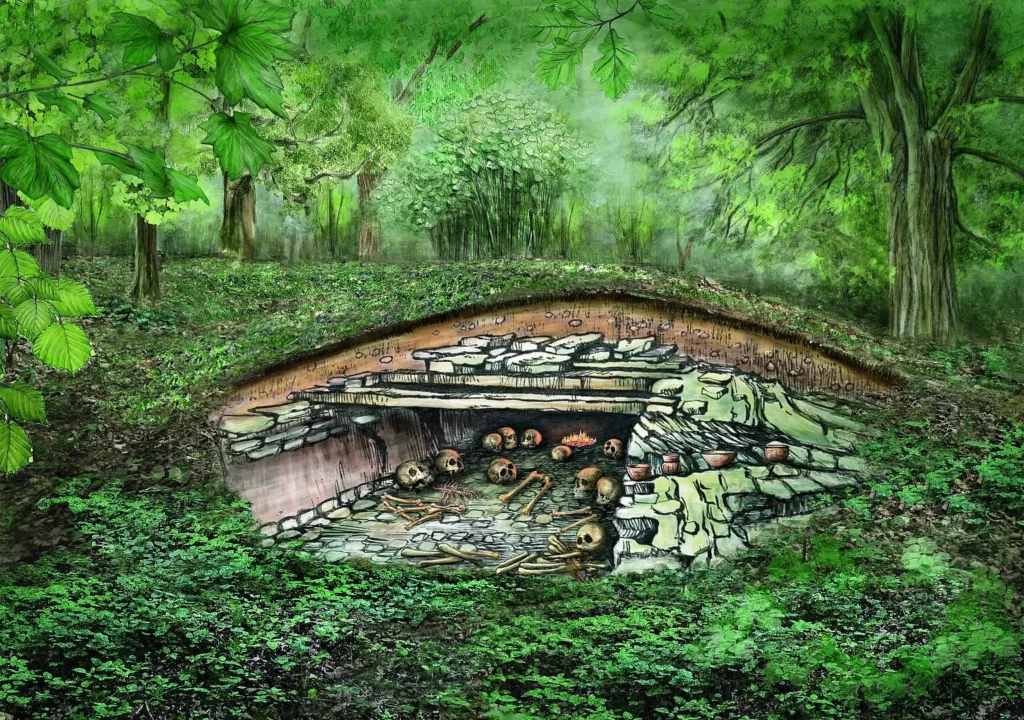
More than 5,000 years ago, the people buried inside Central Europe’s great stone tombs were not always members of a single biological family. Some were kin. Others were connected by ties that cannot be read simply through bloodlines.
A new ancient DNA study led by researchers at Kiel University has revealed that Neolithic communities in Central Europe lived with unexpectedly flexible family structures. Children from different biological backgrounds may have grown up together. Social bonds, not only genetic relationships, appear to have shaped who belonged to a household, a community, and even a shared burial place.
The findings, published in Science, challenge a long-standing assumption about prehistoric megalithic tombs. These monuments have often been interpreted as resting places for biological family groups. But the new genetic evidence suggests a more complex reality.
Ancient families were not always defined by blood
The research was coordinated by Professor Ben Krause-Kyora, an ancient DNA specialist at Kiel University’s Institute of Clinical Molecular Biology. According to the team, communities living more than five millennia ago in Central Europe were organized through a mixture of biological kinship and social affiliation.
That makes the discovery unusually human. The study does not simply describe migration, burial customs or monumental architecture. It brings into focus the intimate structure of Neolithic life: who lived together, who moved away, who returned, and who was remembered as part of the same community after death.
The researchers analyzed DNA from 203 Neolithic individuals, most of them recovered from megalithic tombs linked to the Wartberg culture in present-day Lower Saxony, Hesse and North Rhine-Westphalia. These communities lived between roughly 3600 and 2800 BCE, a period when farming, livestock breeding and permanent settlement had already transformed much of Europe.
It was also the age of megaliths. Across parts of Europe, communities built monumental burial chambers from massive stones. Some still survive today as imposing reminders of one of prehistory’s most ambitious architectural traditions.
Megalithic tombs held communities, not just nuclear families
The genetic results show that individuals buried in the same tomb were not necessarily close biological relatives. This pattern differs from findings at some megalithic sites in Ireland and Sweden, where communal tombs appear more strongly linked to biological nuclear families.
In the Wartberg sites studied by the Kiel-led team, burial seems to have reflected a broader idea of belonging. People may have been placed together because they shared a household, lineage, social role, local identity or long-term community bond.
Professor Almut Nebel, a co-author from Kiel University’s IKMB, noted that these were not simply graves of biological families. They were, in effect, burial places of blended communities.
That distinction matters. It suggests that Neolithic society in Central Europe could absorb children, partners and unrelated individuals into durable social groups. Family was not a fixed genetic unit. It was something built through life, residence, cooperation and memory.
A father and son buried 250 kilometers apart
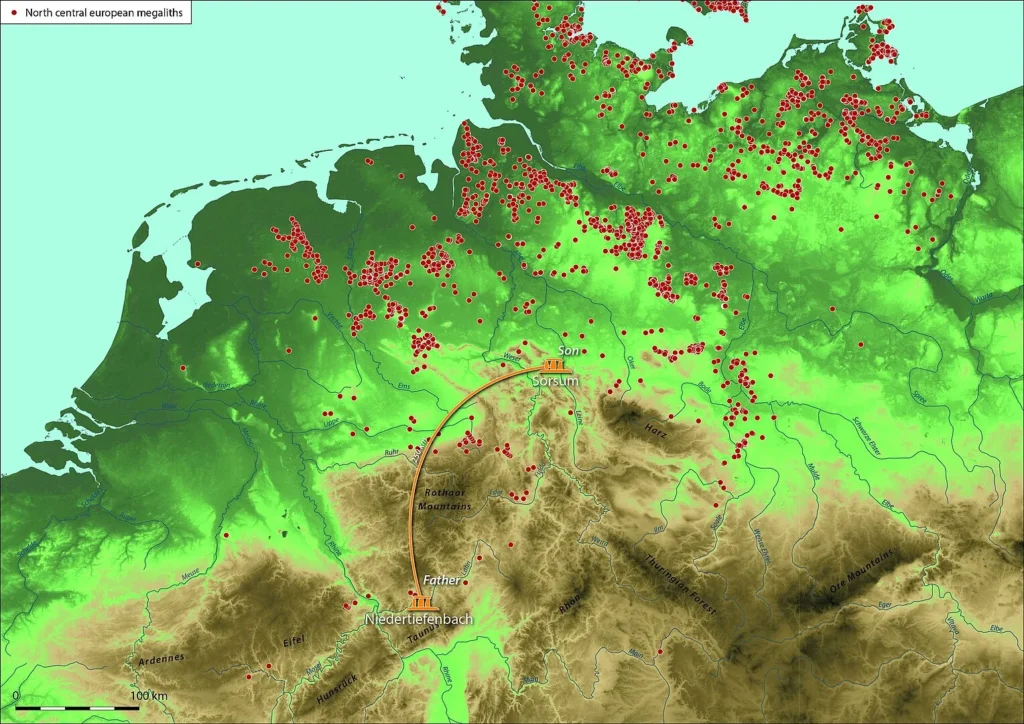
The study also changes what researchers thought they knew about Neolithic mobility. At the megalithic tomb of Sorsum, the northernmost site examined, scientists identified a young man whose biological father had been buried at Niedertiefenbach, about 250 kilometers to the southwest.
The discovery does not prove whether the son lived at Sorsum permanently or died there while travelling. But it does show that close relatives could end up far apart within a single generation.
This is striking because the movement took place long before domesticated horses became a common means of transport in Central Europe. The evidence points to a world in which people, ideas and family connections moved across much greater distances than previously assumed.
Other genetic data from the study support the same conclusion. Close relatives were often separated by considerable distances. Girls and women, in particular, appear to have been especially mobile.
Megalithic architecture spread through culture, not mass migration
The team also compared the Wartberg DNA with previously published genetic data from Western Europe. The result was significant: the Wartberg communities were not the same population as other megalith-building groups elsewhere in Western Europe.
This weakens the idea that megalithic architecture spread mainly through the migration of one specific population. Instead, the evidence points toward cultural transmission. The practice of building large stone monuments may have moved from group to group through contact, exchange, imitation and shared ritual ideas.
Dr. Nicolas da Silva, lead author of the study, said this indicates that the custom of erecting monuments from massive stones was culturally disseminated rather than carried directly by migrating populations.
The picture that emerges is not of isolated farming villages, but of connected Neolithic societies. They exchanged more than goods. They shared architectural concepts, burial practices, partners, children and social identities.
A more complex Neolithic world
For decades, the Neolithic has been described as the period when farming reshaped Europe. That remains true. But studies like this show that the transformation was not only economic. It was social.
The first farming communities of Central Europe were not simple, static groups tied only to land and blood. They were mobile, adaptive, and socially layered. Their tombs preserved not just bones, but the traces of families formed through both ancestry and choice.
More than 5,000 years later, ancient DNA is revealing a prehistoric Europe that feels less distant than expected. Blended families, long-distance relatives, and communities built through social bonds were not modern inventions. They were already part of life in the age of the megaliths.
Da Silva, N. A., Nebel, A., Kolbe, D., Myburgh, D. A., Klimscha, F., Görner, I., Fuchs, K., Meyer, C., Schierhold, K., Rind, M., Hoffmann, R., Franke, A., Meadows, J., Rinne, C., Müller, J., & Krause-Kyora, B. (2026). Long-distance genetic relatedness in megalithic central Europe. Science. https://doi.org/10.1126/science.aeb2926
Cover Image Credit: © Susanne Beyer, Inst. UFG/Uni Kiel
