
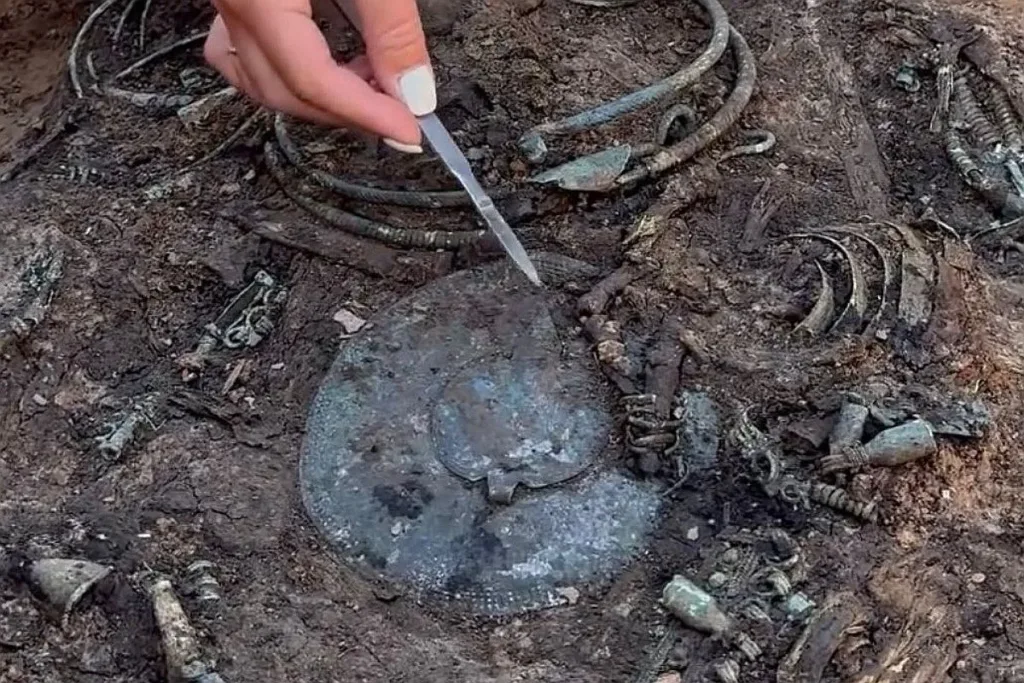
A silver ornament placed on the chest of a young woman buried around 1,300 years ago may have served as a symbolic doorway through which the soul could leave the body, according to archaeologists investigating an early medieval Muroma cemetery in western Russia.
The unusual object—a large disc-shaped silver plaque with a small circular lid at its center—was discovered at the Zvyagino burial ground in the Vachsky District of Russia’s Nizhny Novgorod region. Researchers believe the lid may have been slightly opened during the funeral, transforming the ornament into a symbolic passage between the world of the living and the world of the dead.
The object’s position, construction and association with an elaborate ceremonial costume suggest that it was more than a decorative piece.
A Young Woman Buried in Ceremonial Dress
The burial has been provisionally dated to the late seventh or early eighth century, placing it among the earliest graves currently being examined at the cemetery.
The deceased appears to have been a very young woman or adolescent who was laid to rest wearing an exceptionally rich ceremonial costume. Archaeologists recovered elements of a complex headdress, temple rings, a forehead band, leather strips decorated with metal fittings, and two rigid neck rings.
Greenish traces of oxidized metal preserved in the soil also revealed the outline of a garment once covered with tiny beads.
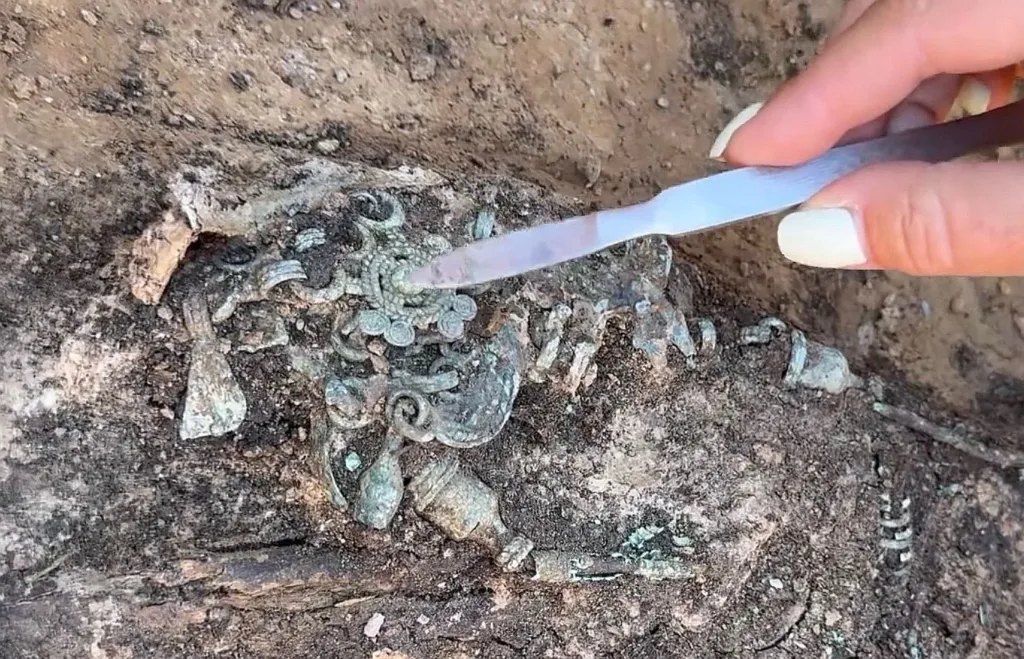
According to Anastasia Shvetsova, head of the archaeology sector at the Nizhny Novgorod Museum-Reserve, the headdress may have included decorated cords that crossed above the head. These could have supported a tall textile covering or formed part of an elaborate hairstyle in which strands of hair were wrapped in leather and bronze spirals.
When worn, the ornaments may have created a halo-like frame around the woman’s head.
Her shoulder decorations were equally elaborate. Leather straps carried groups of metal pendants that would have produced sound whenever she moved. Such “rattling” ornaments are characteristic of several medieval Uralic-speaking cultures of the Volga region and may have combined visual display with protective or ritual meanings.
Among the pendants was a small zoomorphic figure representing a horse. Archaeologists have not established its precise meaning, but horses clearly occupied an important place in Muroma burial traditions.
Was the Silver Lid Opened to Release the Soul?
The most enigmatic object lay on the woman’s chest.
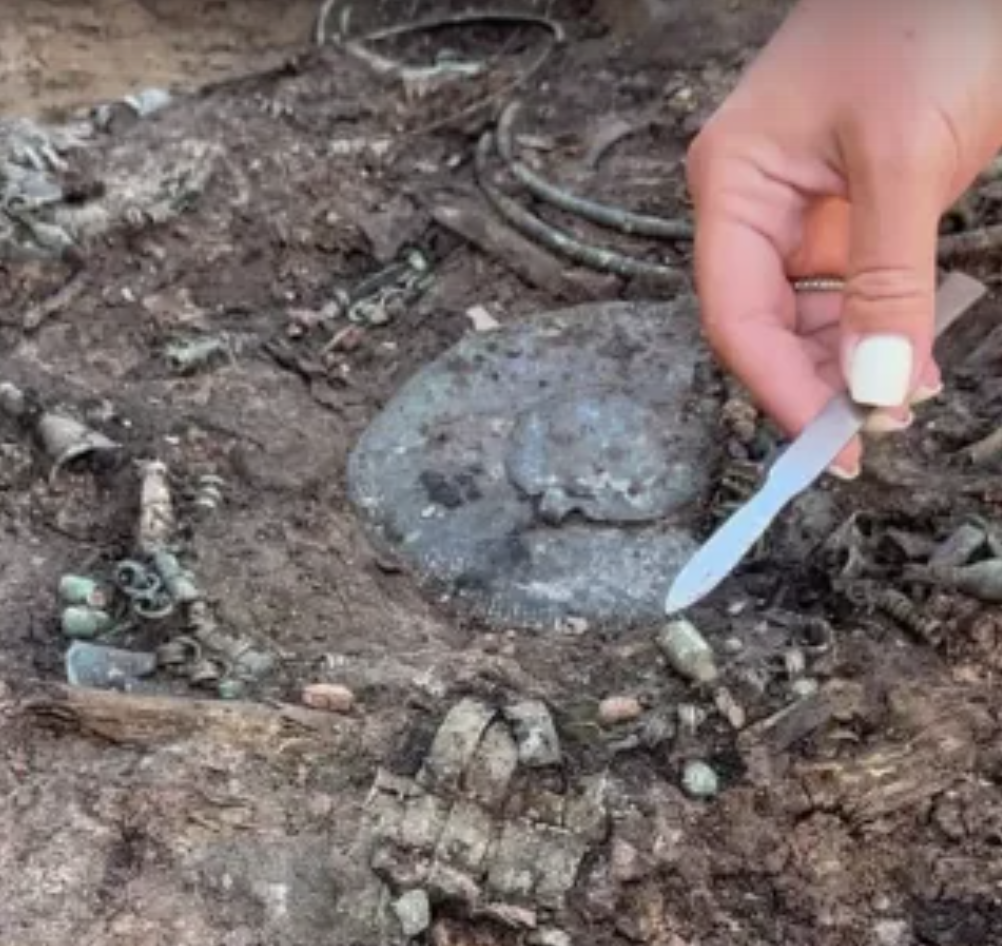
At first glance, the silver plaque resembles a large circular brooch or dress fitting. At its center, however, is a miniature movable lid resembling a tiny door.
Shvetsova said archaeologists are considering the object as part of a ritual costume. One interpretation is that the lid represented an opening through which the soul could leave the body and begin its journey into another world.
Recent accounts of the excavation suggest that the miniature cover may have been left slightly open during the burial ceremony. This reconstruction is plausible, but researchers have not yet presented direct evidence proving exactly how the object was manipulated during the funeral.
The “door to the afterlife” should therefore be understood as a working interpretation based on the object’s form and funerary context—not as a fully established fact.
Even so, the plaque provides a rare glimpse into a belief system that survives almost entirely through archaeology. The Muroma left no known written accounts explaining their rituals. Objects placed on the body, the positioning of the dead and the structure of the graves are therefore essential for reconstructing how they understood death.
An Organized Cemetery with Human and Horse Burials
The Zvyagino cemetery was identified in 2022 after local residents reported illegal digging at the site. Systematic excavations began the following year and are being conducted jointly by the Nizhny Novgorod Museum-Reserve and the Volga Expedition of the Institute of Archaeology of the Russian Academy of Sciences.
The 2026 campaign is concentrating on the northern section of the cemetery, where researchers believe the earliest graves are located. The excavation area contains 42 burials selected for investigation. By mid-July, at least 15 had been examined, while another 11 were being excavated.
The graves were arranged in orderly rows without later burials cutting through earlier ones. Most of the deceased were placed with their heads facing north or northwest, suggesting that the cemetery followed a carefully maintained spatial plan rather than developing randomly.
Four of the graves under investigation contained horses. The animals were smaller than most modern horses and appear to have held considerable ritual importance. Horse burials became less common after the tenth and eleventh centuries, making them an important chronological indicator for the cemetery’s earlier phases.
Previous excavations have also revealed wooden burial structures. Some bodies were apparently placed inside constructions made from thin logs or planks and covered with birch bark, creating a chamber-like enclosure around the deceased.
Who Were the Muroma?
The Muroma were a medieval Volga-Finnic people belonging to the wider Uralic-speaking cultural world. They lived mainly around the lower reaches of the Oka River, east of present-day Moscow.
They appear briefly in the Primary Chronicle, which lists them among the peoples living along the Oka and notes that they possessed their own language. The modern Russian city of Murom still preserves their name.
Archaeological evidence suggests that Muroma culture flourished between approximately the eighth and tenth centuries, although the latest discoveries at Zvyagino may push the cemetery’s origins back into the seventh century—or potentially even earlier. A type of dress fastener found during the current excavations has parallels dating to the sixth century, but archaeologists caution that such objects could have been inherited before being placed in a later grave.
The Muroma were not an isolated forest community. Finds from their cemeteries include Baltic amber, cowrie shells originating near the Indian Ocean, beads linked to Central Asia and Byzantium, Arab silver dirhams and Western European coins. These objects reveal participation in far-reaching trade networks connecting the Oka River with northern Europe, the Islamic world and routes extending deep into Asia.
By the eleventh century, the material culture of the cemetery began to change. Traditional Muroma ornaments appeared alongside objects associated with the expanding Rus’ world. Researchers interpret this as evidence of prolonged contact and gradual cultural integration rather than sudden conquest or disappearance.
By the twelfth century, the Muroma were no longer recorded as a separate people. They were gradually absorbed into the East Slavic population, although elements of their culture may have survived among communities of the Oka region.
The Zvyagino cemetery preserves that transformation across several centuries. Earlier graves contain distinctive Muroma costumes, weapons, horse burials and ritual objects. Later burials display an increasingly mixed cultural identity, making the site one of the most important archaeological records of interaction between medieval Uralic-speaking communities and the emerging Rus’ state.
The young woman’s silver plaque now adds a more intimate question to that broader history: did mourners open its tiny lid to release her soul?
Archaeology may never provide a definitive answer. But the miniature door offers a striking physical expression of how one early medieval community may have imagined the boundary between life and death.
