
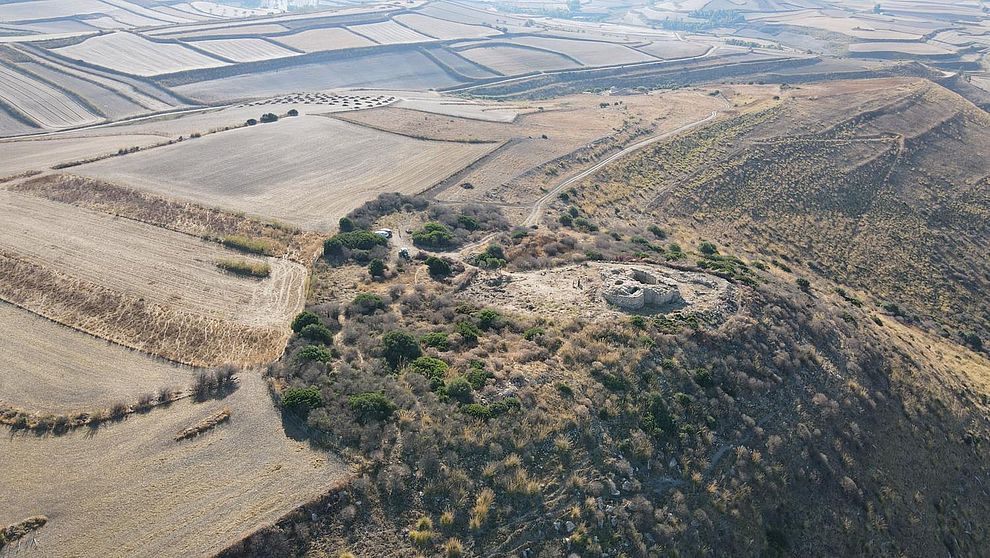
A 3,200-year-old nuraghe in Sardinia reveals how Bronze Age towers were reused as Iron Age cult sites through a sealed well, ritual pottery and a votive bronze sword.
For centuries, Sardinia’s stone towers stood over the island like silent markers of a vanished Bronze Age world. At Nuraghe Barru, one of these ancient monuments is now telling a more complex story: it was not simply abandoned when times changed. It was transformed.
A new interdisciplinary study led by Dr. Silvia Amicone of the University of Tübingen suggests that the Bronze Age tower complex at Nuraghe Barru, in south-central Sardinia, continued to play a social and spiritual role into the Early Iron Age. Inside the monument, archaeologists found a deliberately sealed cistern-well filled with broken vessels, animal and human remains, and nearby votive offerings including a 94-centimeter bronze sword, razor-like bronze objects and a copper lump.
The discoveries indicate that a tower built more than 3,200 years ago was later reused as a place of ritual activity at a time when Sardinian society was undergoing major religious and political change.
A monument from Sardinia’s “island of towers”
Sardinia is famous for its nuraghi, massive stone towers built during the Bronze Age. Nearly 7,000 of them survive across the island, giving Sardinia its reputation as an “island of towers.” These structures, usually built with large stones and corbelled interiors, were raised between roughly 1700 and 1100 BC. Some were simple single towers. Others, like Nuraghe Barru, developed into more complex monuments with several towers, walls and associated settlement areas.
Their purpose remains debated. Archaeologists have interpreted nuraghi as defensive structures, elite residences, territorial markers, community centers or ritual places. Dr. Silvia Amicone notes in the University of Tübingen release that these monuments “dominated the island’s landscape for centuries.” The key question for the Barru team was whether such ancient towers lost their significance when new sacred buildings began to appear in the Final Bronze Age and Early Iron Age.
The answer from Barru appears to be no.
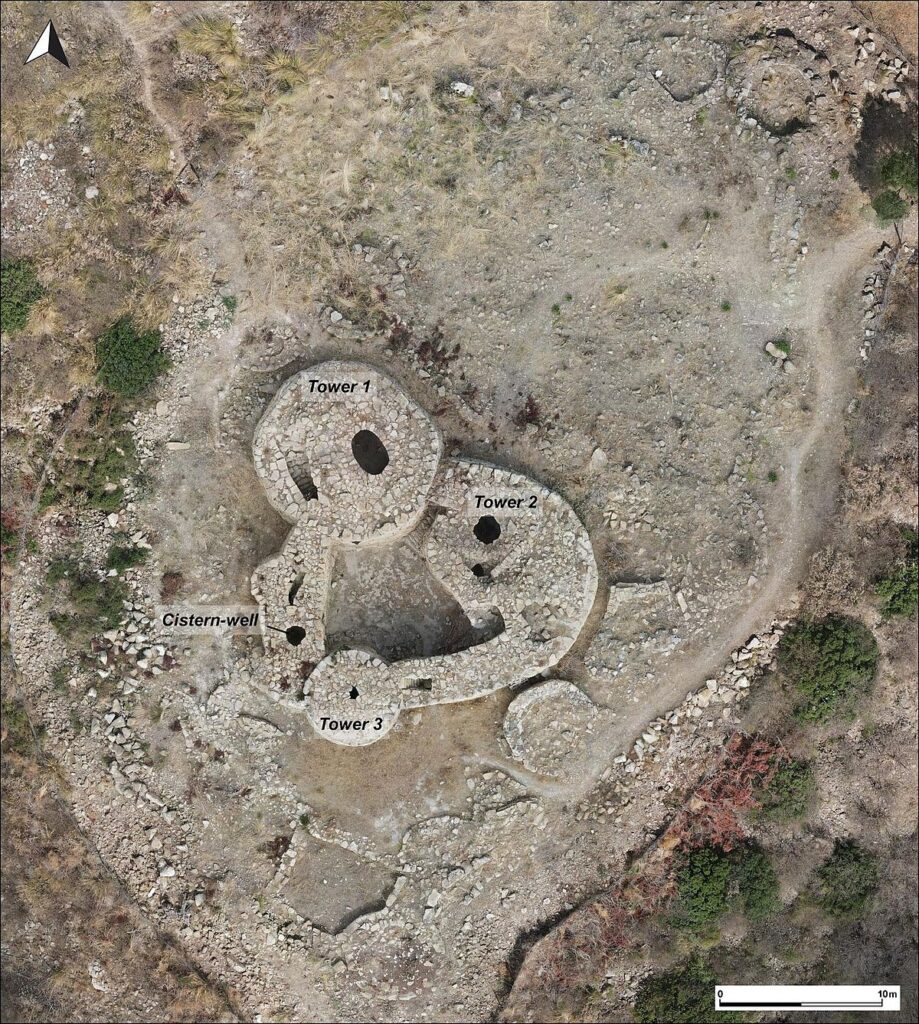
Nuraghe Barru lies in the historical Trexenta region, near the municipalities of Guamaggiore and Guasila. The site consists of a multi-towered nuraghe and an adjacent village whose full extent is still unknown. Earlier excavations showed that the tower complex had been built through successive additions, probably during the Middle or Late Bronze Age. Later work revealed something more unusual inside the western wall of the monument: a cistern-well connected to a staircase leading toward the upper level.
A sealed well filled with broken offerings
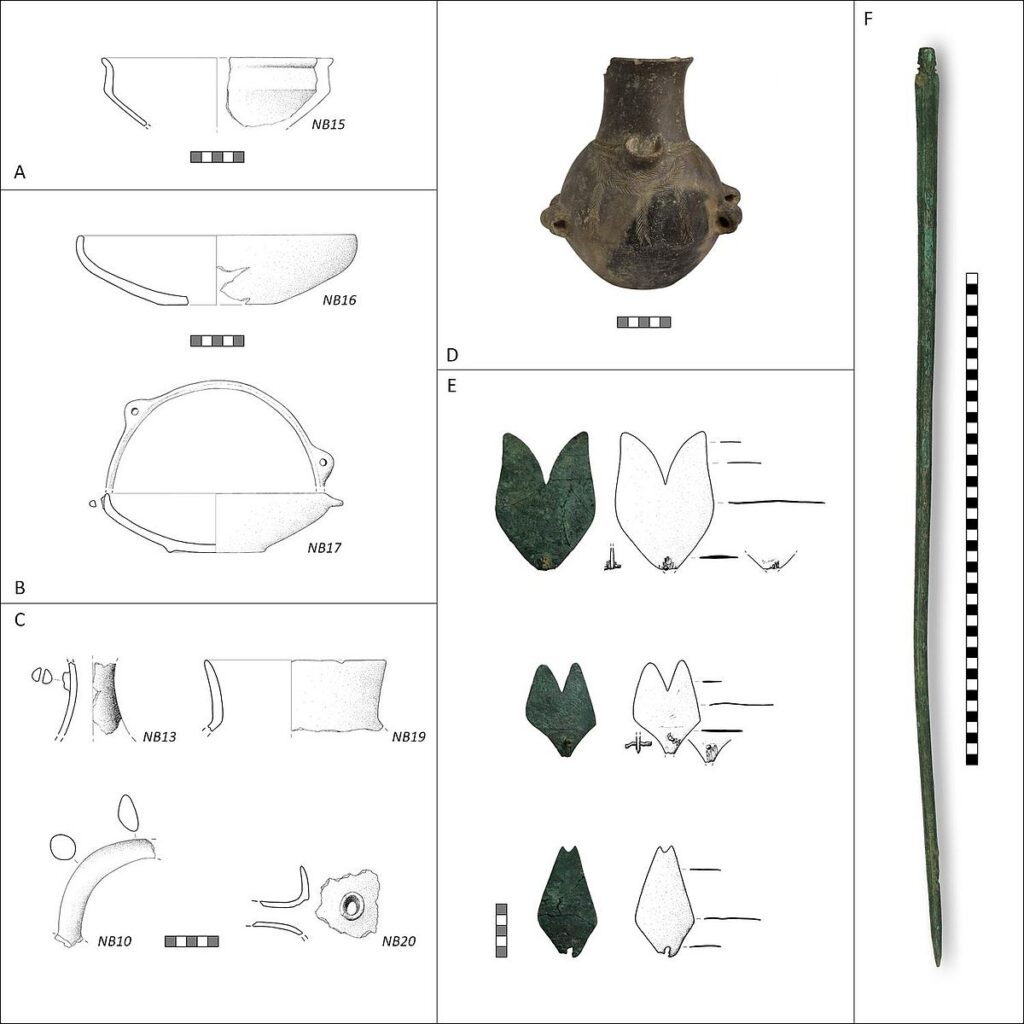
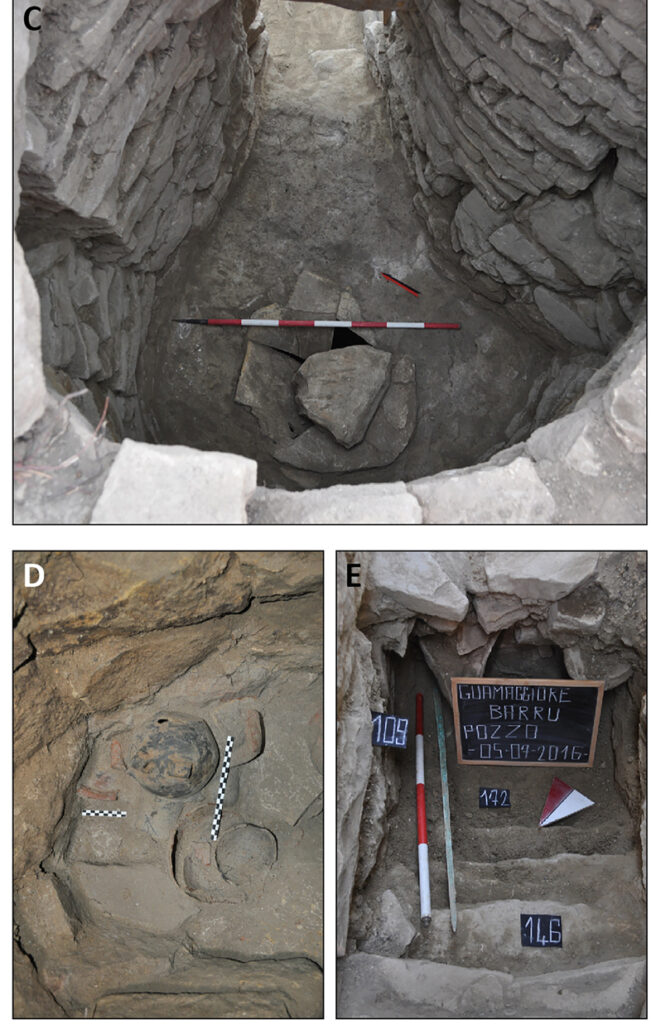
The cistern-well became one of the most important features of the study. According to Dr. Chiara Pilo of the local Soprintendenza, who led the excavation work at the site, the bottom of the well contained a group of deliberately broken ceramic vessels. These included jugs, a miniature amphora and a rare four-handled ceremonial vessel. Animal and human remains had also been placed inside. Afterward, the well was carefully sealed with limestone slabs.
That sealing is important. The objects do not look like ordinary rubbish thrown into a disused structure. Their placement, fragmentation and closure suggest a formal ritual act. Pilo explains that the finds point “rather to an episode of ritual actions than to randomly discarded objects.” In other words, the people who entered this old tower were not simply cleaning, dumping or repairing. They were changing the meaning of the building.
The ceramic assemblage itself also tells a story. The scientific paper, published in Open Archaeology, identifies at least 23 vessels from the cistern-well, along with the decorated four-handled ceremonial vessel. Some forms, including askoid jugs and bowls, are known in Nuragic contexts and may be linked to the serving or pouring of liquids. In a cistern-well, such vessels may have carried meanings connected with water, offering, feasting or purification.
The unusual miniature amphora strengthens the ritual interpretation. Miniature vessels often appear in sacred or symbolic settings because their value is not practical. They are made to represent, dedicate or communicate.
A bronze sword that was not made for battle
The most striking object from Nuraghe Barru is the bronze sword found near the staircase. It measures 94 centimeters long, but the study suggests it was not a functional weapon. Its slender form and metal composition fit the pattern of Nuragic votive swords, objects made for symbolic or ceremonial use rather than combat.
The team also found three bronze objects resembling razors, along with a lump of copper. Portable X-ray fluorescence analysis showed that the sword and razor-like objects were made from copper-rich alloys with low tin content. That composition supports the interpretation that they were symbolic items, not tools designed for long practical use.
The razor-like objects are especially interesting because similar forms are known from mainland Italy during the Early Iron Age. Yet the Barru examples do not appear to be straightforward imports. Their composition suggests local or regional production, even if their shape may reflect wider cultural contacts. This places Nuraghe Barru inside a broader Mediterranean world where objects, styles and ideas moved between Sardinia, mainland Italy and other regions.
After the metal objects were placed by the staircase, access to the upper floor was blocked. This was another deliberate architectural act. The building was not just used for ritual. It was physically altered by ritual.
Pottery from distant parts of the island
The University of Tübingen-led team combined archaeology, geology and materials science to understand where the objects came from. Thin-section petrography, a method that identifies minerals in pottery, showed that most of the vessels from the cistern-well were not made locally.
Of eight ceramic fabric groups identified in the study, seven were considered non-local. Some vessels may have come from nearby areas around 10 kilometers away. Others likely came from regions more than 40 kilometers from Barru. This suggests that the ritual deposit drew together objects from different parts of Sardinia.
For Amicone, this is one of the most important results. The materials used at Barru reflect a wider pattern of exchange across the island. People, goods and ideas were moving through Sardinia, and Nuraghe Barru may have been one of the nodes in that network.
That interpretation changes the image of the site. Barru was not an isolated rural ruin. It was connected to other communities through movement, exchange and shared ritual behavior.
Old towers in a changing religious world
The Barru evidence belongs to a wider transformation in Nuragic Sardinia. Between the Final Bronze Age and Early Iron Age, new sacred wells, sanctuaries, circular shrines and temple-like buildings appeared across the island. These new cult places became important centers of ritual, power and exchange.
But Nuraghe Barru shows that older towers did not necessarily lose their authority. Some were reused, reinterpreted and incorporated into new spiritual practices. Dr. Gianfranca Salis, scientific director of the ongoing excavations for the Soprintendenza, describes Barru as a well-documented case of an active Iron Age center where ritual, identity and social power were negotiated during a period of change.
That phrase is crucial. The finds are not only religious objects. They speak to identity and authority. In many ancient societies, ritual was not separate from politics or social hierarchy. A community that gathered objects from different regions, placed them inside an ancestral tower, deposited a symbolic sword and sealed access to part of the monument was making a powerful statement about memory, legitimacy and belonging.
The old tower still mattered because it carried the weight of the past.
A rare window into Nuragic belief
The study does not claim that all nuraghi became temples. The researchers are careful on this point. Barru is a specific case, and the evidence does not represent every tower on the island. But it adds to growing evidence that some Bronze Age monuments remained meaningful long after their original construction.
The votive sword is particularly rare. According to the study, it is only the second intact votive sword found inside a nuraghe, making it an important comparison for future research on Nuragic ritual deposits.
The meaning of the ritual remains open. It may have been connected to water, drought, hunting, warfare, elite display, or communal renewal. What is clearer is the sequence of action: vessels were broken and placed in a well, remains were deposited, the well was sealed, metal offerings were placed near a staircase, and access was blocked. These were not accidental traces. They were choices.
Professor Karla Pollmann, Rector of the University of Tübingen, said the study shows how interdisciplinary research can produce a fuller picture of past worlds. At Nuraghe Barru, that picture is unusually vivid. A Bronze Age monument did not simply fade into ruin. It became a stage where an Iron Age community reworked its relationship with ancestors, sacred space and power.
More than 3,000 years later, the sealed well and the bronze sword still preserve that moment of transformation.
Amicone, Silvia, Tiezzi, Valeria, Broisch-Höhner, Manuela, Freund, Kyle P., Heinze, Lars, Morandi, Lionello F., Salis, Gianfranca and Pilo, Chiara. “Ritual and Connectivity in Nuragic Sardinia: An Interdisciplinary Study of Ceramics and Metalwork from Nuraghe Barru” Open Archaeology, vol. 12, no. 1, 2026, pp. 20250078. https://doi.org/10.1515/opar-2025-0078
Cover Image Credit: Aerial view of the Nuraghe Barru archaeological site in south-central Sardinia. University of Tübingen
