
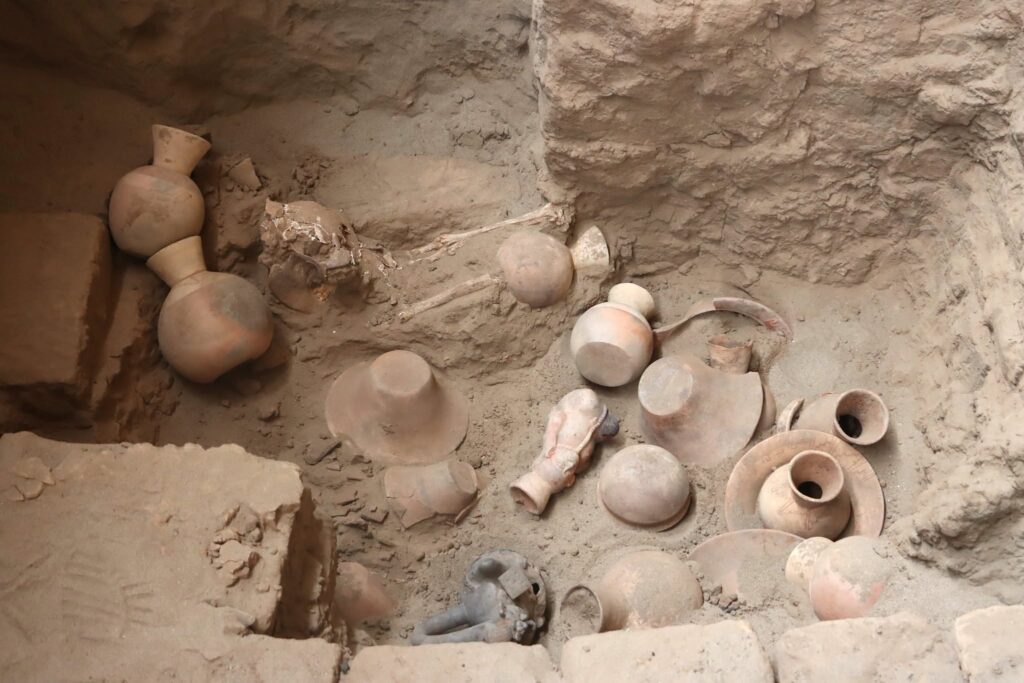
Archaeologists in northern Peru have uncovered an extraordinary Moche grave containing 32 burial offerings, including ceramic objects depicting a bird-like deity and a prisoner with a rope around his neck. Discovered near the ancient temple known as Huaca de la Luna, this tomb may belong to a child from one of the most privileged families in Moche society.
This discovery offers a rare opportunity to examine how the Moche treated their dead during the final stages of their civilization. Although researchers have not yet identified the individual buried in the tomb, the unusually rich collection of offerings and the tomb’s location indicate that this was no ordinary burial.
A Small Tomb with an Exceptionally Rich Collection of Offerings
Researchers from the Huacas de Moche Archaeological Project made this discovery at an archaeological site near Trujillo on Peru’s northern coast. Project director Dr. Carlos Rengifo Chunga presented the findings to officials at the National University of Trujillo (UNT), who announced the discovery on October 6, 2026.
The tomb’s dimensions led archaeologists to believe it likely belonged to a young child. However, the 32 ritual offerings accompanying the burial tell a potentially different story about the deceased’s status in society.
In Moche culture, funeral arrangements generally reflected social distinctions; individuals of high status were accompanied by carefully prepared grave goods. The newly discovered grave raises the possibility that some children may have inherited privileged positions within their communities; however, researchers have not yet confirmed whether this was actually the case.
The tomb’s proximity to Huaca de la Luna adds another important dimension to the matter. The temple served as one of the Moche civilization’s primary religious centers; this makes the burial site’s location particularly significant in terms of social identity and ceremonial privilege.
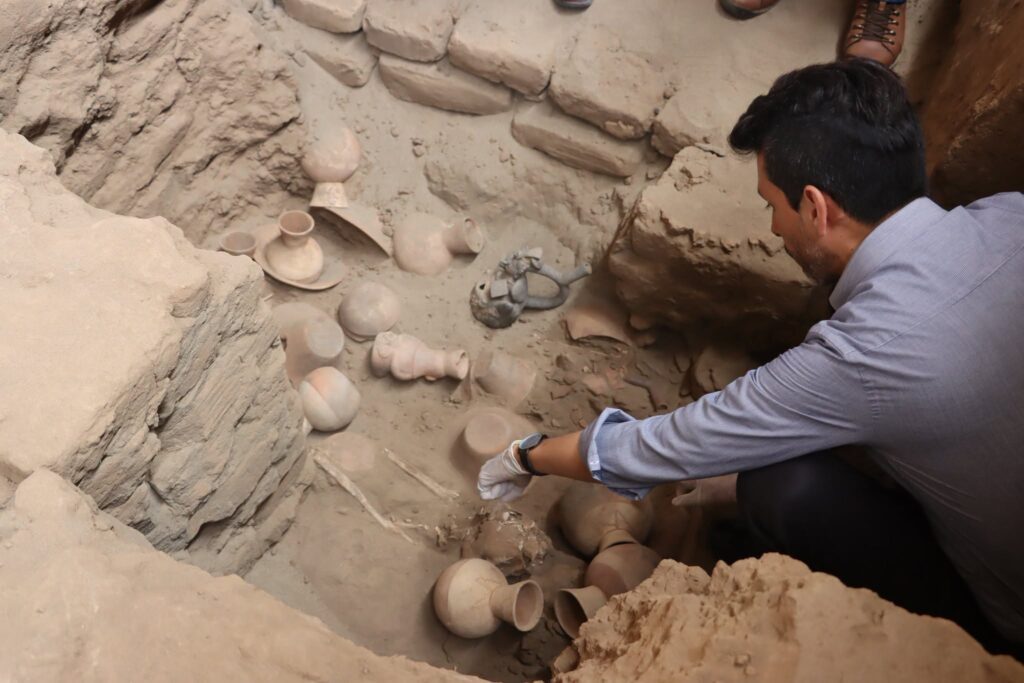
A researcher examines skeletal remains and ceramic offerings inside the newly discovered Moche tomb at the Huacas de Moche archaeological complex in northern Peru. Credit: National University of Trujillo (UNT)
A Bird-Like God and a Prisoner with a Rope Around His Neck
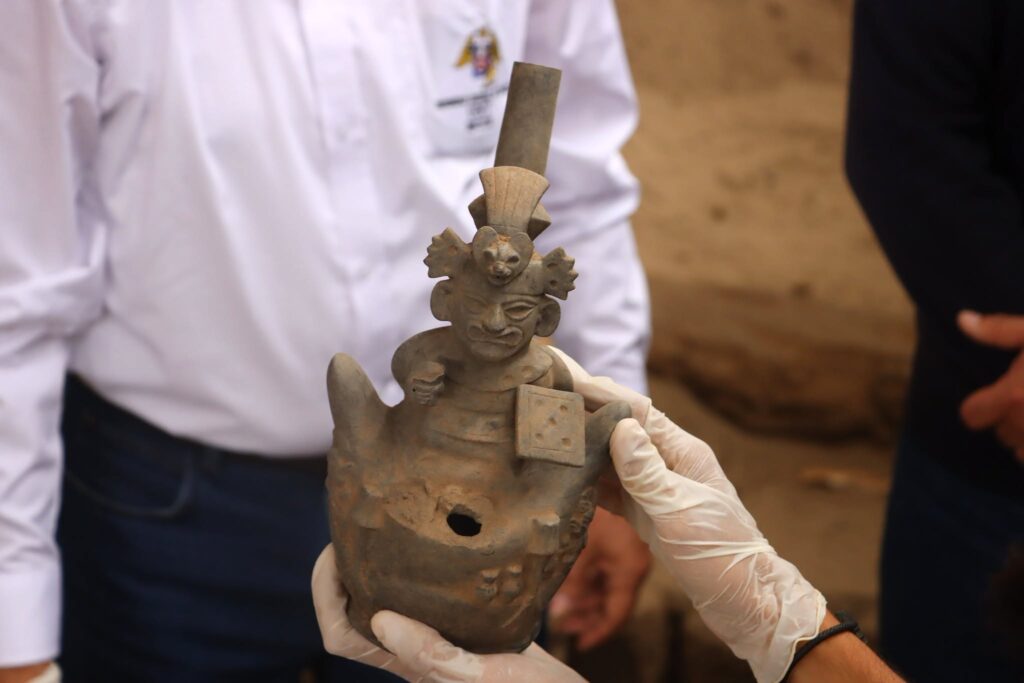
Among the 32 votive objects, two ceramic pieces stand out due to their unusual depictions. Both offer insights into the symbolic world of the Moche, who used the art of pottery to depict gods, warriors, captives, animals, and detailed ceremonial scenes.
One object depicts a god with ornithomorphic features, combining human and bird characteristics. Such hybrid figures were part of the Moche people’s complex religious imagery, which often represented supernatural beings through the fusion of human and animal traits.
The second ceramic object depicts a prisoner with a rope around his neck. This detail is particularly striking because bound captives frequently appear in Moche art, including the monumental decorations of the Huaca de la Luna.
On the temple’s famous ornate façade, victorious warriors are leading away naked prisoners with ropes tied around their necks. Other images depict supernatural beings, ceremonial activities, and figures associated with violence and sacrifice.
The similarity between the newly discovered ceramic prisoner and the temple’s broader visual tradition provides an intriguing connection. However, archaeologists have not yet been able to determine whether the object refers to a specific ritual, religious narrative, or event.
In this context, the most obvious question to ask is why such depictions were included in a child’s burial. These intriguing objects may offer valuable insights into the connections between religious symbolism, social status, funerary rituals, and beliefs about death in Moche society.
Huaca de la Luna and the Religious World of the Moche
The Huacas de Moche archeological complex houses the ruins of one of the most important urban and ceremonial centers of the Moche culture, which thrived on Peru’s northern coast throughout the first millennium AD.
The landscape is dominated by two monumental adobe structures: Huaca del Sol and Huaca de la Luna. While the former served as a major political and administrative center, the latter functioned primarily as a religious and ceremonial complex. Between them lies an extensive urban settlement comprising residences, streets, workshops, and public spaces.
Huaca de la Luna is particularly famous for its monumental architecture and exceptionally well-preserved polychrome murals. Its walls feature scenes depicting warriors, prisoners, supernatural beings, and the close relationship between religious rituals and political authority.
Decades of excavations have also uncovered evidence of ritual violence and human sacrifice practices within the temple. Together with its intricate architectural layout, these discoveries demonstrate that religious institutions played a central role in organizing Moche society and maintaining distinctions between social groups.
This newly discovered tomb dates to a later phase of the Moche civilization, a period of significant political and social transformations. Consequently, the artifacts found in the tomb may provide valuable evidence regarding whether established funeral traditions continued or underwent changes during these final generations.
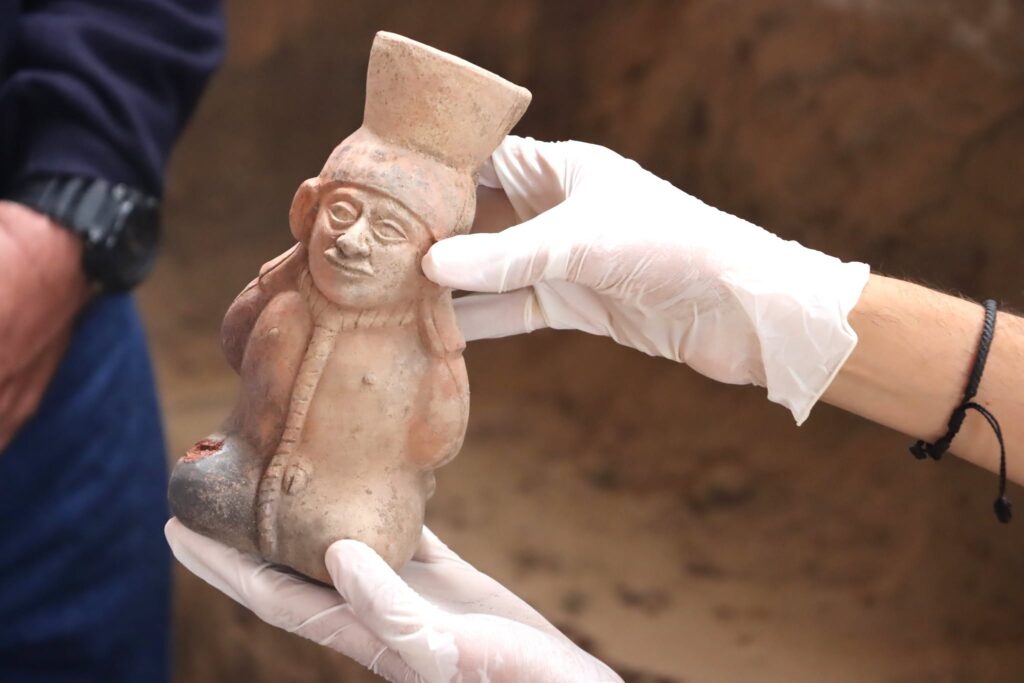
A Moche ceramic vessel depicting a prisoner with a rope around his neck, one of the remarkable artifacts recovered from the tomb. The figure offers a glimpse into the symbolism of captivity in Moche culture. Credit: National University of Trujillo (UNT)
Unanswered Questions About a Child’s Final Journey
The most pressing questions at this point concern the identity of the tomb’s occupant and the meaning of the objects placed within it. Researchers must determine whether the tomb truly belonged to a child of privileged status and how the burial arrangements here compare to those in other Moche tombs.
Two very remarkable ceramic objects provide an additional area of inquiry, connecting the tomb to religious images typical in Moche ceremonial life. The presence of these objects does not necessarily imply that the tomb’s inhabitant took part in the described ceremonies; nonetheless, they may suggest which beliefs and symbols were important to people who organized the burial.
For the time being, this tomb provides intriguing insights into a society in which even the method in which a child is buried may represent religious identity and lineage-based privileges. Further investigation may show if these 32 offerings were left to honor a young member of the Moche aristocracy, or if they represent a more sophisticated funeral practice that archeologists are only now learning about.
