

Archaeologists excavating the ancient urban center of Huacas de Moche in northern Peru have uncovered the burial of a child who died at around one to one and a half years of age. The roughly 1,500-year-old grave contained an unusually evocative group of offerings, including two whistles, a rattle, and a sculptural ceramic vessel.
The Moche child burial emerged from Architectural Complex 61, a residential sector within the urban core that once stretched between the monumental Huaca del Sol and Huaca de la Luna near present-day Trujillo. Rather than coming from one of the site’s imposing ceremonial monuments, the discovery places funerary practices directly within a part of the settlement where archaeologists are investigating everyday Moche life.
A child buried with sound-making objects
Archaeologist Jermi Mejía López, who described the discovery during the presentation of the latest excavation results, said the child’s burial followed a characteristic Moche funerary pattern. Archaeologists found the body lying down with the head oriented toward the south and the legs toward the north.
Beside the young child were two whistles, a rattle, and a sculptural vessel. Although researchers have not yet established exactly what these objects meant in this particular burial, their deliberate placement makes them important evidence for understanding how the Moche treated their youngest members in death.
The presence of whistles and a rattle is especially striking because these were objects capable of producing sound, but archaeologists have not claimed that they were toys or that they belonged to the child during life. Further study of the burial context and the objects themselves may help clarify whether they carried ritual, symbolic or personal significance.
Carlos Rengifo, director of the Huacas de Moche Archaeological Project, described child burials at the site as relatively uncommon. He said the continuing excavations are helping researchers investigate both funerary and ritual practices among people who lived there around 1,500 years ago.
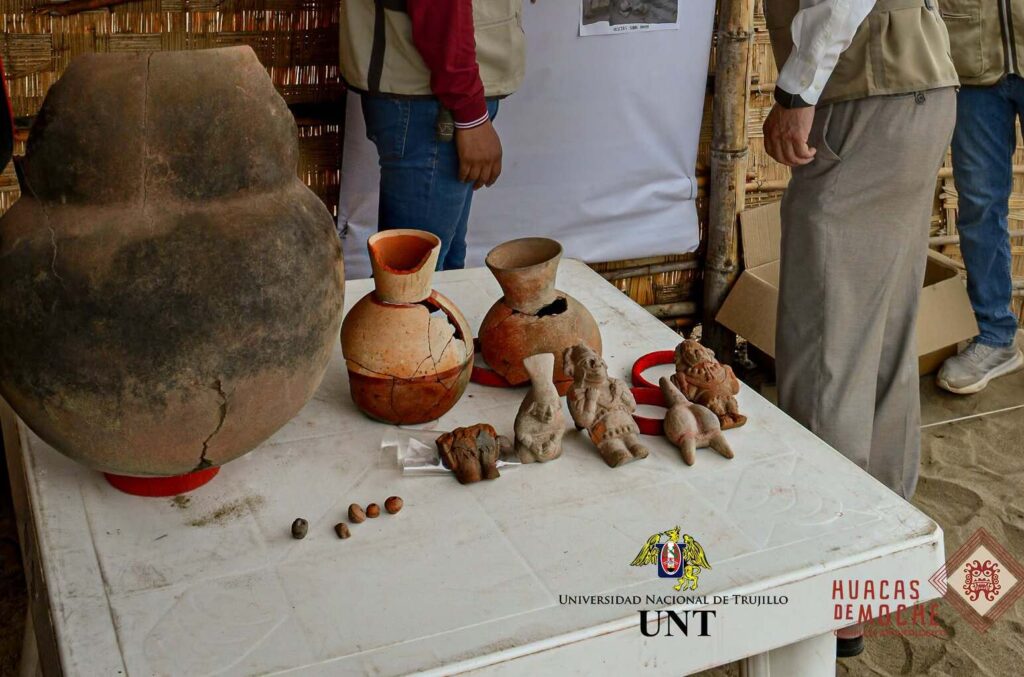
Researchers at the Huacas de Moche Archaeological Complex uncovered the burial of a child about 18 months old in the ancient urban center, accompanied by offerings including whistles, rattles, and a sculptural vessel. Credit: Huacas de Moche via Facebook
A grave inside the ancient Moche city
The location of the burial adds another dimension to the discovery. Architectural Complex 61 lies in the southern part of the Moche urban core and contains small platforms and dividing walls that created spaces for different activities.
Archaeologists have also recovered domestic pottery associated with the abandonment of the complex. These vessels offer evidence about food, household activities, and the ways residents used individual rooms, allowing researchers to reconstruct a setting where daily life and funerary behavior existed within the same broader urban landscape.
That perspective matters at Huacas de Moche, a site internationally known for its monumental architecture and elaborate religious imagery. Huaca de la Luna served as a major ceremonial center with richly decorated walls, while Huaca del Sol became one of the largest adobe structures in pre-Hispanic America. Between them, however, stood a functioning city of plazas, streets, workshops, residences, corridors, and canals.
The new excavation is therefore shifting attention from monumental temples toward the people who occupied the spaces around them.
Looking beyond Moche temples and elites
The Moche developed along Peru’s northern coast during the first millennium AD and became renowned for sophisticated ceramics, metalworking, monumental adobe construction and complex religious imagery. The Huacas de Moche project dates the development of the site’s major Moche center broadly between about AD 200 and 850.
Archaeological research at Huacas de Moche has continued for more than three decades under the direction of the Universidad Nacional de Trujillo. While earlier work revealed spectacular architecture, murals and ceremonial contexts, current research in the urban sector is asking more intimate questions: how residents organized their homes, what they ate, which objects they used and how they treated their dead.
Excavators are documenting Architectural Complex 61 through graphic, photographic, elevation, video, and aerial records before moving into deeper archaeological layers. Those layers may reveal how the complex changed through time and whether earlier phases of occupation survive beneath the structures currently exposed.
The current excavation stage is expected to conclude after approximately a month. Researchers then plan to protect the exposed area with clean sand as a precaution against possible heavy rainfall associated with El Niño conditions.
For now, the small grave offers a particularly human glimpse into this ancient city. Among the monumental adobe temples and traces of households that once filled Huacas de Moche, archaeologists have found evidence of a community that buried a very young child carefully, and placed four objects beside them before closing the grave.
