

Archaeologists at Çayönü Tepesi in southeastern Türkiye have uncovered a roughly 5-square-meter mining workshop dating to 6900–6800 BCE, complete with raw and worked malachite, copper objects, and a stone-paved working area. The discovery provides a rare glimpse not simply of the materials Neolithic people were using, but of how production itself was organized within one of Southwest Asia’s most important early settlements.
The workshop came to light during the 2026 excavations at Çayönü, near Ergani in Diyarbakır Province. Excavations are being directed by Associate Professor Savaş Sarıaltun of Çanakkale Onsekiz Mart University.
According to information released by Türkiye’s Ministry of Culture and Tourism, archaeologists identified the workshop in the western part of the settlement. At least six postholes surrounded the approximately five-square-meter area, while a stone-paved working surface occupied its center.
The arrangement is one of the most revealing aspects of the discovery. The postholes may indicate that a light structure or canopy once covered the workspace, suggesting that the area had been deliberately prepared for production rather than representing an accidental concentration of discarded material.
Different stages of production survived in the same place
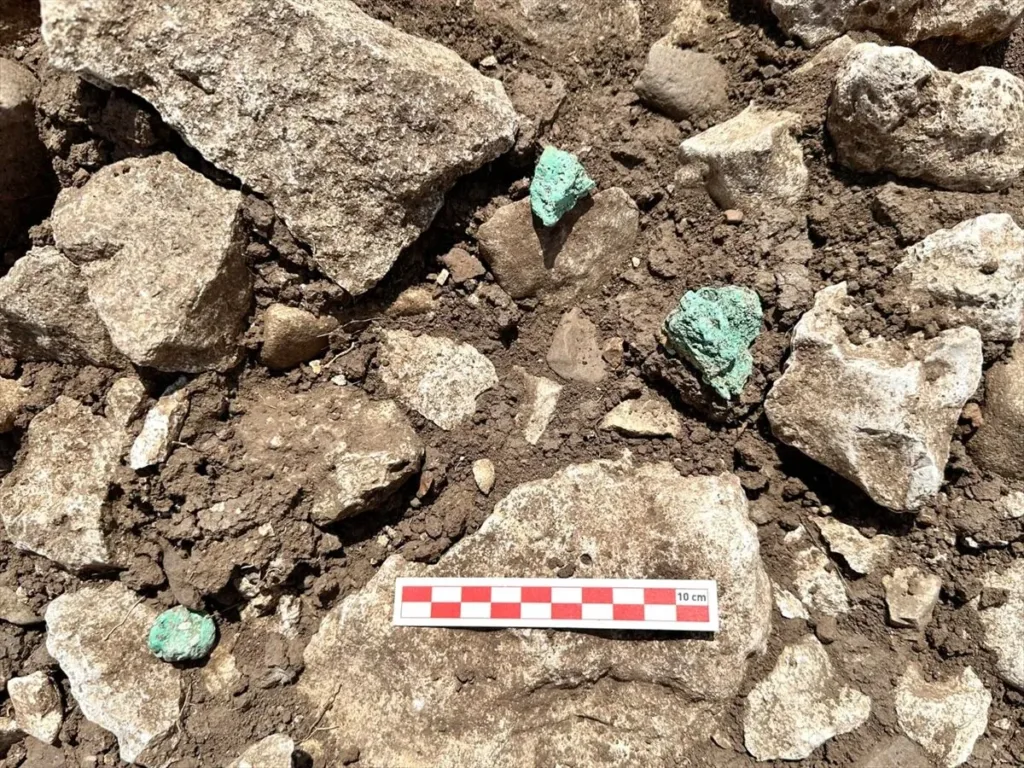
Inside the center of the workshop, archaeologists recovered 18 pieces of malachite. A further 24 to 25 examples were recorded within the workshop and its immediate surroundings, while the wider excavation area has so far produced approximately 42 malachite and copper finds.
These include raw malachite, partly processed pieces, worked malachite, copper beads and other copper objects. Their occurrence together gives the workshop particular archaeological value because several stages of handling and transforming the material can be examined within the same context.
A finished copper object can reveal that a community possessed and used metal. A production area containing raw material alongside partly worked and completed pieces can potentially reveal considerably more: where the work took place, how materials moved through different stages and whether particular activities were concentrated in designated parts of a settlement.
That distinction places the new discovery in a broader story already documented at Çayönü.
Copper and malachite had been used at Çayönü for millennia
Minister of Culture and Tourism Mehmet Nuri Ersoy, announcing the discovery, said evidence for the use of copper and malachite at Çayönü extends back to around 9100 BCE. He described the new workshop as evidence that this tradition continued for approximately two millennia and that specialized production activities were taking place in defined working areas.
Çayönü has long occupied an important position in research into early copper technology. Archaeological studies have shown that communities in Anatolia and northern Mesopotamia were working native copper and copper minerals thousands of years before metal became a commonplace material.
Earlier finds from Çayönü have played a significant role in that discussion. Research on prehistoric metallurgy has identified the settlement among the early sites where native copper was worked, including evidence for techniques such as hammering and annealing: the controlled heating of copper during manufacture.
The new workshop adds something different to that record. Instead of another isolated copper or malachite object, archaeologists now have a defined working area containing material at several stages of processing.
What does a “mining workshop” mean here?
The official announcement describes the newly uncovered area as a “mining workshop.” In this context, the term is most useful as a description of a workspace associated with malachite and copper production; the archaeological significance comes from the combination of raw material, worked pieces, finished objects and the physical organization of the area.
Early copper technology also covered a range of practices that should not automatically be equated with the much later large-scale metallurgy of furnaces and intensive ore processing. Neolithic craftspeople could select and shape copper minerals such as malachite while also working naturally occurring metallic copper through techniques including hammering and heating.
This distinction does not lessen the importance of the Çayönü discovery. On the contrary, it helps place the workshop within the much longer technological process through which communities gradually developed increasingly specialized knowledge of minerals and metals.
A five-square-meter space with a much larger story
Çayönü was occupied during a period of profound change in Southwest Asia. Its archaeological sequence has provided evidence for the development of permanent settlement, changing architecture, food production, and increasingly specialized forms of craft activity.
The 2026 excavations are now adding further evidence for that continuity. In the same western sector, archaeologists recovered pottery associated with the early Pottery Neolithic and the Proto-Hassuna cultural tradition, provisionally dated to around 6800–6600 BCE.
Radiocarbon dating and additional archaeometric analyses are expected to refine the chronology of these deposits. Those studies may also help establish a more detailed relationship between the workshop, surrounding occupation layers and the later phases represented in this part of Çayönü.
For now, the significance of the workshop rests on an unusual combination of evidence. Archaeologists can identify the working area architecturally, examine raw and partly processed material within it and compare those finds with finished copper and malachite objects.
That makes the discovery more than another addition to Çayönü’s already extensive inventory of early copper finds. It provides a physical setting in which one of the settlement’s long-lived technological traditions was actually practiced, bringing archaeologists closer to understanding how specialized production became part of everyday life in a Neolithic community.
