
8 November 2025 The Future is the Product of the Past

8th-Century Tang Dynasty Tomb Unearthed in China Reveals Vivid Murals — and a Blond Foreigner

Archaeologists in northern China have uncovered an exceptionally preserved 8th-century Tang dynasty tomb whose breathtaking murals offer a window into everyday life — and feature a mysterious blond-haired foreigner.

A Rare Glimpse into Daily Life in Ancient China

Discovered near Taiyuan, the capital of Shanxi Province, the tomb dates back to A.D. 736 and belonged to a 63-year-old man and his wife. The find was first made in 2018 during road construction, but only now have researchers revealed the full scope of its astonishing artistry.

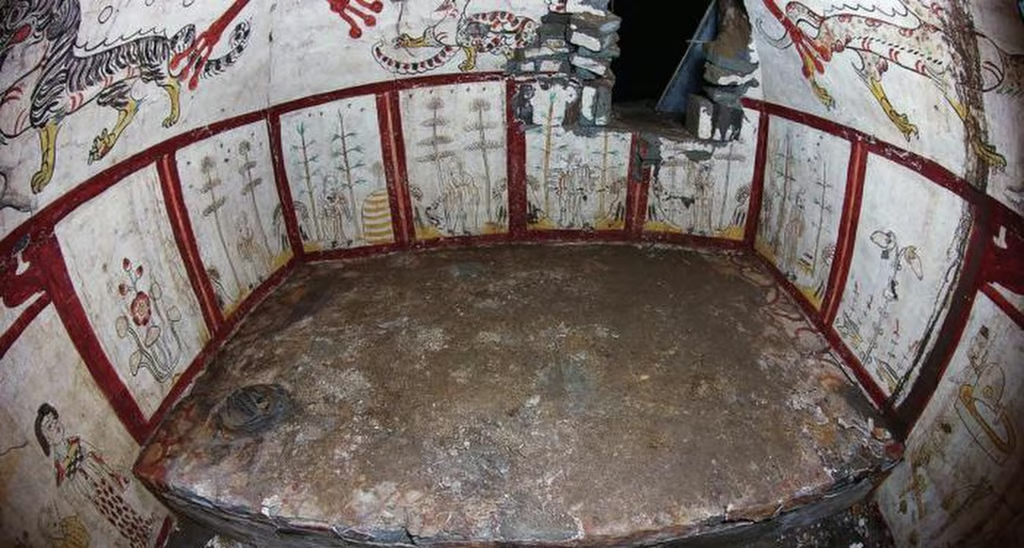
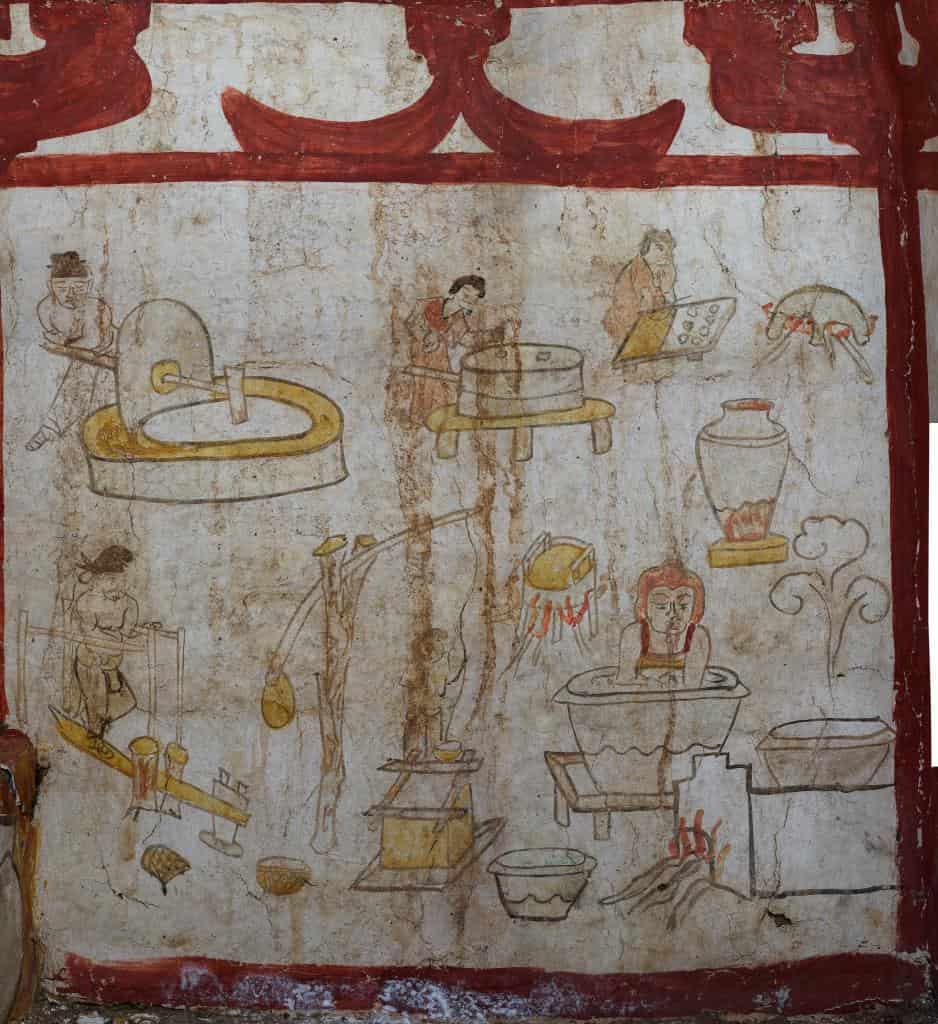
Every inch of the tomb’s walls — except the floor — is covered in vivid murals depicting scenes of Tang-era life. Farmers thresh grain, women fetch water from wells, cooks prepare noodles, and attendants lead horses and camels. These beautifully preserved scenes capture the daily rhythm of ordinary people during China’s golden age of culture, trade, and art.

The Blond Foreigner in the Tomb

Among these depictions, one figure stands out: a man with blond hair and a beard, painted with striking realism. Archaeologists believe this man was likely a Sogdian merchant from Central Asia, a region stretching across modern Uzbekistan and Tajikistan.

During the Tang dynasty (618–907), the Silk Road brought an unprecedented level of cultural exchange. Foreign traders, musicians, and diplomats flocked to the Chinese capital of Chang’an (modern Xi’an) — then one of the most cosmopolitan cities on Earth. The presence of a fair-haired figure in the Taiyuan tomb reflects that vibrant internationalism.


📣 Our WhatsApp channel is now LIVE! Stay up-to-date with the latest news and updates, just click here to follow us on WhatsApp and never miss a thing!!


Every inch of the tomb’s walls — except the floor — is covered in vivid murals depicting scenes of Tang-era life. Farmers thresh grain, women fetch water from wells, cooks prepare noodles, and attendants lead horses and camels. Credit: Shanxi Provincial Institute of Archaeology.

Who Were the Sogdians?

The Sogdians were an ancient Iranian people renowned as the great middlemen of the Silk Road. From their urban centers in Samarkand and Bukhara, they facilitated the flow of silk, spices, precious metals, and ideas between China, Persia, India, and Byzantium.

Historical and genetic evidence shows that some Sogdians possessed light hair and eyes, the result of centuries of intermingling between Indo-Iranian, Turkic, and steppe nomadic groups. Chinese texts from the Tang era even describe Sogdians as fair-haired and sharp-featured, often employed as traders, entertainers, or envoys in China’s frontier cities.

Artistry and Symbolism

The tomb’s single brick chamber features murals painted in a distinctive Tang style, characterized by bold outlines and delicate shading against a white background. Scholars refer to this artistic approach as the “figure under the tree” style — an aesthetic tradition dating back to the Han dynasty.

The domed ceiling is adorned with images of a dragon and a phoenix, symbols of imperial power and immortality. Near the entrance, guards in yellow robes stand watch, their swords drawn — traditional “tomb guardians” meant to protect the deceased in the afterlife.

According to Long Zhen, director of the Jinyang Ancient City Archaeological Institute, the artistic techniques resemble those found in the tomb of Wang Shenzi, a 9th-century ruler. However, the Taiyuan murals focus not on emperors or battles, but on everyday people — a rare and humanizing subject in Tang funerary art.
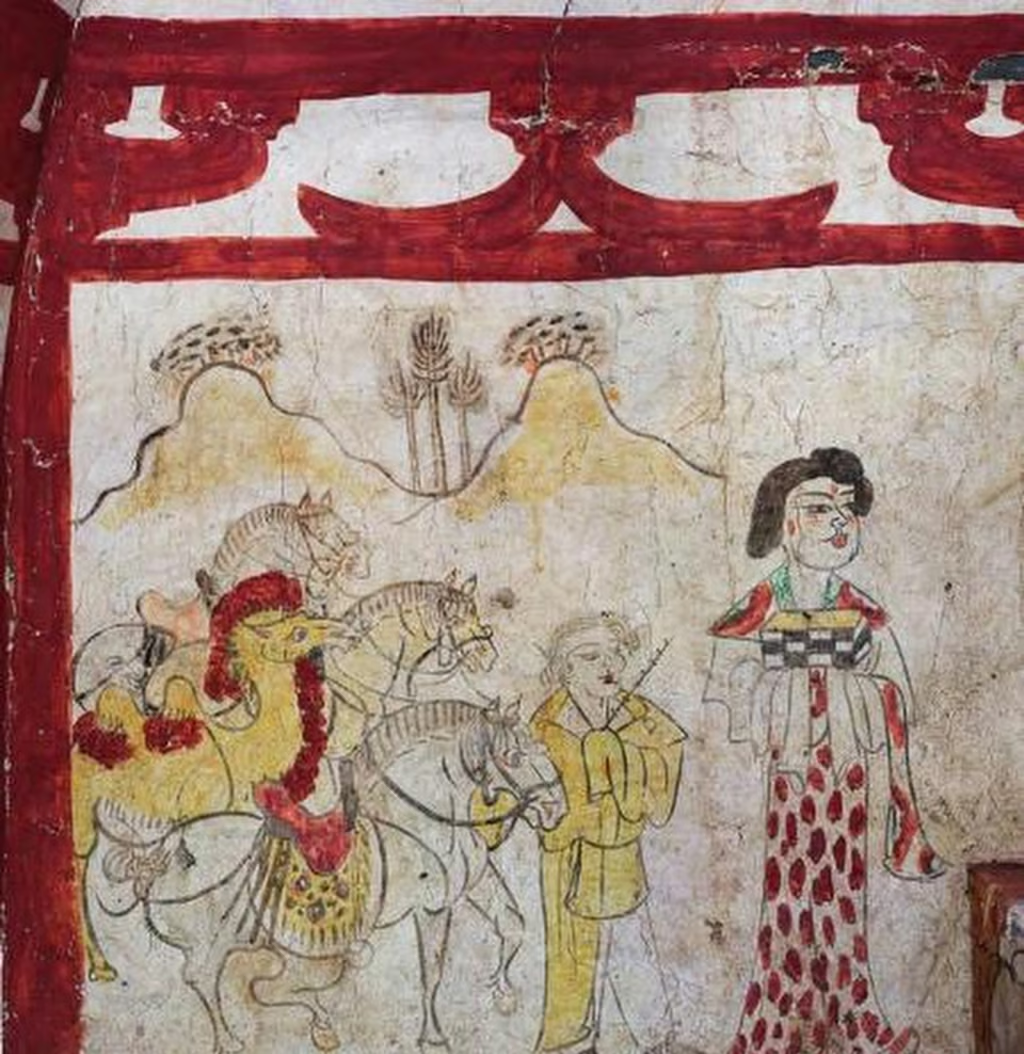
The figures depicted throughout the mural look like the same two people, prompting archaeologists to speculate that they were the owners of the tomb. Credit: Shanxi Provincial Institute of Archaeology.

A Window into the Tang Dynasty’s Cosmopolitan World

The exceptional preservation of these murals offers a “never-before-seen” look at the daily lives of Tang-era commoners. Many of the figures appear to be repeated, suggesting that they depict the tomb’s occupants themselves — captured in an eternal portrait of their worldly lives.

This discovery joins a rich tradition of mural art in China, alongside masterpieces like the Mogao Grottoes of Dunhuang, whose sprawling frescoes line more than 25 kilometers of cave walls. Together, they illuminate a world where China stood at the crossroads of civilizations — a meeting point for East and West connected by trade, faith, and art.

As archaeologists continue to study the Taiyuan tomb, they hope to uncover even deeper insights into how global exchange shaped life, identity, and art in the Tang dynasty — one of history’s most cosmopolitan empires.

Zhang, J., Wang, Y., Zhang, N., Li, J., Qu, Y., Zhu, C., Zhang, F., Cai, D., & Ning, C. (2025). [Unraveling the origins of the Sogdians: Evidence of genetic admixture between ancient central and East Asians]. Journal of Archaeological Science: Reports, 61, 104957. https://doi.org/10.1016/j.jasrep.2024.104957

Cover Image Credit: Xinhua

Related Articles

New study says earliest recorded kiss occurred 4500 years ago in Mesopotamia

18 May 2023

18 May 2023

The University of Copenhagen according to researchers, humanity’s earliest recorded kiss occurred around 4,500 years ago in the ancient Middle...

Huge funerary building and Fayoum portraits discovered in Egypt Fayoum

4 December 2022

4 December 2022

The Egyptian archaeological mission working in the Gerza archaeological site in Fayoum revealed a huge funerary building from the Ptolemaic...

3 mummified skeletons were found in Iznik, western Turkey

8 October 2021

8 October 2021

Archaeologists discovered mummified skeletons dating from the 2nd century A.D. within two sarcophagi at the Hisardere Necropolis in Bursa’s Iznik...

Researchers Discovered Wreckage of a Schooner that Sank in Lake Michigan in Late 1800s

27 July 2024

27 July 2024

Maritime historians from the Wisconsin Underwater Archeology Association discovered the wreckage of a schooner that sank in Lake Michigan in...

Study Reveals Córdoba’s Advanced Sanitation System: A Medieval Model Unmatched in Europe for Centuries

25 April 2025

25 April 2025

Recent research has unveiled the impressive sanitation systems of medieval Córdoba, revealing that the city’s infrastructure was so advanced that...

The discovery that surprised archaeologists; a Rare glass cup adorning the table of rich Romans in Crimea

2 April 2022

2 April 2022

A discovery made in Frontovoye-3 necropolis in Crimea shows that during the Roman Empire there were more centers of glass...

A cemetery belonging to 54 children was found during the excavation in the old quarry in Diyarbakır, Türkiye

4 January 2024

4 January 2024

During the archaeological excavation carried out in the area considered to be an old quarry in the Kulp district of...

From Arnhem to Oldenburg: Nazi-Looted Artifacts Found in Oldenburg Museum Colection

30 August 2025

30 August 2025

A remarkable discovery at the Landesmuseum Natur und Mensch in Oldenburg has shed new light on the dark history of...

14,000-year-old settlement discovered in western Turkey

26 November 2021

26 November 2021

During the rescue excavation carried out in a cave in Dikili, İzmir, in western Turkey, 14 thousand-year-old stone tools and...

In southern Turkey, the remains of a Roman villa whose floor was decorated with geometrically patterned mosaics were unearthed during construction

13 July 2022

13 July 2022

Workers working to lay the foundation of a new building in the Defne district of Hatay, southern Turkey, by accident...

Digital Pathways to the Hittite World – AI Meets Ancient Anatolia

29 October 2025

29 October 2025

A groundbreaking project is opening new digital routes to the ancient world of the Hittites. Under the title “Digital Pathways...

A new chapter in the Hittite world is revealed by painted hieroglyphs discovered in the Hattusa Yerkapı tunnel

30 April 2024

30 April 2024

The painted hieroglyphs discovered in 2022 in the Yerkapı Tunnel in Hattusa, the capital of the Hittites, one of the...

‘Mysterious’ inscription on ancient Dacia sphinx is deciphered

3 January 2024

3 January 2024

The mystery of the inscription on the bronze sphinx statue discovered in the early 19th century was solved 200 years...

1500-Year-Old Petroglyphs Found in Central Iran

13 April 2021

13 April 2021

Researchers have discovered 70 petroglyphs carved into the rock that they think is from the Sassanid era. The petroglyphs were...

A 3200-year-old trepanned skull discovered in eastern Turkey’s Van province

12 November 2022

12 November 2022

A 3200-year-old trepanned skull was discovered in eastern Turkey’s Van province. In the prehistoric era, Anatolia served as a transitional...