
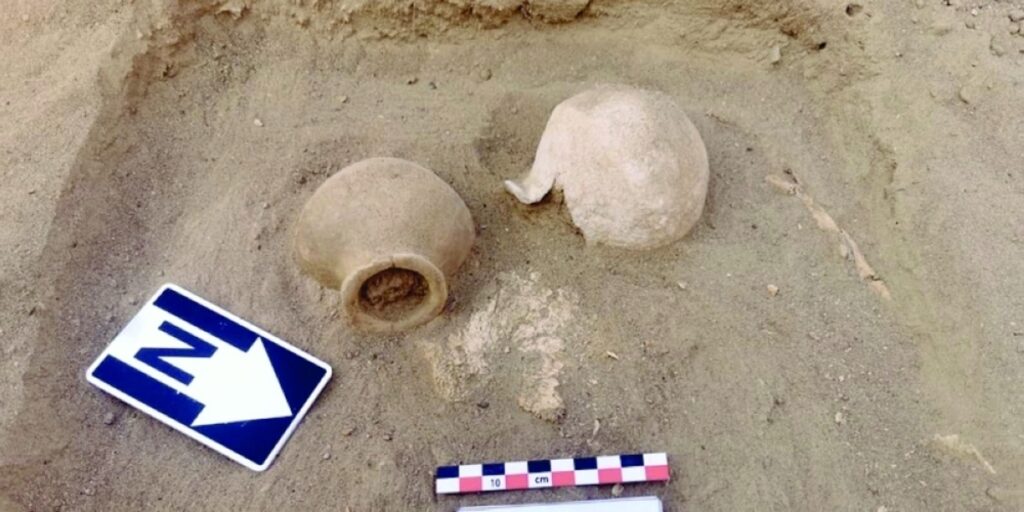
Rescue excavations in northwestern Oman have uncovered approximately 5,000-year-old burial chambers containing human remains, intact pottery vessels, and copper and bronze objects. Omani officials associate many of the finds with Mesopotamia’s Jemdet Nasr culture.
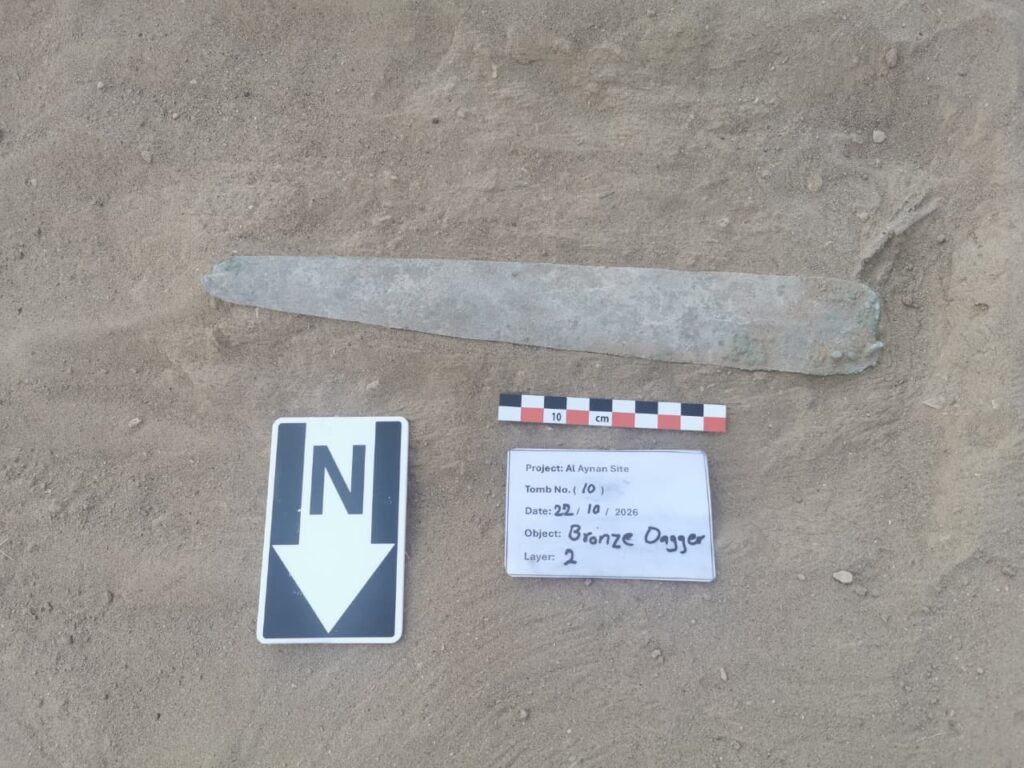
Archaeologists working in a residential development area in Oman have discovered ancient burial chambers containing human skeletal remains and pottery vessels that survived intact. The excavations at Al Aynain, near the city of Ibri, also produced daggers, axes, arrowheads, and numerous beads dating to the third millennium BCE.
The discoveries came during a rescue excavation undertaken by the Department of Heritage and Tourism in Al Dhahirah Governorate. With modern construction threatening archaeological remains in the area, the team began documenting the tombs and recovering objects that might otherwise face destruction.
Bronze Weapons and Pottery from Ancient Burials
Walid bin Hamad al Ghafri, director of the Department of Heritage and Tourism in Al Dhahirah, described the discoveries in a statement to the Oman News Agency (ONA).
According to the statement, archaeologists recovered complete pottery vessels alongside skeletal remains inside burial chambers. The excavations also yielded copper and bronze artifacts, including arrowheads, axes, and daggers, as well as a substantial collection of beads.
Omani officials associated many of the remains with the Jemdet Nasr culture of Mesopotamia and dated them to the third millennium BCE. However, the announcement did not explain which archaeological evidence supports that cultural attribution or provide detailed information about the individual tombs.
The rescue operation began in the latter part of October, with excavations scheduled to continue until the end of the month. Officials consider the preliminary findings important for investigating Oman’s historical connections with neighbouring regions.
The Jemdet Nasr Connection
The Jemdet Nasr period takes its name from an archaeological site in southern Mesopotamia, in present-day Iraq. Archaeologists generally date it to approximately 3100–2900 BCE, a transitional period between the late Uruk era and the emergence of Early Dynastic societies.
Distinctive pottery forms and decorative traditions are among the materials researchers use to identify connections with this period. Such objects have also appeared at archaeological sites in Oman, where they contribute to discussions about contact between southeastern Arabia and Mesopotamia around 5,000 years ago.
Earlier excavations near Ibri provide an important comparison. In a 2020 study published by the University of Trieste, archaeologists Massimiliano Ghiro, Sabatino Laurenza, and Enzo Cocca examined Grave 4 at Al Arid, another burial site in the region.
The researchers identified an unusual combination of features. Although the tomb’s architecture resembled the later Umm an-Nar tradition, a small biconical pottery vessel belonged to the earlier Jemdet Nasr ceramic tradition.
The human skeletal remains also appeared in an unexpected location: inside the pottery vessel rather than in the burial chambers, which contained no human remains. The researchers considered the grave a possible transitional example between the Hafit and Umm an-Nar burial traditions.
These findings demonstrate that archaeologists had identified Jemdet Nasr-related material around Ibri before the latest excavations. However, Al Arid and Al Aynain are separate archaeological sites, and the earlier discoveries cannot establish the precise cultural identity of the newly excavated tombs.
Protecting Oman’s Ancient Burial Heritage
At Al Aynain, the immediate priority remains the documentation and protection of archaeological remains threatened by expanding residential development. The rescue excavation offers specialists an opportunity to record burial contexts and recover artifacts before construction permanently alters the site.
The Department of Heritage and Tourism has not yet released a detailed excavation report identifying the number of tombs, their architectural features, or the results of any analysis of the human remains. Those details will be necessary to establish more precisely how the Al Aynain burials fit into the early history of southeastern Arabia.
For the moment, the combination of human remains, complete pottery vessels, and metal objects provides evidence of burial activity in the Ibri area during the third millennium BCE. Further study may clarify whether the newly recovered material reflects the same wider cultural connections documented at other Early Bronze Age sites in Oman.
