
25 June 2026 The Future is the Product of the Past

4,000-Year-Old Sealed Cuneiform Letters from Anatolia Read Without Breaking Their Clay Envelopes

4,000-year-old sealed cuneiform letters from ancient Anatolia have been read without breaking their clay envelopes, thanks to a mobile X-ray CT scanner designed to bring advanced imaging directly into museum collections.

The study, published in npj Heritage Science, marks an important step for Assyriology and cultural heritage science. Many cuneiform tablets from Southwest Asia remain sealed inside clay envelopes, making their texts inaccessible unless the outer shell is destroyed. For decades, that was the only way to read them. It also meant losing seal impressions and other traces left by the people who sent, handled, and protected the documents.

A portable scanner for ancient letters

The new scanner, called ENCI, short for Extracting Non-destructively Cuneiform Inscriptions, was developed by an interdisciplinary team led by Assyriologist Cécile Michel and X-ray physicist Christian G. Schroer, with specialists from the University of Hamburg and DESY in Germany.

Unlike large stationary tomography systems, ENCI was built to travel. The full device weighs about 420 kilograms and can be taken apart into eight components. Once assembled inside a museum, it can scan a sealed tablet in minutes, creating a high-resolution 3D model that allows researchers to virtually separate the hidden tablet from its clay envelope.

The scanner was first tested at the Louvre Museum in Paris in 2024. It was later taken to the Museum of Anatolian Civilisations in Ankara, where researchers recorded 64 tomograms of 48 tablets and other objects over a three-week campaign.


📣 Our WhatsApp channel is now LIVE! Stay up-to-date with the latest news and updates, just click here to follow us on WhatsApp and never miss a thing!!


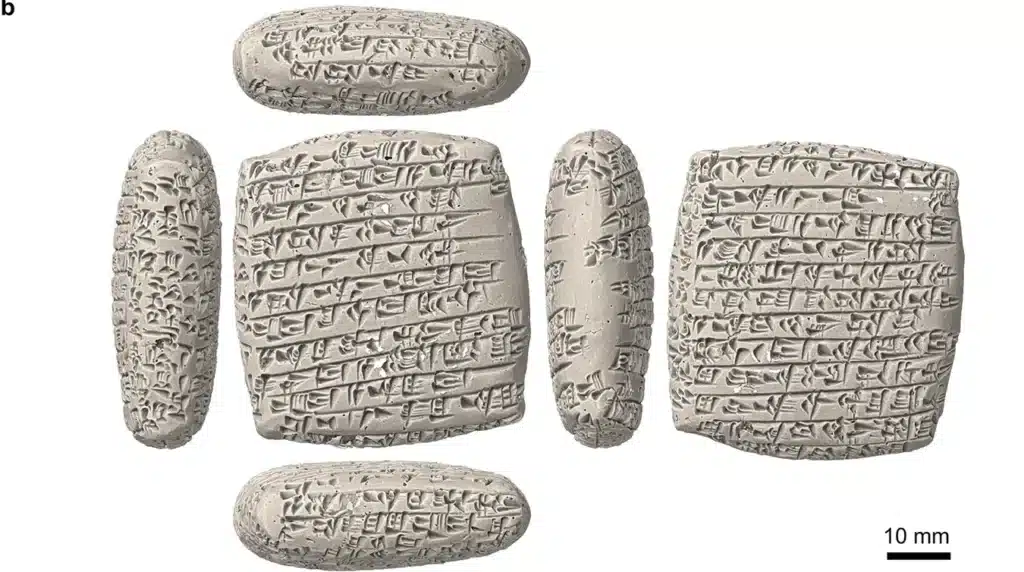
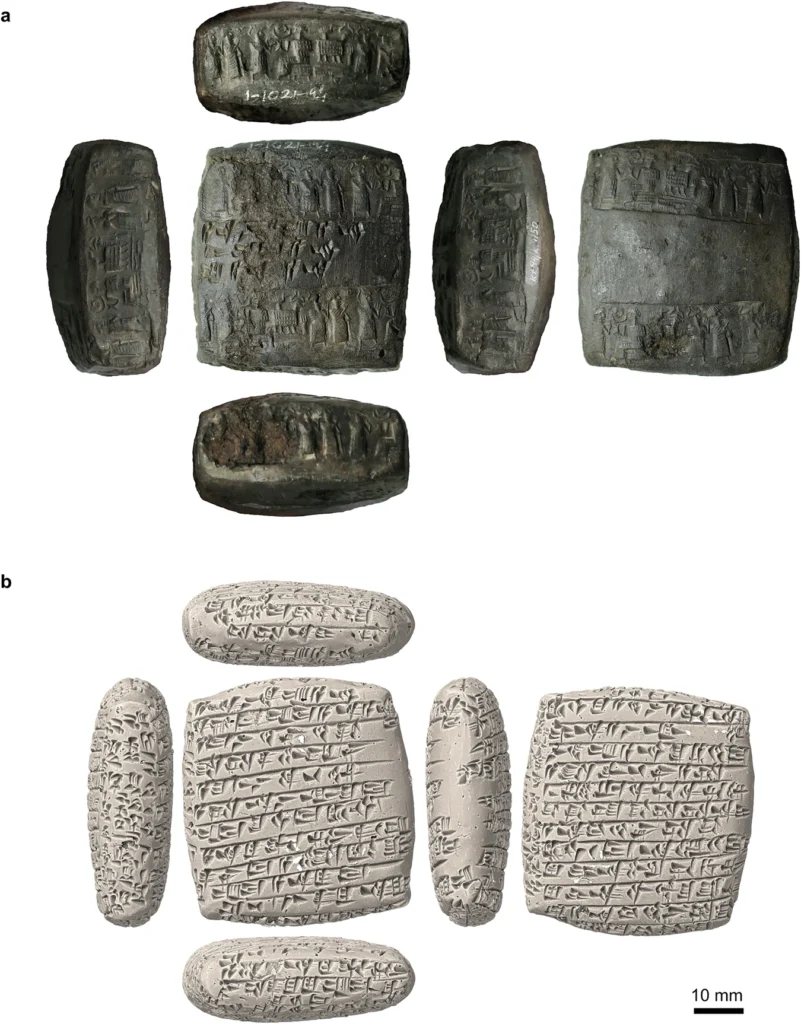
a- envelope of the letter. Size of the envelope: 5.3 cm × 4.9 cm × 2.6 cm. Photos: Samaneh Ehteram. b Visualisation of the hidden tablet (Kt 94/k 1150a). White surface colouring emphasises estimated patches where the envelope touches the tablet. Bounding box: 46.5 mm × 50.3 mm × 17.3 mm. Credit: Michel, C., et. al., 2026

Letters from Kültepe’s Assyrian merchants

Many of the scanned objects come from Kültepe, ancient Kanesh, in central Anatolia. In the 19th and 18th centuries BC, Assyrian merchants from the city of Assur lived and worked there, managing long-distance trade in textiles, silver and other goods.

Their letters were written on small clay tablets and then sealed in clay envelopes. On the outside, only the names of the sender and recipient were usually written, together with seal impressions. The real message remained private until the envelope was broken.

One of the most revealing examples is a letter sent by Anna-anna to her husband Ennum-Aššur. The envelope showed only her seal and his name. Inside, however, the newly readable text tells a more personal and practical story. Anna-anna had been trying to recover silver owed to her absent husband, but the debtor refused to pay her directly, saying he would return the money only when Ennum-Aššur came back.

The letter is valuable because it shows women in Old Assyrian merchant households not as passive figures, but as people involved in business affairs when men were away on trade journeys.
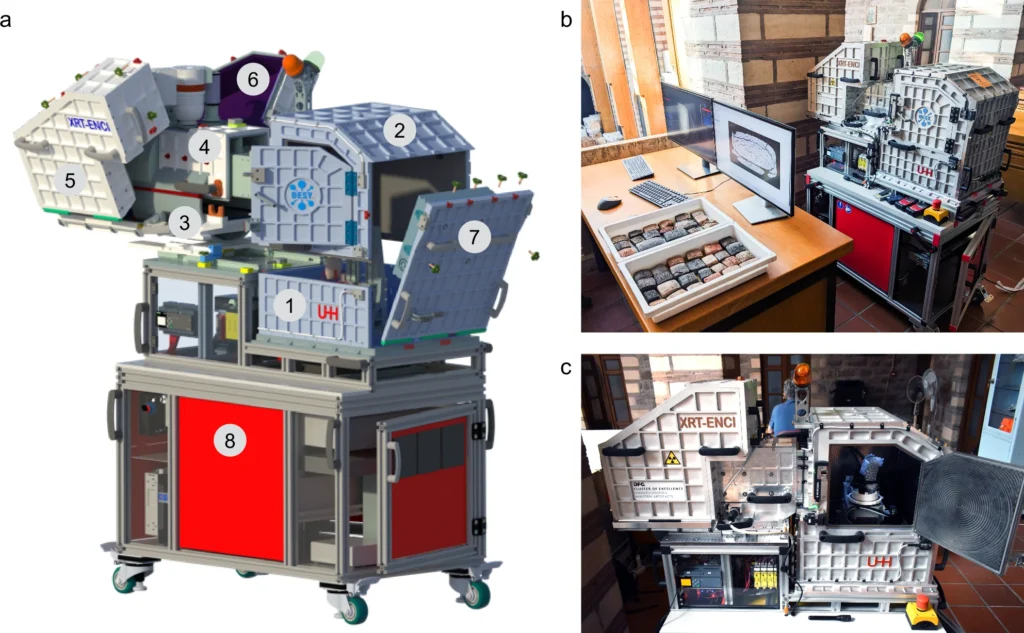
Mobile micro-CT scanner ENCI. Credit: Michel, C., et. al., 2026

More than hidden words

Another sealed letter revealed that ancient scribes sometimes used a second small clay tablet as an extra page when the main tablet was not enough. This particular message dealt with textiles, donkeys and commercial arrangements, offering a direct view of the mechanics of long-distance trade.

The scans also exposed details that could not be seen from the outside. Researchers could identify clay layers, inclusions, possible organic traces and the way envelopes were folded around tablets. The results suggest that many envelopes were not made from a single clay sheet but from several layers, likely making them stronger for transport.

For archaeology, the real significance lies in what may now become readable for the first time. Sealed tablets were never meant to survive as closed objects; most remained intact only because they were lost, undelivered or left behind in ancient archives.

ENCI turns these unopened letters into historical witnesses without sacrificing their envelopes, seals or traces of manufacture. In the case of Kültepe, that means not only recovering words hidden for 4,000 years, but also hearing the practical concerns of merchants, families and women such as Anna-anna, who managed business matters while men travelled across Anatolia’s trade routes.

The technology may now give museums a way to open some of the world’s oldest private correspondence without physically opening it at all.

Michel, C., Schroer, C.G., Olbrich, S. et al. Deciphering 4000-year-old cuneiform letters hidden in clay envelopes using a mobile X-ray computed tomography scanner. npj Herit. Sci. 14, 303 (2026). https://doi.org/10.1038/s40494-026-02568-7

Cover Image Credit: Letter Kt 94/k 1150 from the Museum of Anatolian Civilisations in Ankara. Credit: Michel, C., et. al., 2026

Related Articles

Researchers decipher enigmatic ancient ‘Unknown Kushan Script’

13 July 2023

13 July 2023

A research team at the University of Cologne’s Department of Linguistics deciphered a writing system belonging to the Kushan Empire,...

Lost Viking Gold Pendant Unearthed in Norfolk Rewrites the Story of the Great Heathen Army’s Invasion

1 March 2026

1 March 2026

A rare gold coin pendant believed to have been worn by a Viking Great Army warrior during the 865 invasion...

Hornelund Brooches: Exquisite Viking Gold Ornaments with Norse and Christian Symbolism Unearthed in Denmark

5 August 2025

5 August 2025

The Hornelund Brooches are rare and captivating examples of Viking Age goldsmithing, discovered in southwestern Jutland, Denmark. These two intricately...

8,500-year-old marble statuette found in Çatalhöyük

28 December 2021

28 December 2021

In the 29th season of the excavations in Çatalhöyük, one of the first urbanization models in Anatolia, in the Çumra...

The Lord’s Prayer Carved in Stone with Scandinavian Runes and a Picture of a Boat Discovered in Ontario, Canada

17 June 2025

17 June 2025

Hidden deep in the northern Ontario wilderness, an extraordinary archeological discovery has puzzled researchers and captured the imagination of history...

A Mysterious Human Face Carved on Stone Dated to Bronze Age Discovered in Kazakhstan

21 July 2024

21 July 2024

Kazakhstan’s rich archaeological landscape continues to reveal fascinating details about ancient civilizations. Recent research in the Akmola, and Pavlodar revealed...

An inscription containing 15 headless falcons and unknown ancient rituals found in an ancient Egyptian temple

8 October 2022

8 October 2022

Archaeologists have discovered a shrine containing previously unknown ancient rituals during excavations at Berenike, a Greco-Roman port in Egypt’s eastern...

2,000-year-old stone faces and engravings emerge amid severe drought in Amazon

24 October 2023

24 October 2023

As a result of record-low water levels brought on by the region’s worst drought in over a century, faces carved...

Ancient Altai People Performed Complex Surgical Operations 2,500 Years Ago — New Discovery

17 February 2026

17 February 2026

Researchers from Novosibirsk State University (NSU) have uncovered compelling evidence of a highly sophisticated surgical procedure performed approximately 2,500 years...

3,500-Year-Old Opal Workshop and Rare Lithophones Unearthed in Vietnam

17 August 2025

17 August 2025

Archaeologists in Vietnam’s Gia Lai province have uncovered a remarkable prehistoric site dating back more than 3,500 years. Excavations at...

2,500-Year-Old Phoenician Shipwreck Being Rescued By Spanish Archaeologists

6 July 2023

6 July 2023

A 2,500-year-old Phoenician shipwreck has been found underwater in the southeastern Spanish region of Murcia. An extraordinary Phoenician shipwreck dating...

New Archaeological Discovery Extends Human Settlement of Kodiak Island by 7,800 Years

26 August 2025

26 August 2025

Archaeologists at the Alagnaruartuliq site (KAR-00064) on Kodiak Island’s Karluk Lake have uncovered evidence of one of the oldest known...

Kashmir’s Forgotten Temple? Shivlings and Ancient Idols Found Beneath Sacred Spring

4 August 2025

4 August 2025

A routine restoration of the Karkoot Nag spring in the Salia area of Aishmuqam, Anantnag district, Jammu & Kashmir, has...

Neanderthals caused ecosystems to change 125,000 years ago

16 December 2021

16 December 2021

Researchers say Neanderthals changed the ecosystem by turning forests into grasslands 125,000 years ago. Around 125,000 years ago, these close...

A Child’s Skeleton was Unearthed During the Tozkoparan Mound Excavations

12 August 2021

12 August 2021

The skeleton of a child was unearthed during the rescue excavations carried out in the Tozkoparan mound located in Tozkoparan...

Comments
Leave a Reply

Your email address will not be published. Required fields are marked *