
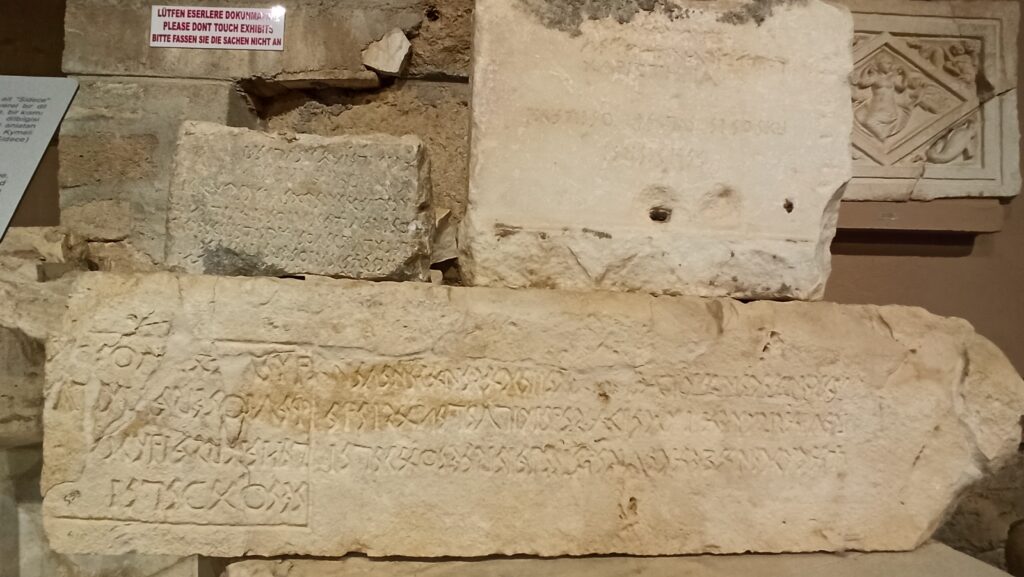
New inscriptions bring fresh hope for Anatolia’s lost language
A lost Anatolian language once spoken in the ancient city of Side is beginning to give up more of its secrets. New research on Sidetic inscriptions from the Mediterranean port city has expanded the known alphabet from 26 to 31 letters, giving scholars fresh material to study one of the region’s most elusive ancient languages.
The newly identified letters come from ongoing work on inscriptions uncovered at Side Ancient City in Antalya’s Manavgat district. Excavation director Prof. Dr. Feriştah Alanyalı and linguists Michaela Zinko and Alfredo Rizza are examining bilingual and multi-line texts that may finally help researchers read Sidetic more clearly after decades of uncertainty.
Sidetic is known from a limited number of inscriptions and coins, most of them connected with Side, an important Pamphylian port city. Scholars generally place it within the ancient Anatolian branch of Indo-European languages, alongside languages such as Lycian and Carian, though its full structure remains difficult to reconstruct because the surviving material is so scarce.
“The inscriptions are few, and most are very short”
Alanyalı said the greatest obstacle is not the alphabet alone, but the limited amount of readable material.
“In recent years, we have found new inscriptions written in Sidetic during the excavations,” she said. “The language still cannot be fully read or understood. The reason is that the number of inscriptions is low, and the existing ones are usually only one or two lines long. This makes decipherment very difficult for researchers.”
That picture has begun to change. According to Alanyalı, the discovery of bilingual inscriptions and longer texts, some reaching 30 to 40 lines, has created new possibilities.
“Both bilingual inscriptions and multi-line inscriptions found in recent years have once again raised hopes,” she said.
For a language like Sidetic, bilingual texts are especially valuable. They allow researchers to compare an unknown script with a better-understood language, often Greek, and identify repeated names, titles, formulaic phrases, or place names. Sidetic is known from Greek-Sidetic bilingual inscriptions as well as coin legends, and earlier scholarship used such material to begin assigning values to the script.
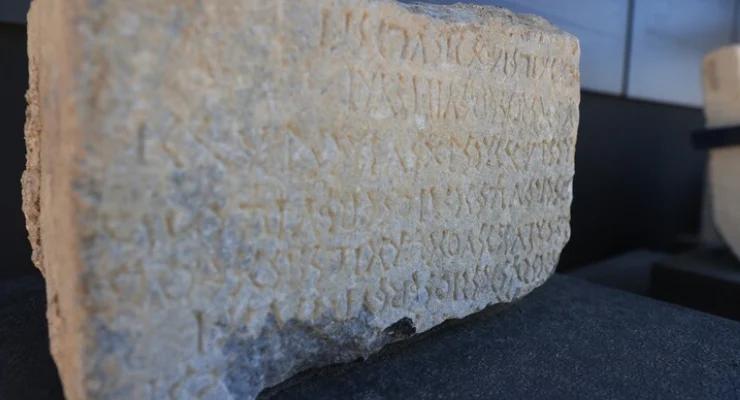
The name of Side may be hidden in Sidetic words
One of the most intriguing points in the new research concerns the words “Siruawn” and “Siruawan.” Alanyalı said researchers increasingly agree that these forms likely refer to the city of Side itself.
That possibility is important because the name “Side” has long been associated with the pomegranate, a symbol that appears frequently on the city’s ancient coinage. Side’s coins are known for pomegranate imagery, reflecting the fruit’s strong connection with the city’s identity.
“This evaluation adds a new dimension to discussions about the early history of Side and the origin of the city’s name,” Alanyalı said. “The work continues, but the city’s name probably still means ‘pomegranate.’ This is a very major finding.”
She also noted that pomegranate cultivation remains significant in the region today, giving the ancient symbol a striking continuity in local memory.
A city older than Greek colonization
Side is often described through its Greek and Roman ruins, but Alanyalı stressed that the city’s deeper identity reaches further back.
“The Sidetic language is a language of Luwian origin, like Lycian and Carian in Anatolia,” she said. “Research on the name of the ancient city is very important for the city’s identity. This city existed before the Hellenes arrived.”
Ancient sources say settlers from Kyme came to Side, but they also preserve an unusual tradition: when they arrived, they forgot their own language and adopted the language spoken by the local population. For Alanyalı, that story points to the strength of the indigenous culture already present in the city.
“Sources say that when those who came from Kyme set foot in Side, they forgot their own language and began speaking the language of the barbarians,” she said. “Barbarian meant someone who spoke a language other than one’s own. We see here a culture dominant enough to make people forget Greek. Before the Hellenes came, Side was already one of Anatolia’s ancient cities.”
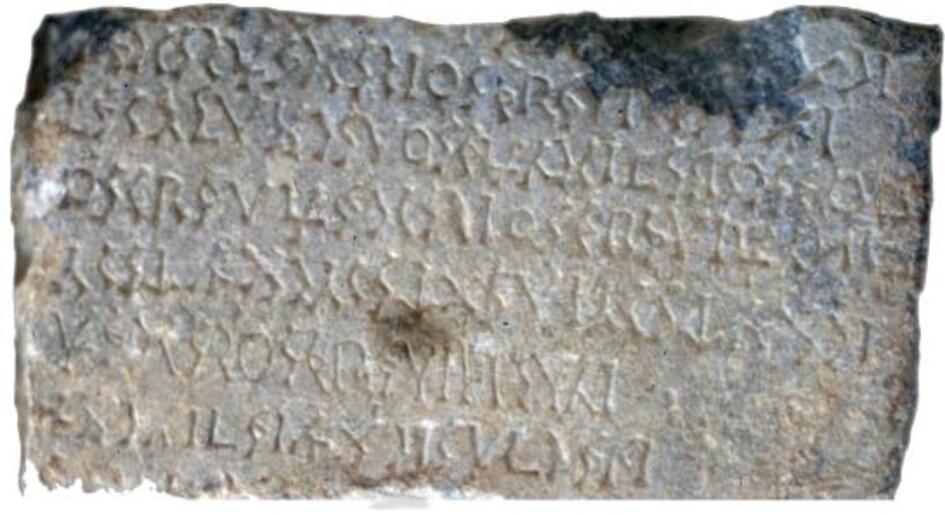
Sidetic survived long after Alexander
The research also challenges the simple idea that Hellenization quickly erased local identities in southern Anatolia. Alanyalı said the inscriptions show that the people of Side continued to use their own language for a long period after Alexander the Great’s campaigns.
“When Alexander took the cities of Anatolia, the people living here were forced to use Greek,” she said. “But before the Hellenistic period, and even during the first 200 years of the Hellenistic period, tthe people of Side continued to speak and write their own language.”
The Sidetic inscriptions appear to disappear around the late second century BCE, suggesting that the language remained active for generations after the city entered the Hellenistic world.
“Even 200 years after Alexander, the people of Side preserved their own language,” Alanyalı said. “Research on this language gives us very important clues about the cultural identity of these cities.”
For her, the message is clear: cities like Side were not simply founded and “civilized” by migrants from the west. They were already old, literate, and culturally developed communities with their own scripts, names, symbols, and regional connections.
Eastern links behind a Mediterranean city
Alanyalı also pointed to evidence that Side had close cultural contact with eastern regions as early as the seventh century BCE. Two seals are especially important. One, a Neo-Assyrian seal, was found during excavations. The other, described as a Neo-Babylonian seal, was obtained by Italian researchers from local villagers before the Turkish War of Independence, when the area was under Italian occupation.
“These two seals show that Side was culturally intertwined with the east,” Alanyalı said.
The latest work on the Sidetic alphabet does not solve the language completely. But expanding the known sign list from 26 to 31 letters gives researchers a sharper tool. Each new sign, each repeated word, and each bilingual line brings scholars closer to understanding how the people of ancient Side named their city, expressed identity, and resisted cultural disappearance in one of Anatolia’s most layered coastal settlements.
Cover Image Credit: Public Domain
