
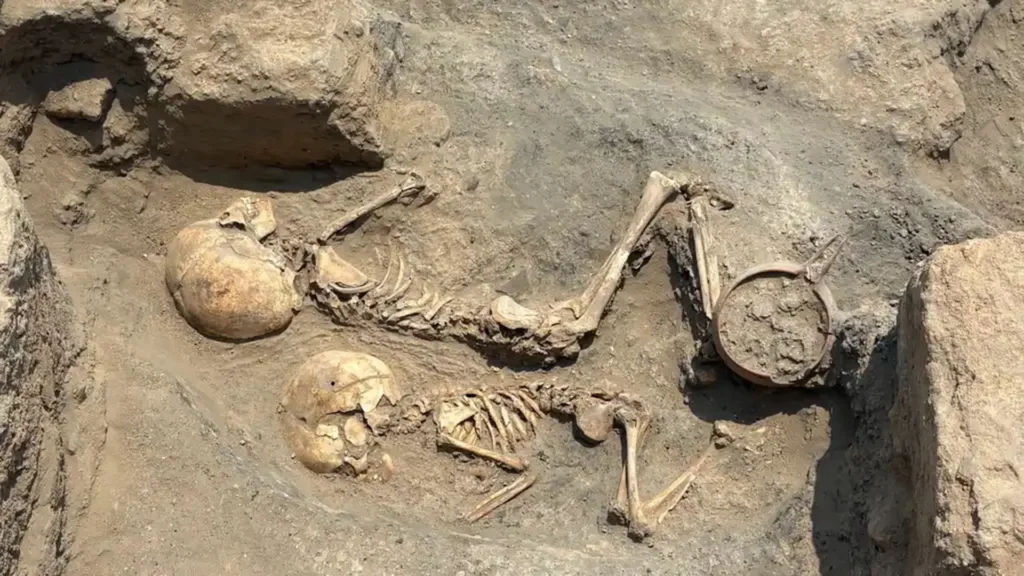
A small grave in southern Uzbekistan has opened an unexpected window onto one of the most delicate and dangerous medical practices of the Bronze Age. Archaeologists working at Djarkutan, a major settlement of the ancient Oxus civilization, have uncovered the remains of two children buried side by side. One of them, around five years old at death, bears clear evidence of cranial trepanation, a surgical opening made in the skull around 4,000 years ago.
The discovery was made during the April 2026 excavation campaign by a joint mission involving the University of Salento, Termez State University, and the Samarkand Archaeological Institute. Researchers say the find is currently the oldest documented evidence of surgical intervention in Central Asia and among the earliest known examples of such a procedure in Asia.
A child’s skull with traces of ancient surgery
The burial contained two non-adult individuals, aged approximately three and five. The older child’s skull shows unmistakable signs of trepanation, a deliberate opening in the cranial bone likely made with stone or bone tools.
Trepanation is one of the oldest known surgical procedures in human history. In different ancient societies, it may have been used to treat head trauma, neurological disorders, epilepsy, migraines, severe pain, or behavioral conditions. Yet in a Bronze Age community such as Djarkutan, the boundary between healing and ritual was probably not clear-cut. The act of opening a child’s skull may have carried both medical and sacred meaning.
That is what makes the discovery so striking. Ancient trepanations are known from several parts of the world, but evidence of such an intervention on a young child in Central Asia around the late third millennium BCE is extremely rare. The find suggests that some people in Djarkutan possessed anatomical knowledge, technical skill, and a social role that allowed them to perform a highly risky operation.
Djarkutan and the world of the Oxus civilization
Djarkutan was not an isolated village. It was one of the most important urban centers of Northern Bactria, in a region close to the modern border between Uzbekistan and Afghanistan. During the Bronze Age, it belonged to the cultural sphere often known as the Oxus civilization, or the Bactria-Margiana Archaeological Complex.
This civilization flourished roughly between 2500 and 1500 BCE across parts of present-day Uzbekistan, Turkmenistan, northern Afghanistan, eastern Iran, and neighboring regions. Its communities developed in oases and river valleys, where irrigated agriculture, craft production, monumental architecture, and long-distance exchange networks supported increasingly complex settlements.
Djarkutan was part of this wider Bronze Age world. Archaeologists have identified organized quarters, substantial architecture, high-quality ceramics, and evidence of social complexity at the site. The new burial now adds another layer: advanced knowledge of the human body and possibly specialized medical or ritual practice.
The region of the Surkhan Darya, a tributary connected to the broader Oxus river system, played an important role in the interaction between Central Asia, the Iranian plateau, the steppe zones, and the Indus world. Djarkutan’s position made it part of a corridor through which ideas, materials, and technologies could move long before the later Silk Road became famous.
Medicine, ritual, or both?
The main question is not only how the procedure was done, but why it was attempted on a five-year-old child.
Researchers have suggested several possible explanations. The operation may have been linked to the treatment of neurological conditions such as epilepsy or migraines, or to trauma and behavioral disturbances. But the possibility of ritual action cannot be excluded. In many ancient societies, illness was not understood only as a physical condition. It could be interpreted through spiritual, social, or symbolic frameworks.
This makes the Djarkutan skull especially important. It does not simply document a technical act. It points to a community in which the body, healing, pain, childhood, and ritual authority may have been closely connected.
The find also raises the question of who performed the operation. Was there a recognized group of healers within the settlement? Did these individuals combine practical knowledge with religious authority? What tools did they use, and how much did they understand about the risks of cutting into the skull?
A multidisciplinary investigation
The Djarkutan project began in 2024 under the joint direction of Professor Enrico Ascalone of the University of Salento and Professor Alisher Shaidullaiev of Termez State University, with the collaboration of the Samarkand Archaeological Institute led by Dr. Komil Rakhimov.
The mission brings together archaeobotany, archaeozoology, physical anthropology, paleogenetics, topography, and archaeometry. This approach is designed not only to recover objects and graves, but to reconstruct the daily life, environment, diet, health, and death practices of the people who lived at Djarkutan.
The wider research program also connects the Uzbek site with investigations at major Bronze Age centers in Iran, including Shahr-i Sokhta and Jiroft. Together, these projects are helping scholars reassess the cultural links that shaped early complex societies across Central Asia and the Iranian plateau.
For now, the child’s skull remains both evidence and question. It proves that a cranial operation was attempted in Central Asia 4,000 years ago. But it also leaves behind a more human uncertainty: who was this child, what condition led to such an intervention, and what did the people of Djarkutan believe they were trying to heal?
Further paleogenetic and anthropological studies are expected to provide more answers in the coming months. Until then, the burial stands as one of the most remarkable medical discoveries yet made from the Bronze Age world.
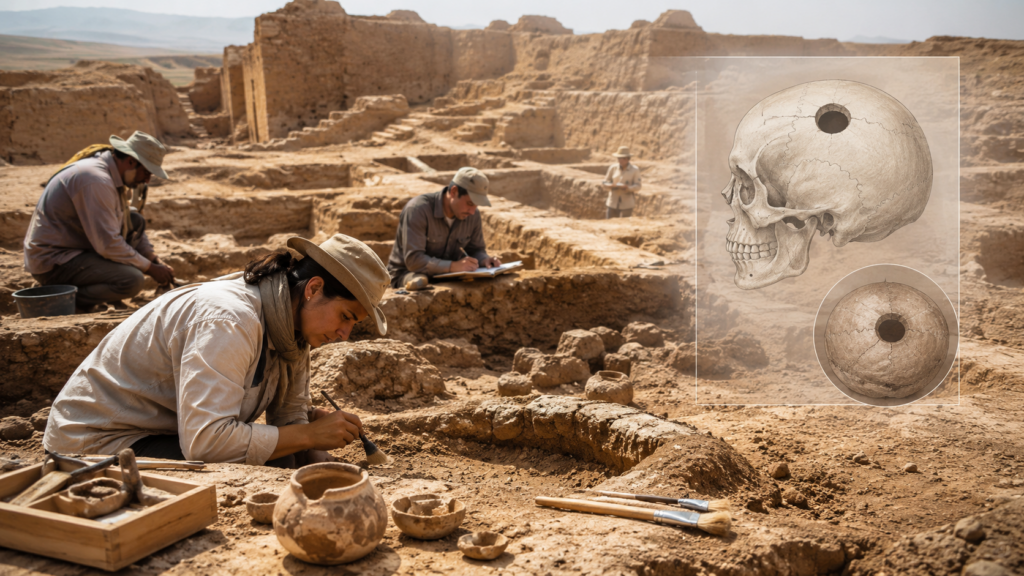
Cover Image Credit: AI-generated illustration of an archaeological excavation at Djarkutan in Uzbekistan.
