

A gold necklace placed in an elite Scythian burial more than 2,300 years ago carries a miniature world that archaeologists may have misunderstood for decades. A new study argues that the strange winged figures hanging from the necklace are not snake-legged goddesses or sirens, as earlier interpretations suggested, but hybrid women with the bodies of bees. At the center of the composition sits another unexpected figure: a tiny female head wearing a Phrygian cap, a detail that may identify her as an Amazon.
The necklace comes from the North Tomb of the Oguz burial mound, one of the major Scythian funerary monuments of the fourth century BCE. Mikhail Treister, an independent researcher based in Bonn, reassesses the object in the 2026 volume of Drevnosti Bospora, drawing together its construction, iconography and parallels from across the Greek and Black Sea worlds. The result turns an already extraordinary piece of gold jewelry into evidence for a much more complicated network of religious imagery.
A necklace from a woman linked to Scythian royalty
The Oguz Kurgan lies near Nyzhni Sirohozy in Kherson Oblast, southern Ukraine, within the Black Sea steppe. Its North Tomb contained the burial of a high-status woman whom previous researchers have linked to the so-called “Bosporan princess.” One hypothesis suggests that she married into the Scythian royal family, possibly becoming the wife of a Scythian ruler connected with King Ateas. The identification remains hypothetical rather than certain.
Researchers also continue to debate the precise date of the burial. Earlier studies placed it around 330–310 BCE, while more recent assessments have proposed dates around 350–340 BCE or 330–320 BCE. Treister therefore places the necklace within the rare gold jewelry traditions of roughly the middle to third quarter of the fourth century BCE.
The craftsmanship matches the social status of the grave. The necklace contains 84 beads made by soldering together two halves. Double lotus flowers separate sections of the necklace, each decorated with five-petaled rosettes and additional hanging figures. At the center hangs a three-dimensional female head.
But the necklace’s smallest figures may carry its most important message.
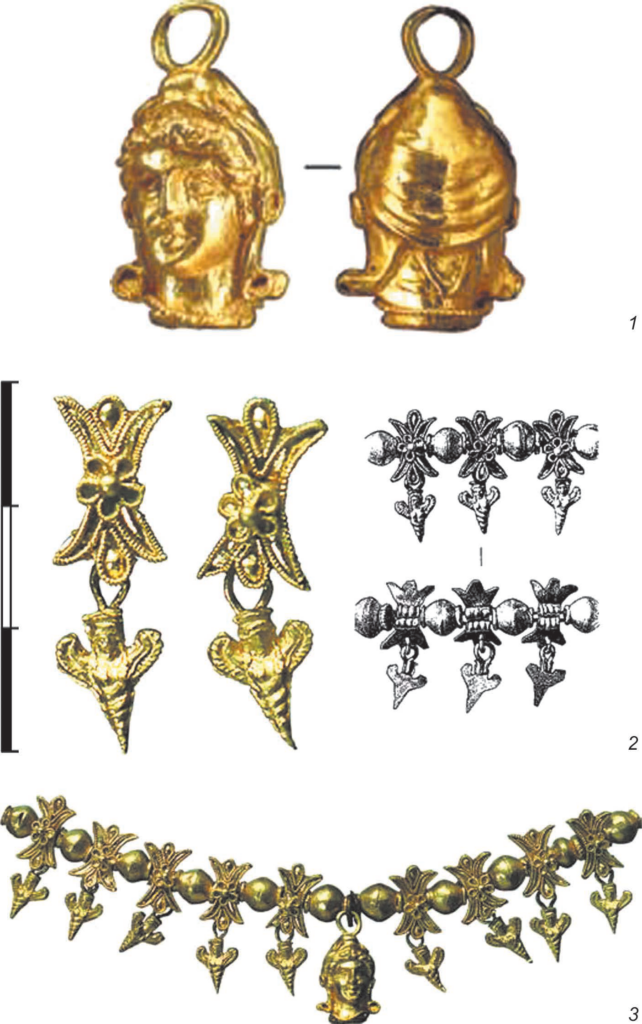
Gold necklace from the North Tomb of the Oguz kurgan, showing the central female-head pendant, divider pendants, and part of the necklace assembly. Credit: After M. Yu. Treister, Drevnosti Bospora 31 (2026).
The figures may be women with the bodies of bees
Thirty-four complete and two fragmentary small pendants survive. Each shows a female figure with an exposed upper body and upward-curving, crescent-shaped wings. Below the waist, however, the anatomy changes dramatically: the body narrows into a ridged, conical form.
Previous interpretations often identified these figures as a snake-legged goddess. Others compared them with sirens, creatures that also appeared with female bodies and wings in Greek art. Treister argues that neither explanation fits the Oguz pendants particularly well.
For him, the decisive feature lies below the human torso. The lower section does not divide into serpentine limbs, and it does not resemble the legs associated with siren imagery. Instead, Treister reads it as an insect abdomen — more specifically, the body of a bee. The pendants therefore represent what he describes as a syncretic “bee-woman” image.
That interpretation leads far beyond the Scythian steppe.
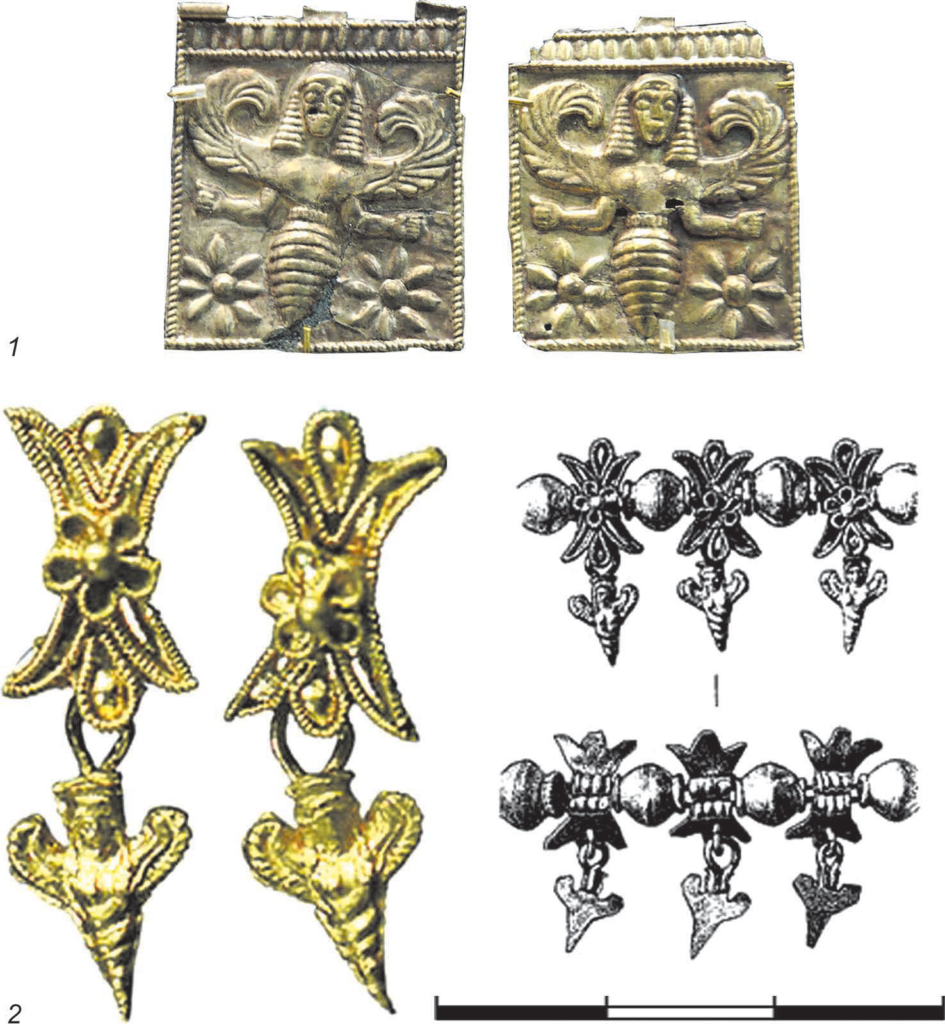
Treister finds the closest visual ancestors not among contemporary fourth-century jewelry, but on ornaments from Rhodes and Melos dating to the second half of the seventh century BCE. Those objects show comparable hybrid female-bee figures and predate the Oguz necklace by roughly three centuries. The study notes that no closer prototypes are currently known.
The archaic figures have been associated with Melissa, a nymph whose name itself means “bee,” and with female religious figures connected to the Artemision at Ephesus. Later examples from the Bosporus, Theodosia, Madytos and western Asia Minor offer chronologically closer comparisons, but they differ in one conspicuous respect: they lack the wings seen on the Oguz figures.
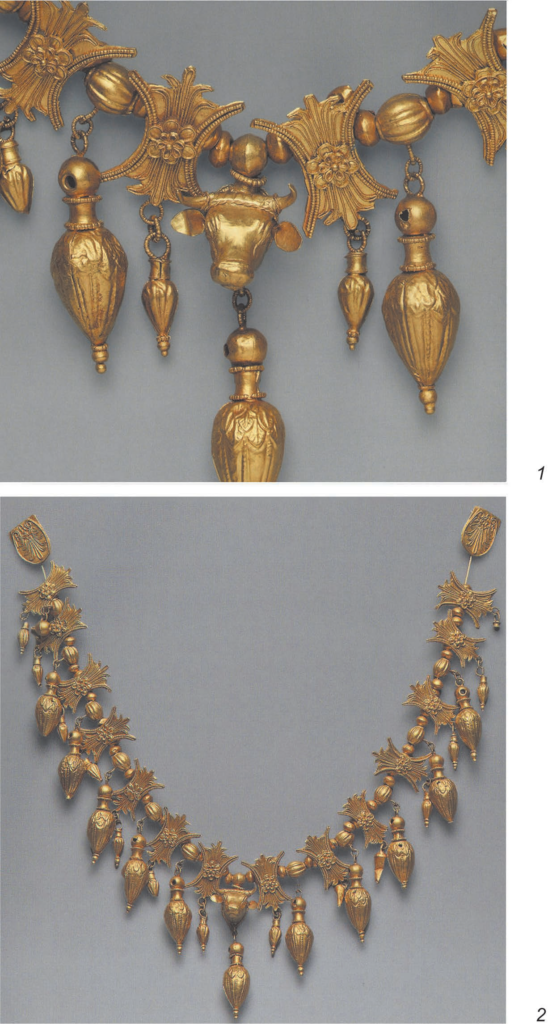
Gold necklace from the Karagodeuashkh burial mound, identified in the study as the closest compositional parallel to the Oguz necklace.
Credit: After M. Yu. Treister, Drevnosti Bospora 31 (2026).
At the center of the necklace, a possible Amazon
The central pendant introduces a second iconographic puzzle.
Only 0.9 centimeters high, it consists of two joined gold halves forming a female head with an oval face, straight nose and almond-shaped eyes. The woman wears an unmistakably elaborate head covering whose upper section bends forward and folds across the back. Treister identifies it as a Phrygian cap.
That detail matters because Greek artists repeatedly used such headgear when depicting Amazons. Earlier publications described the Oguz pendant simply as a female head, but Treister argues that the cap makes an Amazon interpretation considerably more plausible. Similar headgear appears on Amazons in red-figure vase painting, including vessels from the Bosporan region, as well as in fourth-century BCE metalwork and other representations of Amazonomachy.
Yet the pendant remains unusual even within that tradition. Three-dimensional female-head necklace pendants are rare, and most known examples come from the Bosporus and Olbia. According to Treister, no close parallel is known for a necklace pendant combining this particular female-head form with a Phrygian cap.
The result is a striking composition: an apparent Amazon positioned at the center of a necklace surrounded by winged women with bee bodies.
The question is why.
Artemis may connect the Amazon and the bee-women
Treister proposes that the connection may lie with Artemis of Ephesus.
Amazons had deep mythological associations with Ephesus and its sanctuary of Artemis, while bees also occupied an important place in Ephesian religious symbolism. Bee imagery appeared prominently in the city’s visual culture, including jewelry and coinage. Treister therefore suggests that the two seemingly different motifs on the Oguz necklace may belong to the same religious framework.
The argument gains additional relevance because the cult of Ephesian Artemis was not confined to western Asia Minor. Evidence indicates that it also reached the Cimmerian Bosporus during the fourth century BCE, precisely the broader environment in which Treister places the manufacture of the necklace.
One object from the Nymphaion necropolis offers an especially suggestive comparison. A gold earring showing Artemis seated on a doe also carries a tiny soldered bee on its rosette-shaped setting. For Treister, that combination provides indirect evidence that Artemis and bee imagery could appear together in Bosporan jewelry.
The study does not claim that the Oguz necklace provides definitive proof of an Ephesian Artemis cult object. Instead, it presents the Artemis connection as the most plausible way to explain why an Amazon and bee-women appear within the same carefully constructed composition.
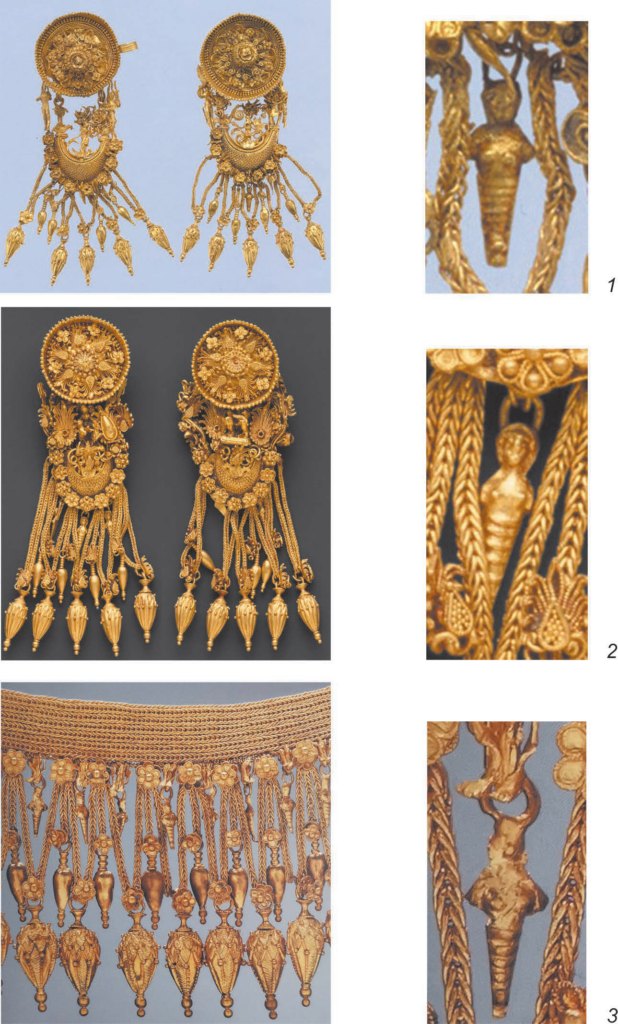
Gold jewelry with “bee-woman” pendants from Madytos, western Asia Minor, and Theodosia, cited as later parallels for the unusual figures on the Oguz necklace. Credit: After M. Yu. Treister, Drevnosti Bospora 31 (2026).
A Bosporan masterpiece with much older imagery
Treister also argues that the necklace was probably produced in a Bosporan jewelry workshop. Its closest compositional parallel comes from the Karagodeuashkh burial mound, where another elaborate gold necklace combines beads, decorative dividers and suspended elements in a related arrangement.
What makes the Oguz necklace exceptional, however, is not simply the amount of gold or the complexity of its construction. Its imagery appears to preserve motifs separated by centuries and geography: archaic bee-women with parallels in the Aegean, an Amazon-like central figure, and religious associations that may lead toward Artemis at Ephesus, all assembled in jewelry probably made in the Bosporan world for a woman connected with the highest levels of Scythian society.
The necklace had been known for decades. The new study changes the question from what the object is to what its images were meant to communicate — and the answer may lie in a forgotten combination of Amazons, bees and Artemis.
M. Yu. Treister. “Gold Necklace with Pendants from the North Tomb of the Oguz Burial Mound.” Drevnosti Bospora, Vol. 31, 2026, pp. 281–297. DOI: 10.25681/IARAS.2026.978-5-94375-501-9.281-297.
