
More than two millennia ago, someone in the ancient Chu Kingdom carefully wrapped grains in leaves, tied the bundles with plant cords and placed them inside a royal tomb. Waterlogged conditions preserved many of those fragile packages for roughly 2,200 years, leaving archaeologists with an unusually intimate glimpse of a ritual that had almost disappeared from the material record.
The bundles come from Wuwangdun in eastern China, a major Warring States-period tomb associated with King Kaolie of Chu, who died in 238 BC. Their age alone makes them remarkable, but researchers believe their real significance lies in something less tangible: the way they seem to echo an ancient story surrounding Qu Yuan, one of China’s most celebrated poets.
Bundles preserved inside a royal tomb
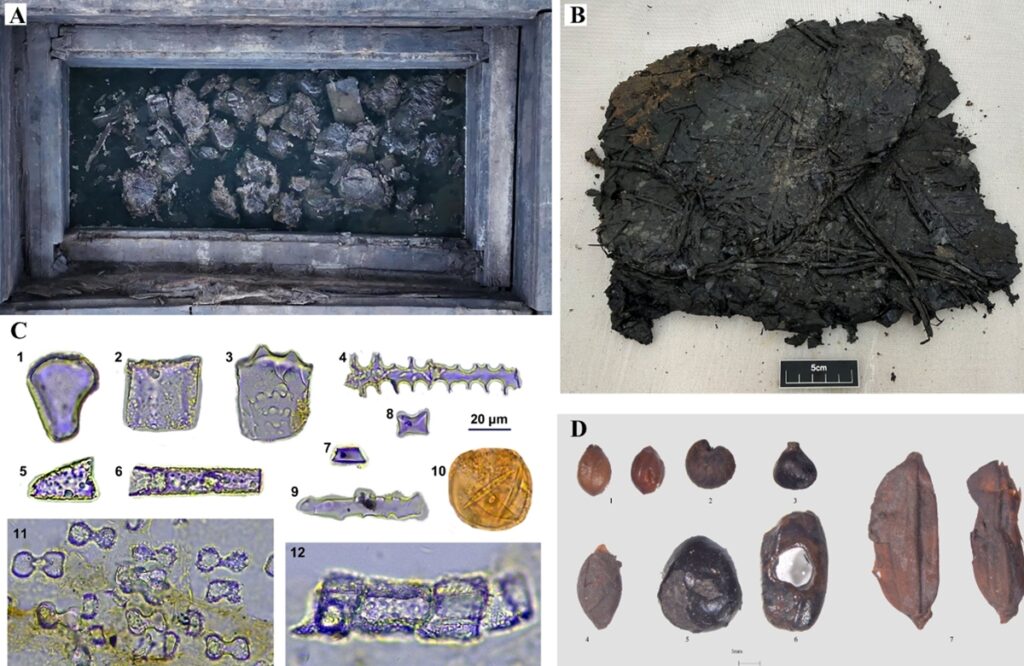
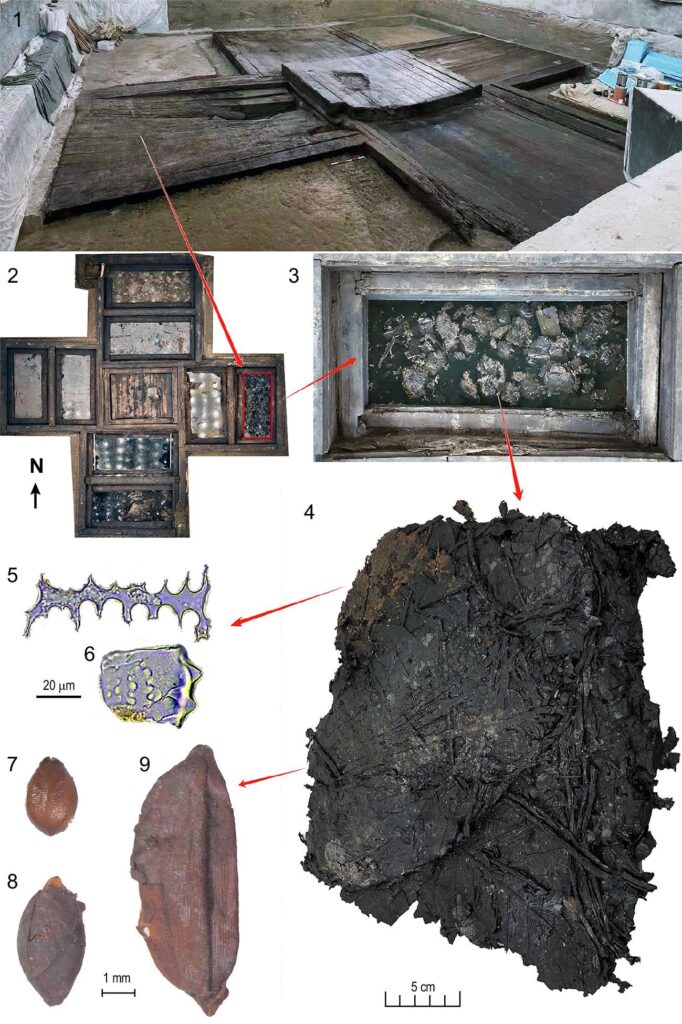
Archaeologists found several concentrations of the plant bundles inside the tomb’s waterlogged East I chamber. The surviving examples consisted of compact plant material wrapped in leaves and secured with cords, a simple arrangement that remained recognizable despite more than two thousand years underground.
Laboratory examination showed that the wrapping leaves came from Quercus dentata, a species of oak. The cords appear to have been made from grasses rather than hemp. Inside, researchers identified hundreds of remains belonging mainly to rice, broomcorn millet and foxtail millet, alongside traces of other plants.
Analysis of 456 seeds from ten bundles showed that rice accounted for 43.6 percent of the assemblage, while broomcorn millet represented 26.1 percent and foxtail millet 28.5 percent. Most survived only as husks, with just a single partially decayed rice grain recovered.
At first glance, such bundles can easily resemble food parcels. The evidence, however, points in a different direction.
These were probably offerings, not meals
The large number of intact husks suggested that the grains were never prepared for ordinary consumption. Researchers also examined thin layers of brown residue preserved inside the leaves, initially considering whether the material could have been rice or millet flour.
Microscopic analysis found no starch granules, ruling out flour or dough made from ground grain. Instead, the residue contained large quantities of grass pollen and phytoliths associated with cereal inflorescences, including parts of wheat and barley that people normally would not eat. Together with the rice and millet husks, these remains suggest that the bundles deliberately included symbolic plant material rather than ingredients for a meal.
Their placement inside a tomb strengthens that interpretation. In early Chinese funerary traditions, grain could carry meanings that went far beyond nutrition, representing agricultural wealth and resources for the dead. One ancient text cited by the researchers even describes soybeans as gold and millet as money in the world of the dead.
The Wuwangdun bundles therefore appear to have functioned as ritual offerings. That interpretation becomes more intriguing when their date and cultural setting enter the picture.
An ancient story about Qu Yuan
Qu Yuan lived during the final centuries of the Warring States period and served as both a poet and statesman in the Chu Kingdom. According to the traditional story, he drowned himself in the Miluo River after political exile and despair over the fate of his homeland.
The legend says that people threw leaf-wrapped grain into the river so fish would eat the offerings instead of Qu Yuan’s body. Over time, that story became closely connected with zongzi, the leaf-wrapped rice or millet parcels eaten during the Dragon Boat Festival. Yet the historical development of that tradition remains difficult to trace because secure archaeological evidence has been scarce.
The Wuwangdun discovery does not prove that the legend happened as later generations told it. What it does show is that people in the Chu cultural world were already wrapping grains in leaves, binding them with plant cords and using them in funerary rituals around the same broad period associated with Qu Yuan.
That overlap gives archaeologists something legends rarely provide: a surviving material practice from the same cultural landscape.
A tradition that may have survived for centuries
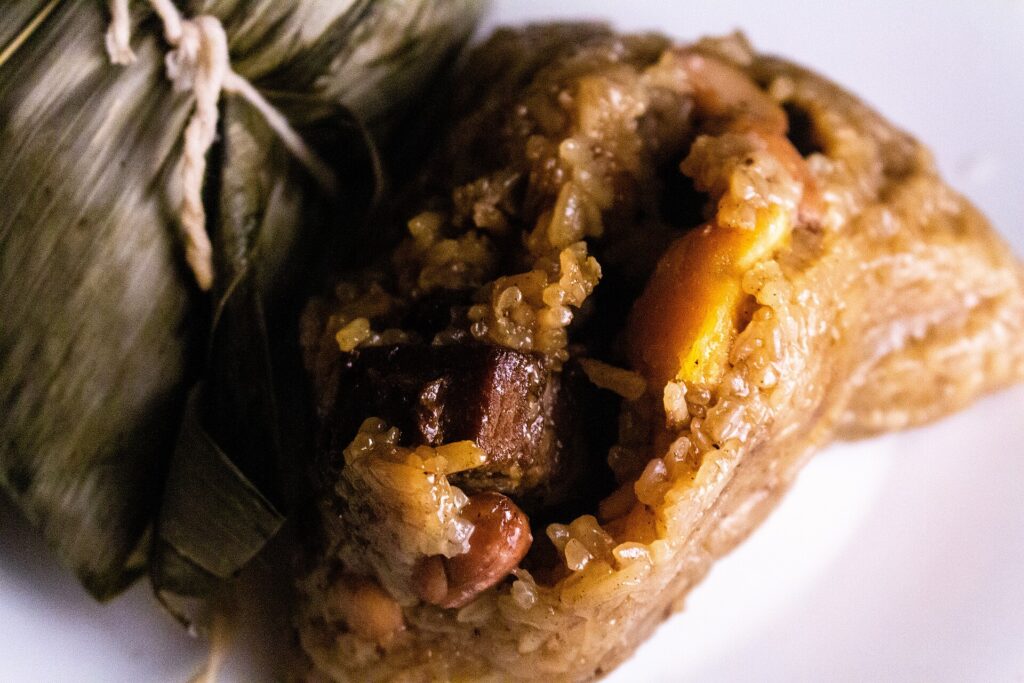
The resemblance to later zongzi is difficult to miss. Modern zongzi traditionally contain sticky rice or millet wrapped in leaves and tied with cord. The ancient Wuwangdun bundles used essentially the same structural idea, although the researchers stress that they were not identical to modern zongzi and may not have served the same purpose.
Later written sources describe similar practices. A text dating to the third century AD records sticky rice and millet wrapped in leaves, while a sixth-century account describes zongzi bound with coloured ropes and offered in connection with Qu Yuan. These accounts preserve the same basic combination seen archaeologically: grain, leaves and cord.
Wuwangdun is not the only Chu-period site to produce such evidence. Comparable bundles from Chengyangcheng also contained rice and broomcorn millet wrapped in Quercus dentata leaves, suggesting that this was not an isolated act but a wider funerary custom within the Chu Kingdom.
Researchers therefore stop short of calling the Wuwangdun finds ancient zongzi. Instead, they describe them as a possible precursor to the later tradition, showing that the practice of wrapping grains in leaves for ritual purposes had already emerged in the Chu Kingdom at least 2,200 years ago.
That distinction matters. The discovery does not turn legend into history, but it does reveal that a ritual remarkably close to the one remembered in later tradition genuinely existed in the right place and at roughly the right time.
Fan Yang, Yong Ge, Ling Fang, Haiyan Wang, Shuzhi Wang, Jiajun Wang, Zhiguo Zhang, Tradition of wrapping grains in funerary rituals 2200 years ago, National Science Review, Volume 13, Issue 17, September 2026, nwag504, https://doi.org/10.1093/nsr/nwag504
