
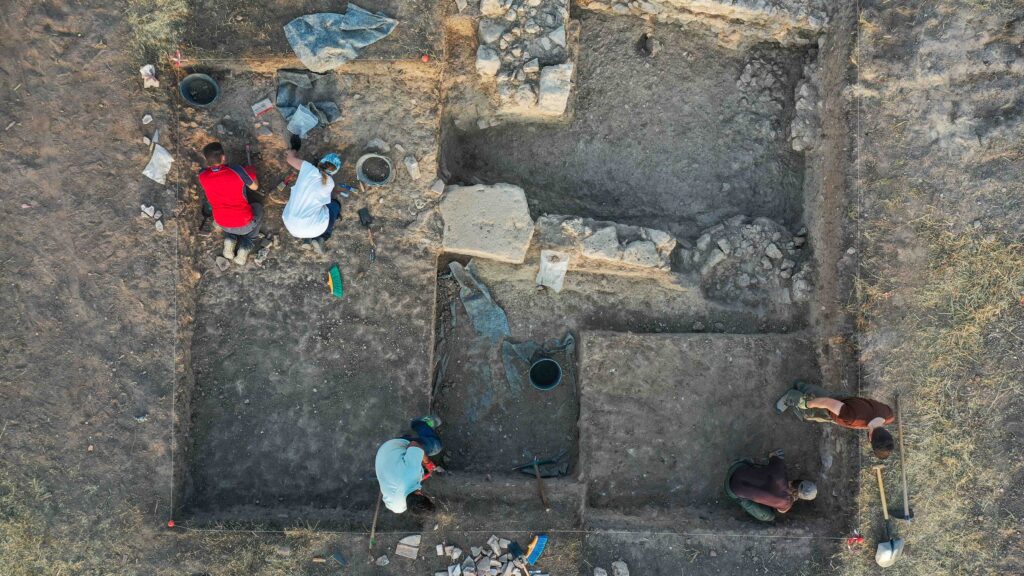
A frying pan, cooking pots, storage jars, and pieces of a portable bread oven have emerged from the ruins of a 2,000-year-old Roman kitchen in northern Spain. The room has lost much of its original structure, but its surviving contents tell a remarkably familiar story: people needed somewhere to store their ingredients, prepare their meals, and bake their bread.
Archaeologists discovered the kitchen at La Era in Sasamón, Burgos province, during the latest excavation of the ancient Roman city of Segisamo. Dating to the reigns of Augustus and Tiberius, the finds reveal a household where Roman cooking habits met traditions that had existed in the region long before Rome arrived.
A Roman City with Deeper Roots
The kitchen lies at the foot of the Church of Santa María la Real, where researchers from the University of Salamanca and Spain’s National Research Council (CSIC) have been excavating since 2023. Their work forms part of a decade-long project exploring how the region changed as its indigenous communities came under Roman rule.
Before turning to Segisamo, the team investigated Cerro Castarreño, a major Iron Age settlement associated with the Turmogi people. They also examined the remains of a Roman siege enclosure linked to the end of that settlement’s occupation.
Now, at La Era, the archaeologists are uncovering the city that developed in the Roman period. The kitchen belongs to an early chapter of its history, but it may not be the oldest structure on the site. In another excavation trench, researchers found buildings beneath the Roman remains that resemble earlier Iron Age constructions.
Their discovery raises an intriguing possibility: Segisamo may have grown from a place where local communities had already lived before the Roman city took shape.
A Simple Room Where the Fire Once Burned
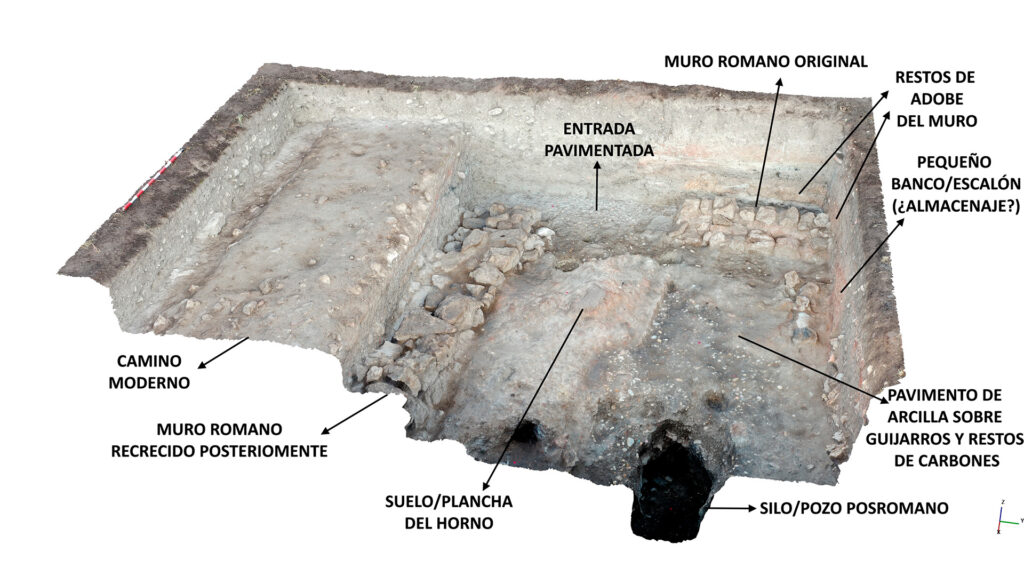
There was nothing particularly luxurious about the kitchen. Its builders used adobe walls on stone foundations, possibly finished with plaster, and made the floor from compacted clay laid over small pebbles.
The materials were inexpensive but practical. The floor was durable and easy to clean, an important consideration in a room where food was prepared and fires were lit.
A small step led to a raised area that may once have supported an oven. Although most of the structure has disappeared, a thick layer of ash and charcoal survived where the fire probably burned.
Later disturbances damaged the room, leaving archaeologists with only part of its original layout. Yet the surviving floor, traces of the oven, and objects scattered through the ash offer a picture of a working space far removed from the grand villas and decorated buildings often associated with Roman life.
Frying Pans, Mortars, and a Portable Bread Oven
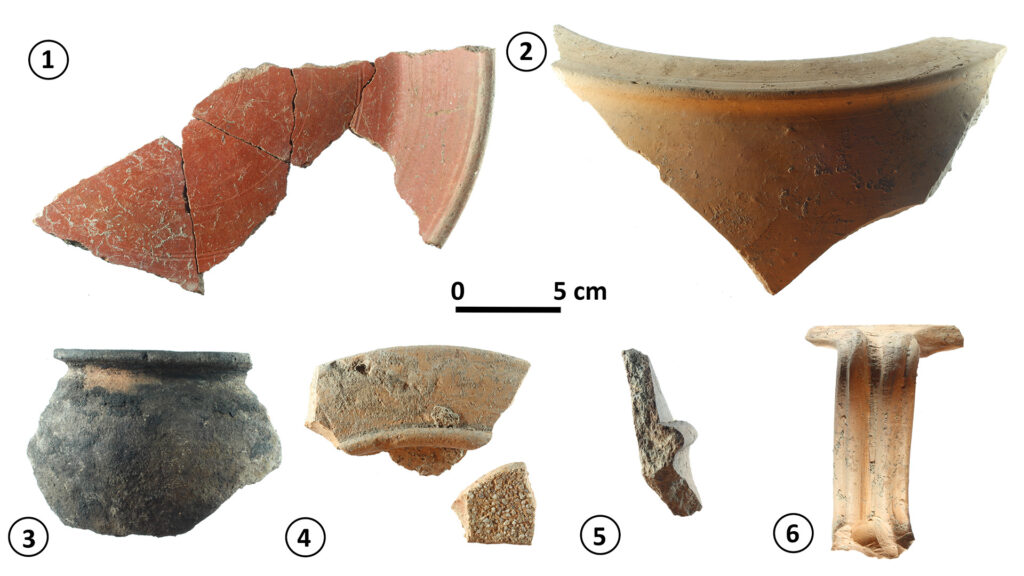
The kitchen’s contents are perhaps its most engaging feature. Archaeologists recovered large ceramic vessels called dolia, used for storing food, along with jugs, bowls, and mortars for preparing ingredients.
There were ordinary cooking pots, too, but the frying pans stand out. Some belong to the famous Pompeian red-slip pottery tradition, known for its distinctive red coating and cooking properties. These vessels offer a tangible connection to the cookware used elsewhere in the Roman world.
Even more interesting are fragments of a clibanus, a small portable oven that could be used to bake bread on a heat-resistant surface. Unlike the larger oven suggested by the room’s surviving architecture, the portable oven is represented by pieces of pottery recovered during excavation.
Together, the objects suggest a kitchen equipped for several everyday tasks. Ingredients could be stored in large jars, ground or mixed in mortars, cooked in pots and pans, and turned into bread using a portable oven.
The archaeologists have not yet established exactly what meals were prepared here. For now, the utensils themselves provide the clearest picture of how this ancient kitchen worked.
A Turmogi Grandmother’s Kitchen?
Not everything in the room came from the same cultural tradition. Some vessels were imported from the Italian Peninsula, while others appear to have been made locally, including pottery that continued older Turmogi traditions.
That mixture tells an important story about the people of Segisamo. Although Roman cooking practices had reached the city by the time of Augustus and Tiberius, the presence of imported cookware does not mean everyone using it had come from Italy.
Local families could adopt new utensils and cooking habits without abandoning everything they already knew. The kitchen may have belonged to people whose daily routines combined elements of both cultures.
The researchers themselves offered a playful comparison, describing the assemblage as something like a Turmogi grandmother’s kitchen: a little of the new alongside a little of the old.
It is an appealing image, although the identity of the people who used the room remains unknown. What the pottery does show is that Roman influence reached beyond public buildings and city streets into something as ordinary and personal as preparing a meal.
More Than a Roman Kitchen Beneath Sasamón
The kitchen is only one chapter in the history of La Era. As excavators work down through the soil, they are also encountering evidence of people who occupied or used the same ground long after the Roman city declined.
Medieval remains survive beneath later buildings, while other structures date to the sixteenth through eighteenth centuries. The team has also uncovered around ten nineteenth-century graves, apparently separate from the church’s established burial area.
A military uniform button from the reign of Isabella II, between 1833 and 1868, helped researchers date the burials. Their apparently hurried arrangement has raised the possibility of a connection with an epidemic, although this remains unconfirmed.
Elsewhere in the excavations, the archaeologists have recovered jewelry, oil lamps, iron knives, and pottery bearing ancient graffiti. Some bricks even preserve impressions left by footwear in wet clay, small reminders of the people who once worked with the building materials.
Back in the Roman kitchen, the next stage of research may reveal something the cooking pots cannot. The team still needs to examine the large collection of animal bones and other discarded materials recovered during the excavations, which could help identify what the inhabitants of Segisamo actually ate.
The pans, jars, and portable oven have already shown how food could be prepared. The remains of the meals themselves may eventually tell the other half of the story.
