
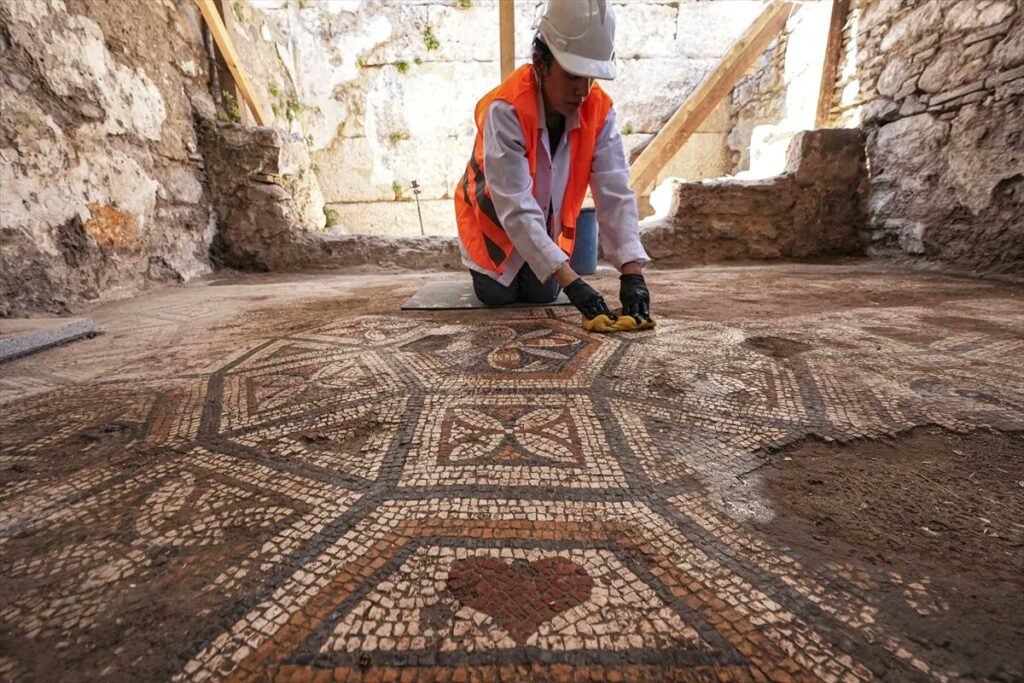
Archaeologists working in the ancient city of Smyrna in İzmir, western Türkiye, have fully uncovered a 1,500-year-old mosaic room that is shedding new light on the city’s Late Antique architecture, decorative art and urban life.
The mosaic is being studied in a structure known as the “Mosaic Room,” located on the North Street of the Agora of Smyrna. Excavations are being carried out under Türkiye’s Ministry of Culture and Tourism’s “Heritage for the Future Project,” with the work directed by Prof. Dr. Akın Ersoy of İzmir Katip Çelebi University.
According to Ersoy, this is only the second mosaic pavement uncovered at the site in nearly seventy years, making the find both rare and scientifically significant for a city where large-scale public architecture is well documented but decorated interior floors are not.
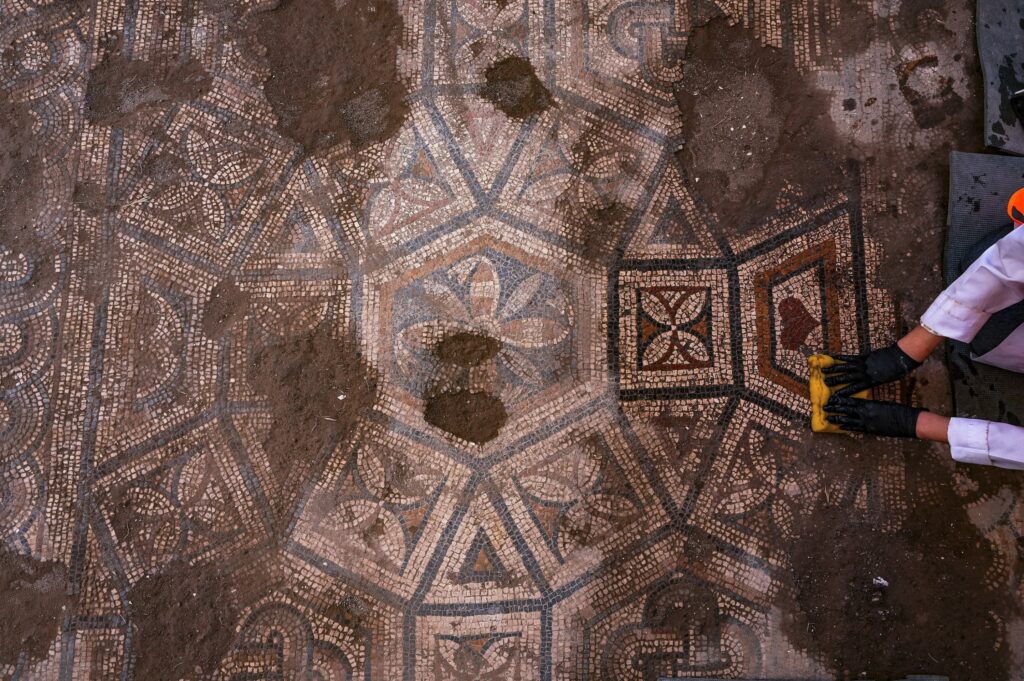
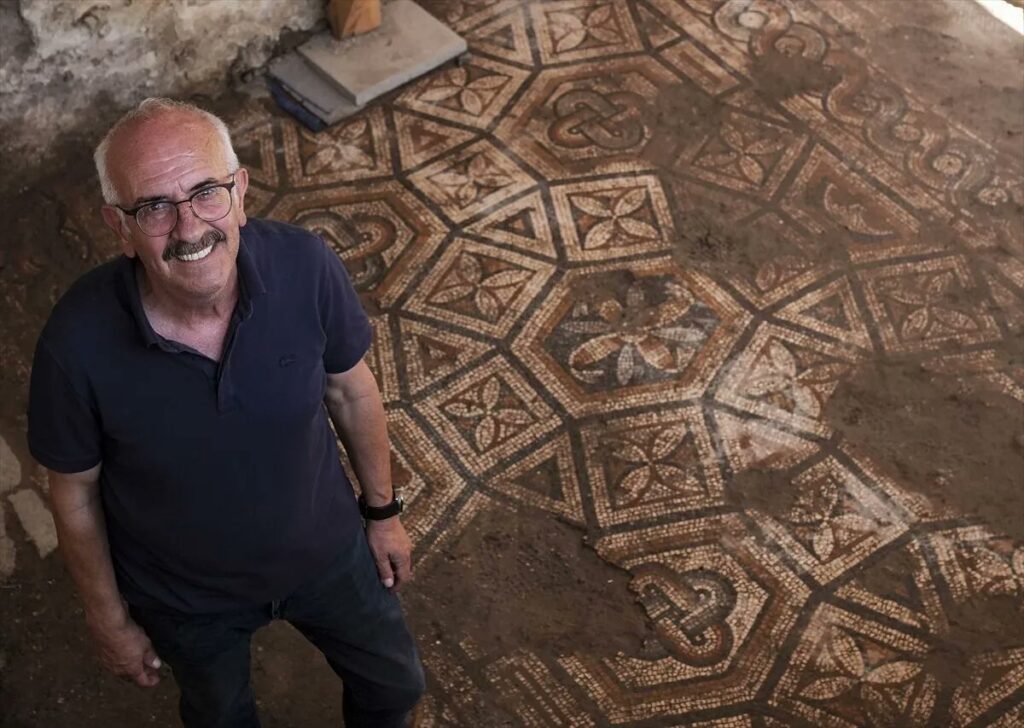
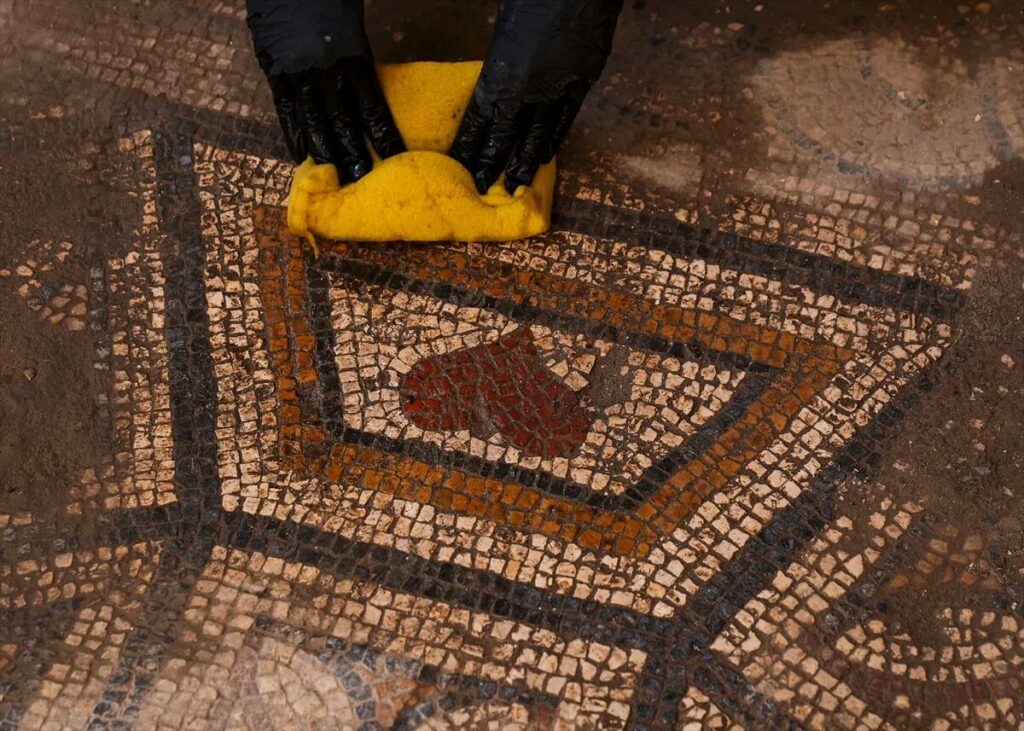
The floor, measuring about 5 meters by 2.5 meters, is decorated with interlocking 12-sided geometric panels, triangles, squares, and vegetal motifs. Part of this area was already visible when the room was first reported earlier this year at a smaller footprint; this season’s excavation has now exposed the room in full, along with an adjoining space. Among the most striking elements are heart-shaped ivy leaves, laurel-like forms and patterns that appear to include the well-known Solomon’s Knot, a motif often associated in Late Antique visual culture with protection and warding off misfortune.
A Mosaic Built on Geometry, Not Spectacle
The Smyrna mosaic does not rely on dramatic mythological figures or large narrative scenes. Its strength is quieter. The design is controlled, repetitive, and carefully ordered, using geometry to create a sense of rhythm across a relatively modest floor surface.
That makes the discovery interesting in a different way. Rather than pointing to a single grand message, the mosaic seems to belong to the everyday visual language of Late Antiquity: a world in which houses, public buildings or semi-public rooms could be decorated with patterns that were attractive, familiar and possibly protective.
The heart-shaped ivy leaves are especially notable. In later periods, the heart shape became strongly linked with romantic love, but in the ancient world ivy had broader associations, including endurance, attachment and continuity. It clings to walls and trees, and that physical quality may explain why it often carried meanings connected with loyalty or persistence. Taken together with the Solomon’s Knot, researchers read the floor’s iconography as touching on several overlapping ideas at once — loyalty, protection, sanctity and fertility — rather than illustrating a single fixed theme.
Still, these meanings should be read carefully. Ancient motifs rarely had only one fixed interpretation. A knot, a leaf or a geometric frame could be decorative, symbolic or both at the same time. The value of the Smyrna mosaic lies precisely in that overlap: it shows how beauty, belief and architectural order could meet in a single floor.
The “Mosaic Room” and Its Architectural Context
According to Prof. Dr. Ersoy, part of the mosaic was exposed last year, while this season’s work has revealed the entire room and an adjoining space. Archaeologists have also identified wall traces around the mosaic, helping them understand the limits and plan of the original structure. “In connection with this, we also found traces of the walls that defined the space,” Ersoy said. “We believe that a structure was built over the mosaic during the Ottoman period in the 19th century, and that the new layout was created while avoiding damage to the mosaic floor as much as possible.”
That 19th-century structure appears to have been part of a hospital complex built over the ancient floor, which helps explain why the mosaic survived relatively intact despite centuries of later construction above it.
The mosaic has been dated to between the 4th and 6th centuries AD, a period when Smyrna was still part of the eastern Roman world and when cities across Anatolia were adapting older Roman urban forms to new social, religious and administrative realities.
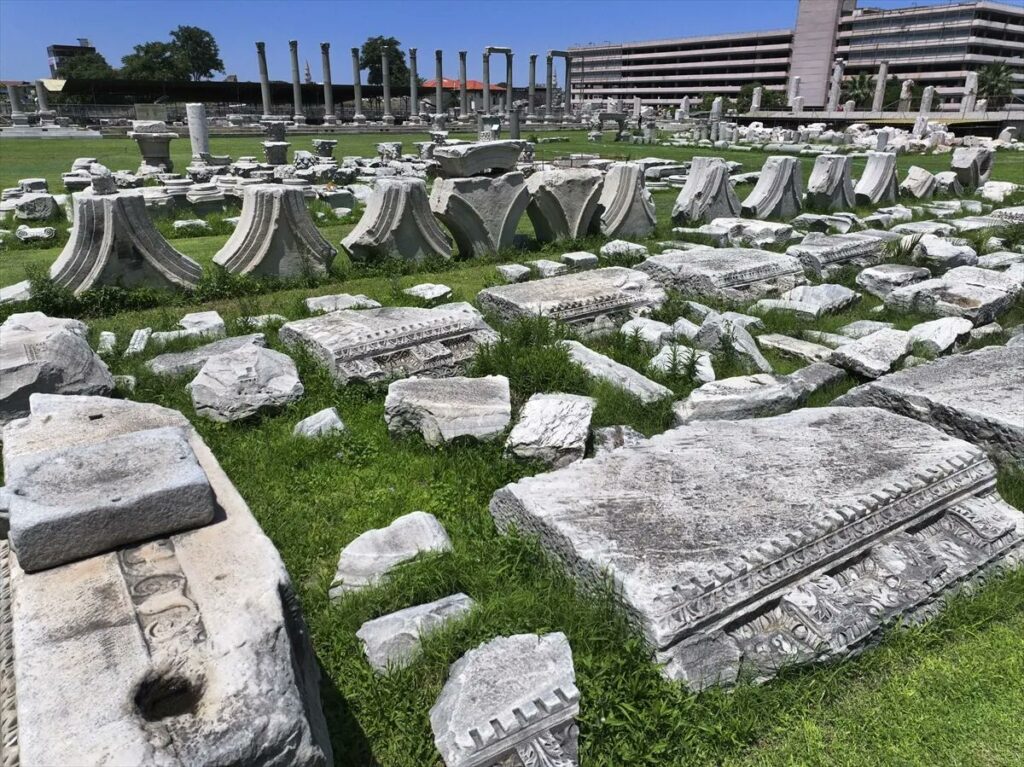
The location is important. The Agora of Smyrna, established on the northern slope of Pagos Hill, was one of the central spaces of ancient İzmir. In the Roman period, it functioned as an administrative, judicial and commercial hub. Its stoas, basilica, streets and public spaces made it one of the most important archaeological witnesses to urban life in western Anatolia.
The newly exposed mosaic adds a more intimate layer to that picture. Large public architecture tells us how cities were planned and governed. Mosaic floors, by contrast, tell us something about taste, movement, interior space, and the visual habits of people who lived or worked inside these buildings.
A City Reused Across Centuries
One of the more revealing details from the excavation is not only the mosaic itself, but what happened to it later. Archaeologists found that during the 19th century, in the Ottoman period, a new structure was built over the ancient floor. The later builders appear to have created a new spatial arrangement while causing limited damage to the mosaic.
Excavators also recovered objects from the layers above the mosaic — including bags, pottery and ceramic vessels dating to the late Ottoman and early Republican periods — showing that the space continued to be used roughly 1,500 years after the mosaic was first laid down.
This is an important point. It shows that the Agora area was not simply abandoned after antiquity and rediscovered by modern archaeologists. It remained part of İzmir’s living urban fabric for centuries, reused, adapted and reinterpreted by different communities.
Such continuity is one of the defining features of Smyrna. The ancient city was not isolated from the modern city; it lies beneath and within İzmir. The Agora’s later use as a cemetery, its Ottoman-period occupation and its position near the historic Kemeraltı district all show how the same urban landscape continued to carry new meanings over time.
A New Piece in the Urban History of Smyrna
The discovery is significant not because it is the largest or most luxurious mosaic in Anatolia, but because it comes from a major ancient city where the layers of Hellenistic, Roman, Byzantine, Ottoman and modern İzmir overlap.
The mosaic helps archaeologists refine the story of Late Antique Smyrna. Its geometric and vegetal decoration points to artistic traditions that were widely shared across the eastern Mediterranean, yet its placement inside the Agora gives it a local urban context. It is both familiar and specific.
The find also carries a further layer of significance: Smyrna is one of the seven cities addressed in the Book of Revelation, and the mosaic joins a string of recent discoveries in Anatolia’s biblical-era cities. Earlier finds have included a large Roman council hall linked to early Christian worship at Laodicea and a Roman-era marble bathtub uncovered at Ephesus, adding Smyrna’s mosaic to a broader pattern of archaeological attention on the region’s early Christian and Late Roman past.
For Smyrna, the find strengthens the evidence that the city remained active and visually sophisticated between the 4th and 6th centuries AD. For İzmir, it adds another piece to the long history of a port city that has been shaped by trade, migration, rebuilding and reuse for more than two millennia.
As excavation continues around the Mosaic Room and its adjacent spaces, archaeologists may be able to determine more clearly what kind of building this was and how it related to the North Street of the Agora. For now, the mosaic offers a compact but valuable glimpse of Late Antique Smyrna: ordered, symbolic, urban, and still partly hidden beneath the modern city.
Cover Image Credit: AA
