
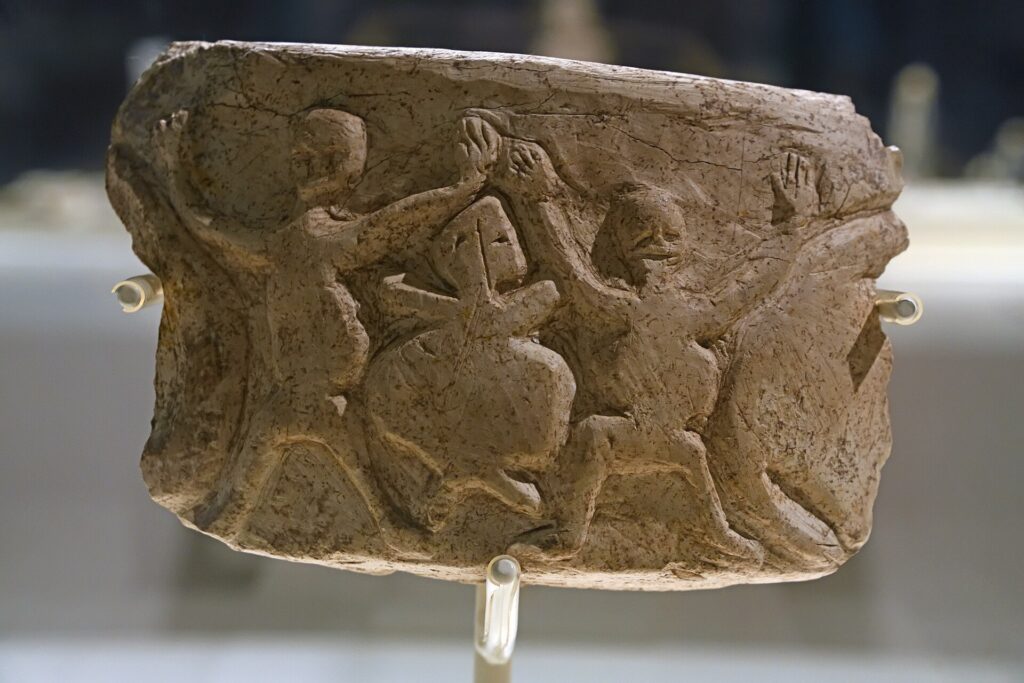
A limestone bowl discovered at Nevalı Çori in southeastern Türkiye carries an extraordinary prehistoric scene: two people with raised arms surrounding a mysterious third figure. Dating back roughly 10,000 years, the carving has inspired competing interpretations involving dancing, childbirth, and the symbolic world of early Neolithic communities.
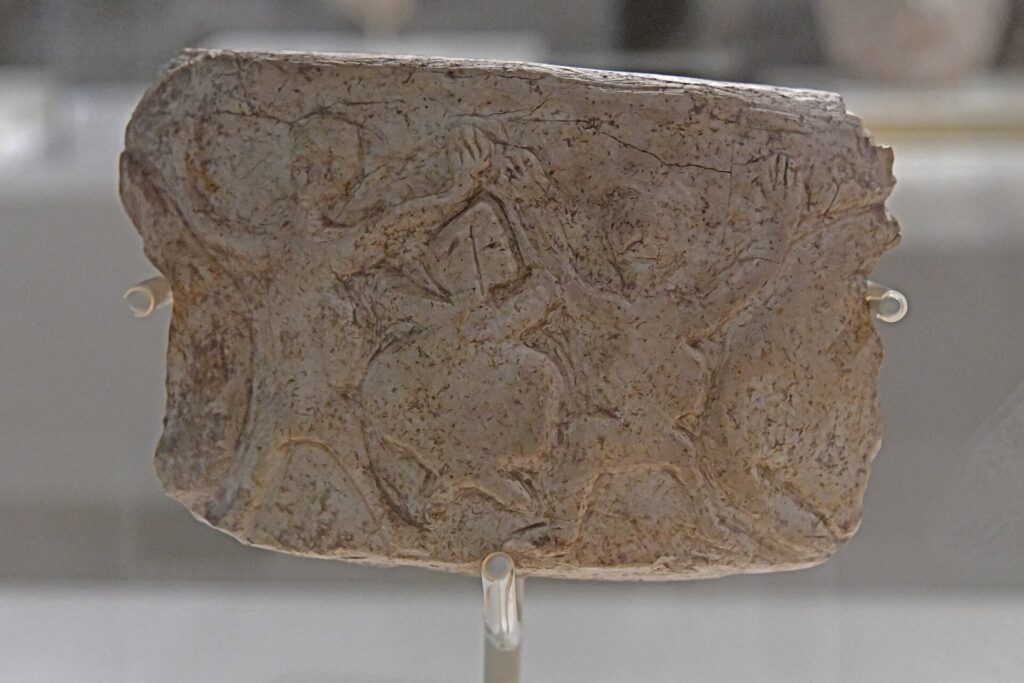
On a fragment of a limestone bowl from Nevalı Çori, two human figures stand with their arms raised around a smaller, strangely shaped figure. Carved roughly 10,000 years ago, it may represent one of the earliest depictions of dancing in prehistoric Anatolia. Yet the central figure’s identity remains uncertain, making this small artifact an intriguing example of how Neolithic people portrayed human activity and symbolic ideas.
The surviving fragment measures approximately 19 by 13 centimeters, but its broken edges suggest that the original decoration extended around a larger portion of the vessel. Unlike many prehistoric objects decorated with geometric patterns, this bowl presents a scene involving several figures whose positions appear deliberately connected.
An Unusual Scene Carved in Stone
The two larger figures have recognizable human features. Their raised arms end in carefully carved hands, while their legs extend outward in poses that researchers have interpreted as movement. Their position on either side of the smaller figure gives the composition an almost theatrical appearance.
The figure between them is much harder to identify. Its diamond-shaped head, rounded body, and short limbs have prompted comparisons with a turtle, although some researchers believe it represents a human or a creature combining human and animal characteristics.
The artist’s attention to bodily gestures is particularly interesting. Rather than portraying three separate figures, the composition appears to place them in a shared activity. Additional traces along the broken edges suggest that other figures may once have formed part of the scene.
This arrangement has encouraged archaeologists to consider whether the vessel depicts a communal performance, a symbolic ceremony, or an episode connected with beliefs that remain unknown.
Dancing, Childbirth or a Mysterious Being?
Archaeologist Yosef Garfinkel examined the Nevalı Çori carving in his research on prehistoric dancing. In his 2003 book Dancing at the Dawn of Agriculture, he discussed the possibility that the central figure represents a woman rather than a turtle, raising the prospect of a scene involving people dancing together.
Other interpretations have connected the arrangement to childbirth or ceremonies celebrating birth. Researchers have also considered whether the central figure belongs to the wider tradition of unusual human-animal representations found in Neolithic art.
None of these explanations has gained universal acceptance. The raised arms and apparent interaction between the figures support the possibility of dancing, but the carving offers no direct evidence of music, ceremonial rules, or the precise activity taking place.
The different interpretations reflect the complexity of Neolithic imagery, in which human figures sometimes appear alongside creatures with unusual or ambiguous features. At Nevalı Çori, the arrangement of the three figures suggests a shared activity, although its precise meaning remains unknown.
Nevalı Çori and the Symbolic World of the Neolithic
Archaeologists excavated Nevalı Çori between 1983 and 1991 under the direction of Harald Hauptmann. The settlement, located near Hilvan in Şanlıurfa province, belonged to the Pre-Pottery Neolithic period, when communities across the region were establishing permanent settlements and developing increasingly elaborate forms of architecture and artistic expression.
Excavations uncovered domestic buildings, sculptures, and a monumental structure containing T-shaped stone pillars. These discoveries helped researchers understand the architectural traditions that also appear at nearby Göbeklitepe, particularly the use of carefully shaped limestone monuments in special buildings.
The stone bowl belongs to this broader world of symbolic expression. Although archaeologists cannot establish whether its imagery had a religious purpose, the deliberate arrangement of its figures suggests that depicting relationships and gestures held significance for the people who created it.
The settlement eventually disappeared beneath the waters of the Atatürk Dam reservoir. Archaeologists recovered numerous objects before the site was submerged, preserving material that continues to inform research into early Neolithic life.
A Curious Parallel with a Traditional Folk Game
A study published in Folklor Akademi in December 2025 introduced another perspective on the vessel’s imagery. Researchers compared the ancient figures with a traditional village game known as meşh, also called arı in some regions of Anatolia.
During the game, participants adopt distinctive positions, including raised arms and gestures involving the face. The researchers drew attention to similarities between these bodily arrangements and the figures carved on the Nevalı Çori vessel.
The comparison is especially interesting because the game has been documented in the wider Şanlıurfa region. However, similarities in posture cannot establish that the same activity survived unchanged for 10,000 years. The study provides a possible cultural parallel, not proof of an uninterrupted tradition.
Today, the limestone vessel fragment is preserved at the Şanlıurfa Archaeology Museum.
Kahraman Çınar, A., Hiçyılmaz, M., Baydar, R. & Sarıca, G. (2025). Neolitik Dönem’den Günümüze Kültürel Süreklilik Bağlamında Eğlence. Folklor Akademi Dergisi, 8(4).
Garfinkel, Y. (2003). The Earliest Dancing Scenes in the Near East. Near Eastern Archaeology, 66(3), 84–95.
