
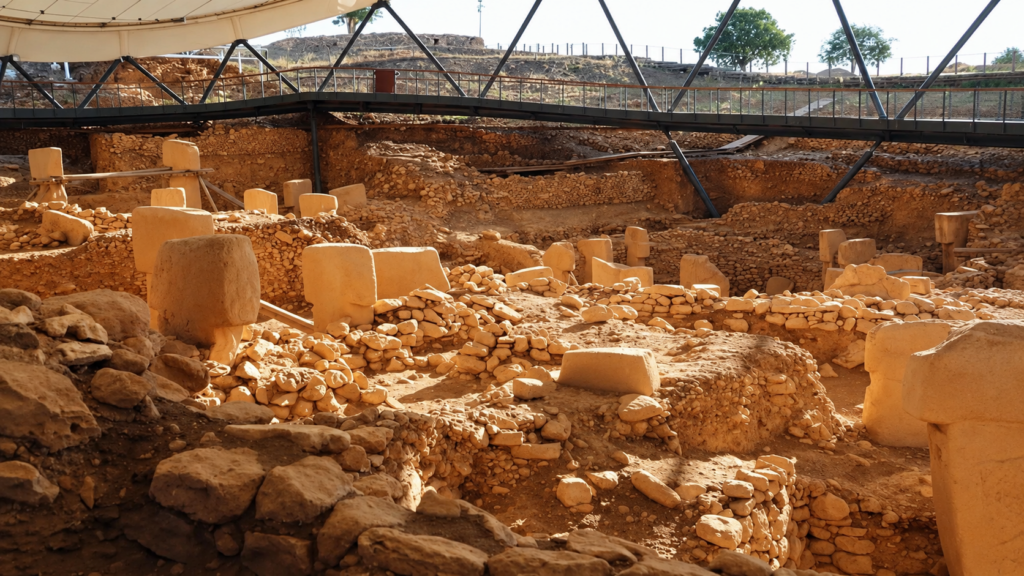
For more than three decades, archaeologists at Göbeklitepe in southeastern Türkiye have encountered a puzzling sight: hundreds of broken human bones scattered among the remains of its monumental stone buildings. Yet despite the site’s extraordinary archaeological record, researchers had found no clearly identifiable graves that could explain where these remains came from.
Now, a new study of the first two burials identified at Göbeklitepe offers a possible answer. Published in PLOS ONE on September 22, the research suggests that some of the mysterious bone fragments may have originated in graves beneath the floors of nearby buildings before erosion carried them into the monumental structures.
The findings provide new evidence for how people treated their dead at the Neolithic settlement, while raising further questions about the relationship between everyday life and ritual practices at one of the world’s most remarkable prehistoric sites.
The First Burial Contained Three People, Possibly Four
Researchers Julia Gresky and Lee Clare examined two burials dating to the Pre-Pottery Neolithic B period, approximately 8700–8000 BC. Both lay close to the monumental structures in the southeastern part of Göbeklitepe, around 15 kilometers northeast of modern Şanlıurfa.
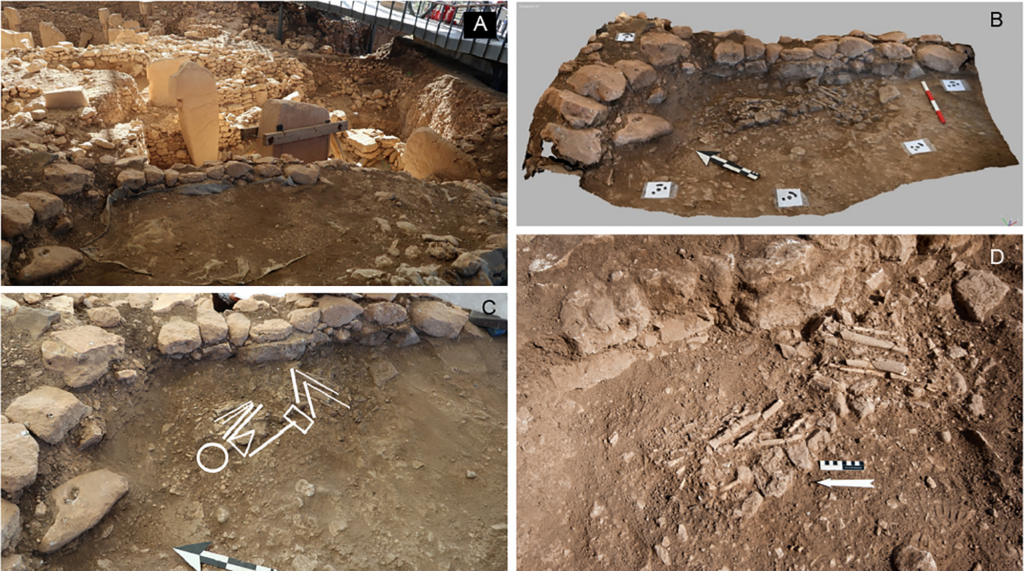
The first burial came to light in 2017, when construction workers were preparing a drainage channel for the permanent protective shelter covering the main excavation area.
Beneath the plaster floor of a rectangular building, archaeologists discovered a kidney-shaped burial pit containing the skeletal remains of at least three individuals. Osteological analysis identified a woman aged at least 35, a man between 20 and 30, and an adolescent girl approximately 11–14 years old.
The arrangement of their remains presented an intriguing detail. Someone had gathered the skulls in the southeastern corner of the pit, while other bones lay in the center and along its western side.
Researchers also noticed that one skull appeared too mature to belong to the adolescent. Two foot bones differed from those associated with the three principal individuals, raising the possibility of a fourth person.
The grave’s relatively small dimensions suggest that the community did not bury all three bodies simultaneously. Instead, the researchers propose that people initially placed complete bodies inside the pit and later rearranged earlier remains to accommodate additional burials.
The absence of cut marks and the presence of small hand and foot bones support this interpretation. The evidence points toward successive burials rather than the deliberate deposition of selected, defleshed skeletal remains.
A Woman Buried Beside Göbeklitepe’s Monumental Building A
The second burial has a longer excavation history. Archaeologists first encountered it in 2012 but covered it for protection because they lacked sufficient time to complete the excavation. They returned in 2022 and uncovered the remaining skeleton.
The grave occupied a small space immediately west of Monumental Building A. Unlike the collective burial, it contained the largely undisturbed remains of a young adult, probably a woman aged 20–30.
She lay on her left side with her legs bent and her face directed eastward. Her body rested on a layer of fist-sized stones, although the excavators could not identify a clearly defined burial pit.
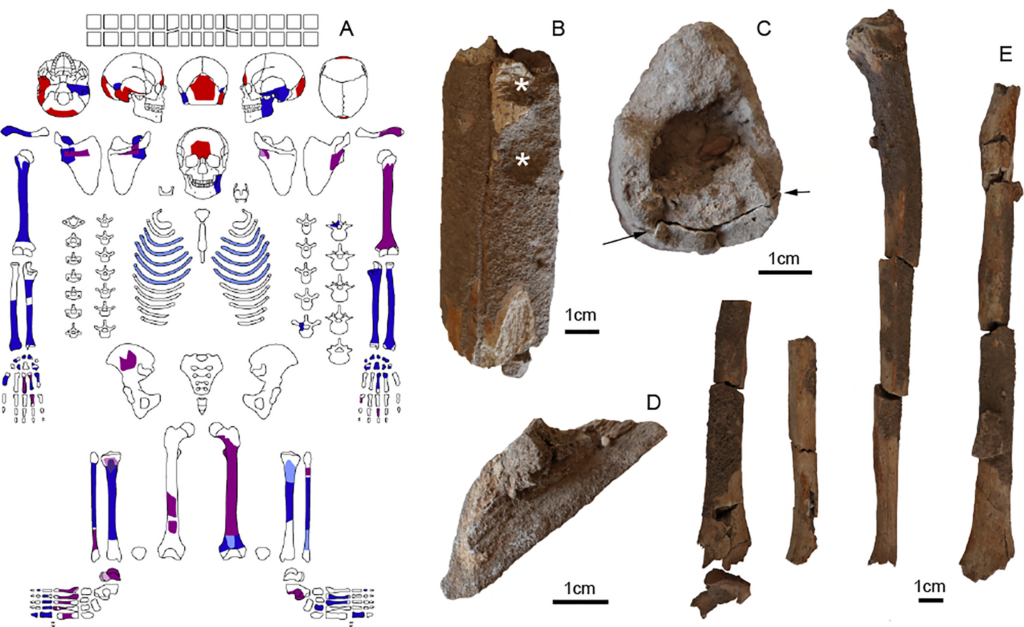
Some skull fragments recovered during the initial excavation may belong to another individual. The researchers therefore caution against assigning every fragment from the burial area to the woman.
Although the skeleton remained largely in its original position, many bones had fractured. The ends of several long bones were missing, and calcareous deposits covered portions of the surviving remains.
These details became particularly important when the researchers compared the skeleton with the hundreds of unidentified human bone fragments previously recovered across Göbeklitepe.
How Did 928 Human Bone Fragments End Up Among the Stone Buildings?
Since excavations began in 1995, archaeologists have recovered human bones from both the fills of Göbeklitepe’s monumental buildings and the spaces between them. Excluding the two newly studied burials, the assemblage now comprises 928 individual fragments. The remains represent males and females across different age groups, but their scattered distribution has made it difficult to associate individual pieces with particular people.
For years, researchers considered whether prehistoric inhabitants deliberately deposited selected bones within the monumental structures as part of unusual mortuary rituals. The new study offers another explanation, drawing on evidence from the two burials and the natural processes that affected the skeletons after death.
Both burials show extensive damage caused by soil pressure, calcareous deposits, and animal activity. Soil pressure fractured larger bones, while calcareous deposits penetrated bone tissue and contributed to further fragmentation. Crucially, the skeleton in the second burial demonstrates that severe fragmentation could occur even when a body remained largely undisturbed within its grave.
Gresky and Clare propose that some of the scattered remains originally belonged to people buried beneath the floors of buildings higher up the settlement mound. Over time, slope movements may have carried soil, building debris, and human remains downhill into the lower-lying monumental structures. This process could explain why fragments from different individuals accumulated across such a broad area without any clear original burial context.
The interpretation also challenges an earlier understanding of Göbeklitepe’s monumental buildings as structures that people deliberately filled when they abandoned them. Recent research has increasingly emphasized erosion and the movement of settlement deposits in explaining how these fills accumulated. However, the researchers do not claim that erosion accounts for every human bone discovered at the site.
The Mystery of Göbeklitepe’s Skull Rituals Remains
The newly identified burials also contribute to a broader reassessment of Göbeklitepe. Once widely interpreted as a ritual center without substantial permanent habitation, the site has increasingly yielded evidence of residential buildings and everyday activities.
Burials beneath building floors add another dimension to this picture. Such practices were widespread across Neolithic Anatolia and the Levant, where communities often buried their dead within settlements rather than in separate cemeteries.
Yet not all human remains at Göbeklitepe fit this pattern. Researchers have identified skull fragments belonging to five individuals that exhibit deep, deliberate incisions. These modifications suggest that some people received distinctive treatment after death, potentially reflecting practices involving particular members of the community or enemies.
Comparable discoveries at other Taş Tepeler settlements reveal considerable variation in how Neolithic communities handled human remains.
At Sefertepe, archaeologists uncovered a small chamber containing at least 21 human skulls, most facing southeast. Karahantepe has also yielded skull fragments bearing evidence of intentional cutting, scraping, and exposure to fire.
Göbeklitepe’s scattered remains differ from these more concentrated deposits, suggesting that multiple processes and potentially different burial traditions contributed to the archaeological record.
The new study therefore offers a plausible explanation for a substantial portion of the previously unidentified bones without dismissing the possibility of additional mortuary practices.
Further analysis and absolute dating will be necessary to establish when these different practices occurred and how they relate to the site’s long history.
For now, the first two burials provide something archaeologists have sought for decades: a clearer connection between Göbeklitepe’s mysterious human remains and the people who once lived alongside its monumental stone structures.
Gresky, J., & Clare, L. (2026). First burials give insights into mortuary rites at Göbeklitepe, Early Neolithic Türkiye. PLOS ONE, 21(9), e0358979. https://doi.org/10.1371/journal.pone.0358979
