
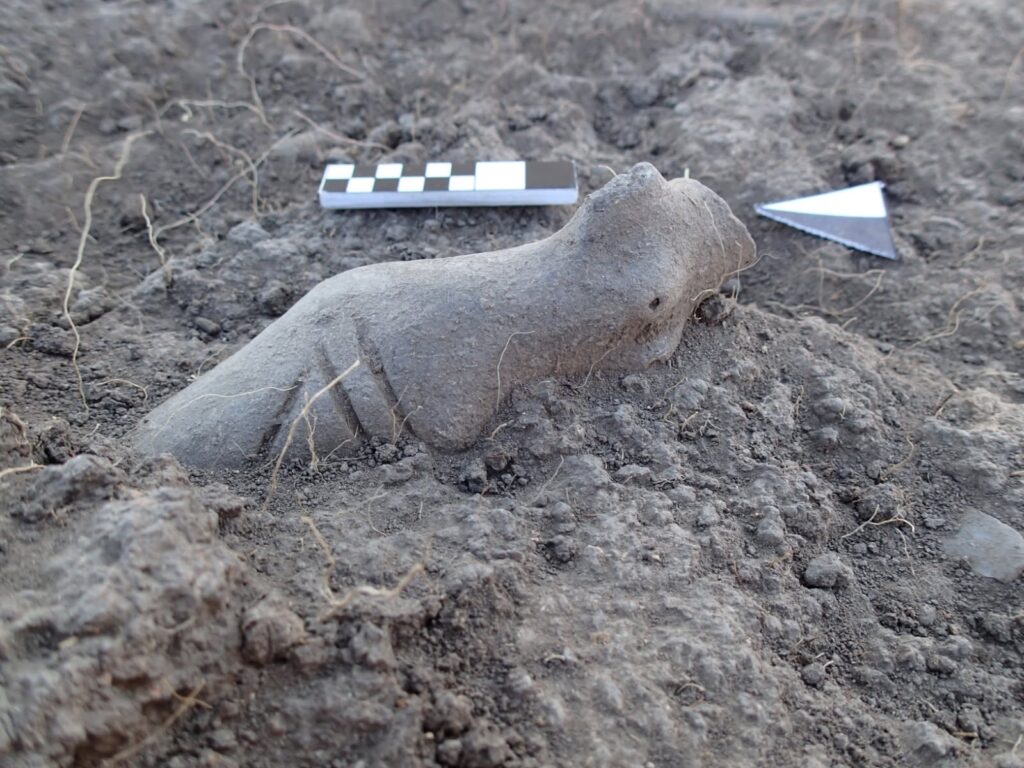
Headless figurines at Kanlıtaş Höyük in western Türkiye may preserve one of the most intimate traces of Neolithic ritual behavior: the moment when a building was deliberately closed, and something meaningful was left behind.
The four clay female figurines, found near İnönü in Eskişehir Province, date back roughly 8,000 years. Their discovery in the lower fill levels of rectangular buildings suggests that Neolithic communities in Inner Western Anatolia may have marked the end of certain spaces with a deliberate ritual act.
The figurines were recovered during excavations led by Prof. Dr. Ali Umut Türkcan of Anadolu University. Although fieldwork at the site has ended, post-excavation studies continue to refine what Kanlıtaş Höyük can tell us about belief, settlement life, craft production, and cultural contact in the late Neolithic and Early Chalcolithic periods.
A rare ritual clue from Inner Western Anatolia
Kanlıtaş Höyük is one of the earliest known settlements in the cultural zone known as the Porsuk Culture, a prehistoric horizon associated with Eskişehir, Afyonkarahisar, and Kütahya. The mound occupies a key position between Central Anatolia, northwestern Anatolia, and the routes leading toward the Marmara and Balkan worlds.
Excavations revealed many rectangular-planned buildings and enclosed spaces. In several of these areas, archaeologists found terracotta female figurines near floor levels within the fills. According to Türkcan, the fact that the figurines were discovered in spaces that appear to have been intentionally closed strengthens the idea that they were not ordinary discarded objects.
The most striking detail is their missing heads. Some of the figurines may have been deliberately broken before deposition. For Türkcan and his team, this raises the possibility that the objects were left as offerings during building closure rituals.
Small objects, deliberate gestures
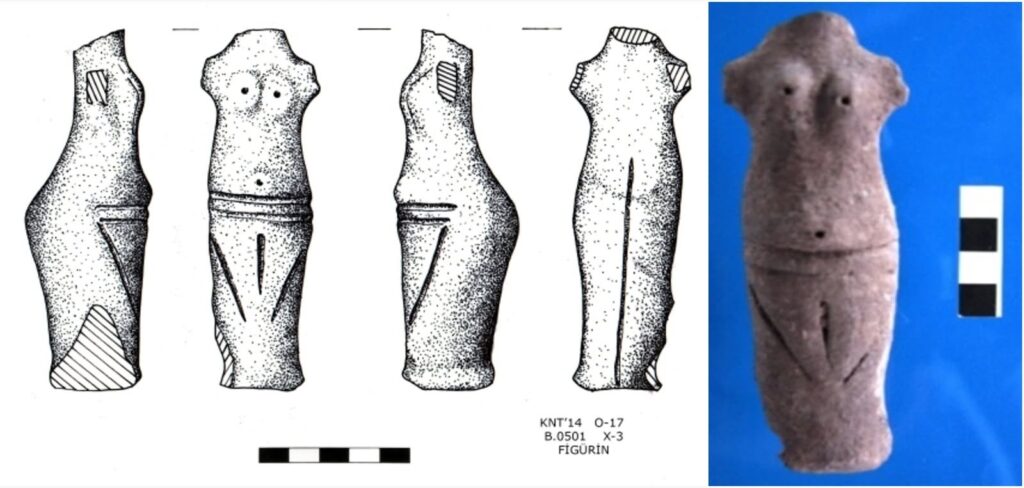
The figurines vary in size. The largest and most distinctive example measures about 12 to 13 centimeters, while the others are generally around 5 to 6 centimeters high. All were made of fired clay, a material widely used for symbolic objects across Neolithic Anatolia.
Figurines are common in Neolithic contexts, but the Kanlıtaş examples stand out because of their findspots and physical condition. Their broken or missing heads are not treated simply as damage. In archaeology, the position of an object can be as important as the object itself. A figurine found in a living area tells one story; a headless figurine placed near the floor of a sealed structure tells another.
At Kanlıtaş, the pattern points toward a ritualized act connected with the end of a building’s use. The people who lived there may have closed rooms, houses, or special spaces not only by filling them physically, but also by marking the act symbolically.
A tradition also known from Çatalhöyük
Türkcan notes that similar building closure practices and the deposition of figurines are known from Neolithic Çatalhöyük in central Türkiye. This comparison does not mean Kanlıtaş copied Çatalhöyük directly. Rather, it suggests that certain ritual habits may have circulated across Anatolia during a period of intense social and cultural change.
In Neolithic and Early Chalcolithic communities, buildings were not always treated as disposable shelters. Houses could carry memory, identity, and social meaning. When a structure reached the end of its life, people sometimes closed it with care. Floors were covered, fills were placed, and objects were deposited in ways that seem intentional rather than accidental.
The Kanlıtaş figurines fit into this wider pattern. Their presence hints at a world in which architecture, memory, and ritual were closely linked.
Female figurines with Balkan echoes
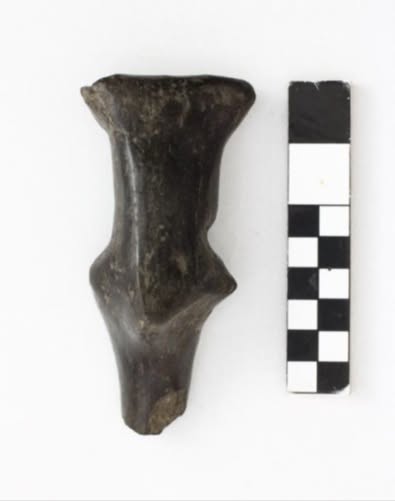
The Kanlıtaş figurines also attract attention because of their form. Türkcan points especially to the emphasized hip area, a feature that distinguishes them from some other Anatolian examples. This detail has drawn comparisons with early female figurines from the Balkans, particularly regions associated with the former Yugoslavia.
That connection matters because Kanlıtaş Höyük and the Porsuk Culture have long been discussed in relation to the development of the Vinča Culture in the Balkans. Radiocarbon dates indicating the earlier position of the Porsuk Culture add weight to the idea that Inner Western Anatolia was not a marginal zone, but an active cultural corridor.
Kanlıtaş stood at a meeting point. Traditions from Central Anatolia, northwestern Anatolia, and the Balkans may have passed through this landscape, leaving traces in pottery, architecture, craft production, and symbolic objects.
More than a ritual site
Kanlıtaş Höyük is important not only for the figurines. Studies of the site have shown that it was also a settlement with strong evidence for specialized production. Research has identified marble bracelets, magnesite tools, chipped stone materials, pottery, grinding stones, bone tools, and other finds that point to a complex prehistoric community.
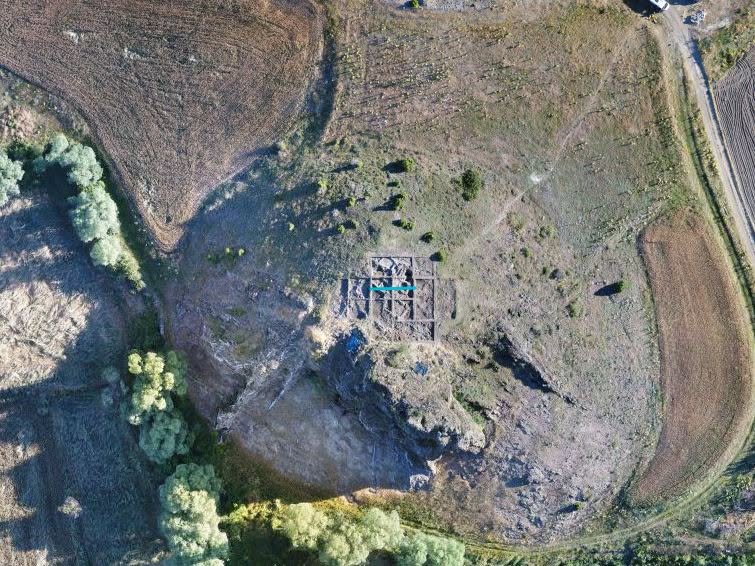
The mound is located near Aşağı Kuzfındık village, in a valley landscape west of Eskişehir. Archaeological research in the wider area has also revealed earlier traces of human activity, including Paleolithic finds in the Kuzfındık Valley. This gives the region a much deeper archaeological background than the Neolithic settlement alone.
For Kanlıtaş, however, the 8,000-year-old figurines offer a different kind of evidence. They do not speak of tools, food, or craft. They speak of gestures. Someone broke or placed them. Someone closed a space. Someone marked an ending.
Kanlıtaş adds a new layer to Neolithic belief
The discovery strengthens the view that Neolithic ritual life in Anatolia was not limited to famous centers such as Çatalhöyük or Göbekli Tepe. Smaller and less widely known settlements also preserved complex symbolic practices.
Kanlıtaş Höyük now adds Inner Western Anatolia to that discussion with unusual clarity. The headless figurines suggest that ritual behavior could be embedded in everyday architecture, carried out at the level of rooms, floors, and building fills.
Türkcan and his team plan to publish the results of their work in a comprehensive scientific monograph and a separate reference volume. Those studies are expected to clarify Kanlıtaş Höyük’s role in the Porsuk Culture and its possible connections with wider Anatolian and Balkan traditions.
For now, the four headless figurines remain a powerful reminder that archaeology often finds belief in small things. Not in temples or monuments, but in a clay figure left behind when a building was closed 8,000 years ago.
Cover Image Credit: Arkeoloji Haber via Facebook
