
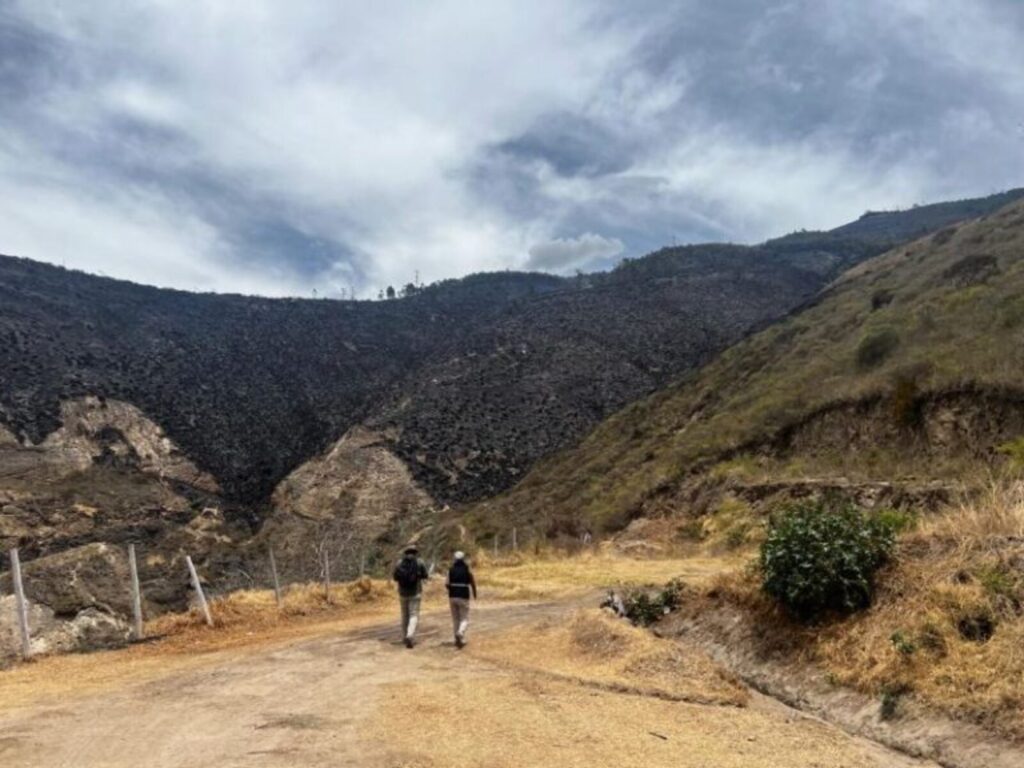
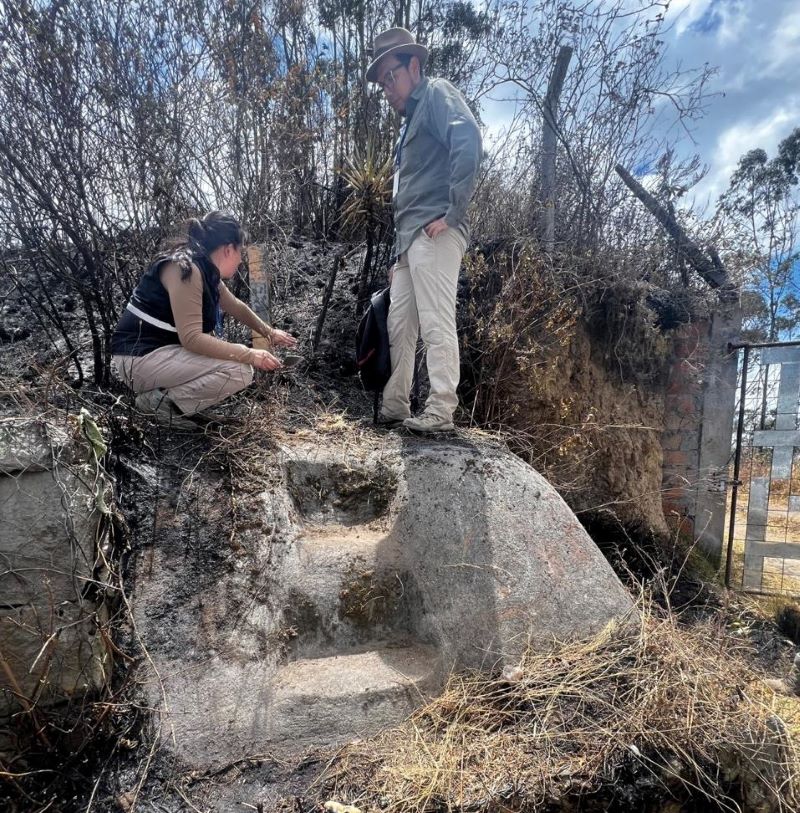
A wildfire that swept across Cerro Casitagua near Quito has exposed an archaeological feature that had remained concealed beneath vegetation: a section of steps carved directly into the rock.
Archaeologists from Quito’s Metropolitan Heritage Institute (Instituto Metropolitano de Patrimonio, IMP) identified the structure while inspecting archaeological sites affected by the fire, which burned across the mountain between September 17 and 20. The institute says the newly visible stairway may have an Inca connection, although further investigation will be needed before its age and purpose can be established.
The location makes the discovery particularly intriguing. The steps lie near the Radioloma culunco, an ancient pre-Hispanic trail in the Lulumbamba Valley, an area containing evidence of human occupation stretching back thousands of years.
A wildfire uncovered what vegetation had hidden
After the fire stripped vegetation from parts of Casitagua, IMP specialists surveyed four known archaeological locations: Tagshima, Barrio Cuba Alto, Radioloma and Huiyachul, also known as Uyachul.
Tagshima and Huiyachul showed no visible surface damage, while burned vegetation appeared at Barrio Cuba Alto without evidence that archaeological material had been affected. At Radioloma, the ancient trail itself also appeared to have escaped significant damage.
Nearby, however, the changed landscape revealed something archaeologists had not previously documented: a stretch of steps cut directly into the natural rock. IMP described the structure as possibly belonging to the Inca period and said specialists will now investigate its characteristics and relationship to the surrounding archaeological site.
For the moment, the Inca attribution remains a hypothesis rather than a confirmed identification. No dating results have been announced, and the region contains archaeological remains from periods long before the Inca expansion into northern Ecuador.
Why archaeologists are considering an Inca connection
The location of the stairway offers important context. It stands close to a culunco, a type of ancient pathway, within a landscape where archaeologists have recorded roads, fortified sites known as pucarás, and settlement areas.
Pomasqui, on the northern side of Quito, also occupied an important position during the Inca expansion into the northern Andes. Historical and archaeological research indicates that the Incas relocated mitimae communities into the valley and incorporated the area into their political and agricultural system. The local government of Pomasqui records the presence of Quechua-speaking groups transferred there following Inca expansion.
Nearby Rumicucho provides another piece of that landscape. Archaeological research has interpreted the pucará as part of the infrastructure associated with Inca expansion during the late 15th century. Its elevated position allowed control over movement through a region connected to important interregional routes, including routes toward northwestern Ecuador.
A rock-cut stairway beside an existing pre-Hispanic route therefore fits a landscape that the Incas clearly used. That context explains the IMP’s cautious suggestion of an Inca affiliation, but it does not by itself prove who carved the steps.
Casitagua was occupied long before the Incas
Casitagua’s archaeological history extends much deeper into the past.
At the Tagshima archaeological site on the southern slope of the mountain, investigations conducted by the IMP previously uncovered evidence dating between approximately 1500 and 500 BCE. Archaeologists found compacted floors, hearths, postholes, polished stone objects, decorated ceramics and ancient animal remains.
Tagshima covers roughly 50 hectares and sits more than 3,000 meters above sea level. Its remains show that people were living and working around Casitagua well over a millennium before the Inca state reached this part of the Andes.
That longer history makes the newly discovered stairway more complicated — and potentially more interesting. The structure could belong to the Inca period, but archaeologists must also consider the communities that occupied the Lulumbamba and Pomasqui valleys before them.
A new piece of Quito’s ancient landscape
The discovery adds another element to an already dense archaeological landscape north of modern Quito. According to the IMP, the Lulumbamba Valley contains pucarás, ancient paths, roads, and habitation areas representing successive periods of human activity from the Preceramic era through the colonial period.
The fire that exposed the steps also demonstrated how much of that landscape may remain difficult to see beneath modern vegetation. In this case, an environmental disaster unexpectedly revealed a feature that archaeologists can now document and study.
Further work will need to determine when the stairway was carved, how far it extends, and whether it formed part of the nearby Radioloma route. Until then, its possible Inca connection remains an archaeological question rather than a conclusion — but its location places it directly within one of the most historically complex landscapes in the northern Andes.
