

New research at Hagbard’s Gallows, a Bronze Age monument in southwestern Sweden, has dated the construction of one of its monumental mounds to roughly 1400–1200 BC. The results suggest that the unusual site, where standing stones, rock art and burial mounds occur together, is several centuries older than previous estimates based mainly on the style of its carvings.
Located in Asige parish in Halland, Hagbard’s Gallows consists of two pairs of monumental standing stones positioned on two mounds about 40 meters apart. The stones rise between 3.5 and 4 meters high, and three carry carved motifs that include concentric circles, human figures, circular designs and a ship.
Standing stones, rock art and burial mounds all occur elsewhere in Scandinavia. What makes Hagbard’s Gallows exceptional is their combination in a single monument. According to the researchers, no comparable arrangement of all three elements is currently known elsewhere in northern Europe.
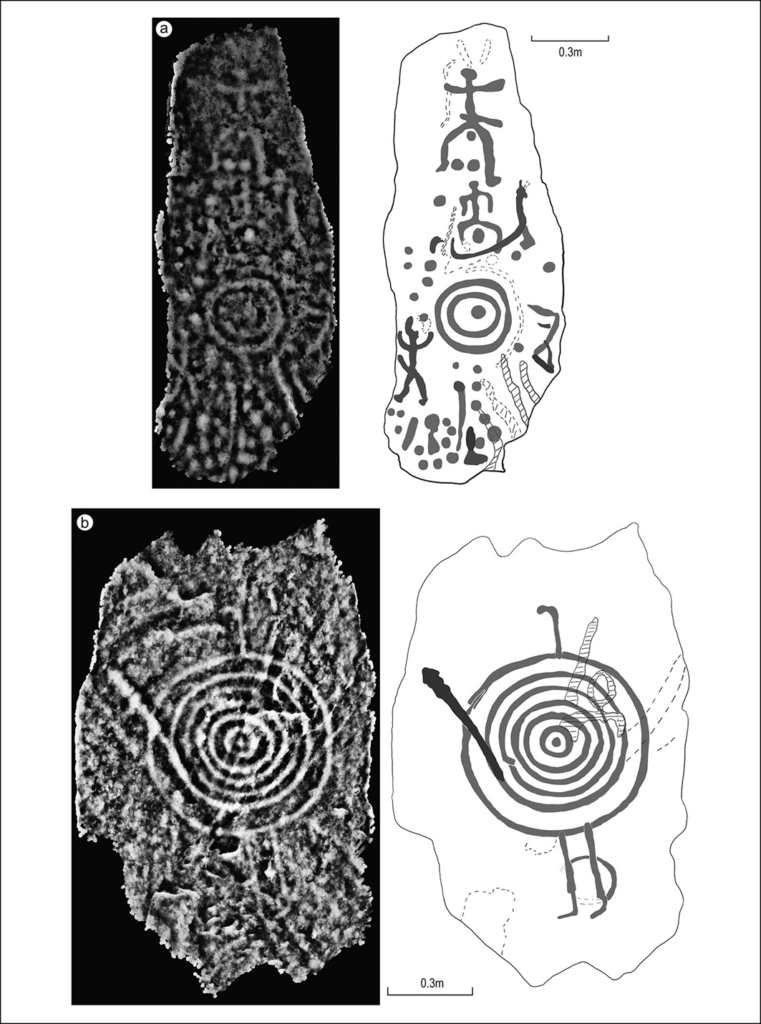
Dating a monument that had never been excavated
Despite its prominence, archaeologists had not previously excavated the monument itself. Earlier chronological estimates relied largely on comparison with other Scandinavian rock art, placing the decorated stones around 1100–900 BC.
A research project launched in 2023 set out to establish a firmer chronology and understand how the monument related to the surrounding Bronze Age landscape. Archaeologists carried out small-scale excavations in 2024 after ground-penetrating radar indicated possible buried features near the mounds.
One trench cut into the edge of the larger mound. Excavators found that its base consisted of redeposited glaciofluvial sediments covered by three layers of cobbles, some of which appear to have been brought from deposits several hundred meters away.
A sample of birch charcoal from beneath the lowest cobblestone layer produced a calibrated date that broadly fell within the late second millennium BC. Because older charcoal can sometimes become incorporated into later construction deposits, the team did not rely on radiocarbon dating alone.
Instead, the researchers also used optically stimulated luminescence, or OSL, which can determine when mineral grains were last exposed to sunlight. Three of four OSL samples produced dates of approximately 1400–1200 BC, closely matching the radiocarbon evidence. Together, the two methods allowed the researchers to associate the charcoal securely with the construction of the mound.
The results place the foundation of the monument several centuries before the tentative 1100–900 BC date assigned to some of its rock art.
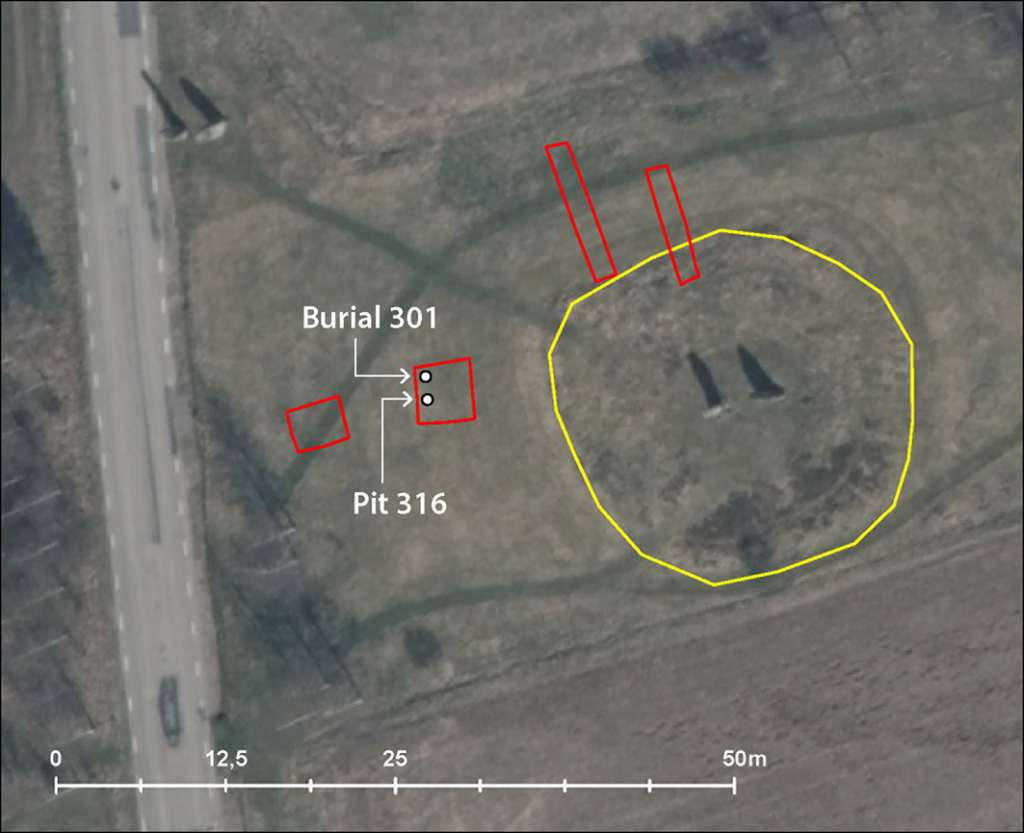
Site plan showing the mound (yellow line) and the trenches (red outlines). OSL samples were taken from the trench that cuts into the mound (figure by Anders Andersson & Stina Tegnhed, Kulturmiljö Halland). Credit: Skoglund et al. (2026), Antiquity
A child burial reveals a later chapter
Excavations beside the mound also uncovered another striking feature: an urn containing the cremated remains of a child who had died at around 10 years of age.
Radiocarbon measurements from burned birch and bone dated the burial to approximately 1000–800 BC. That places the cremation several centuries after the mound was first constructed and roughly within the period previously proposed for the rock carvings.
The difference between the mound’s construction date, the later rock art, and the child burial points toward a monument that developed over time rather than appearing as a single building event.
The researchers suggest that Hagbard’s Gallows may have passed through at least two major chronological phases. The mound and its standing stones appear to have begun around 1400–1200 BC, while later generations added or interacted with rock art and burials several centuries afterward.
This longer sequence changes the way the site can be understood. Rather than representing a single moment in the Bronze Age, Hagbard’s Gallows appears to have remained meaningful across generations, accumulating new carvings and funerary activity long after its original construction.
For a monument already unusual within northern Europe, the new chronology adds another layer of significance: Hagbard’s Gallows was not simply built and abandoned. Its archaeological record suggests a place repeatedly revisited and reshaped over centuries.
Skoglund, P., Díaz-Guardamino, M., Tegnhed, S., Andrieux, E., Möller, P., Axelsson, T., & Wranning, P. (2026). Hagbard’s Gallows in context: dating a Bronze Age monument in south-western Sweden. Antiquity, 1–7. doi:10.15184/aqy.2026.10426
