
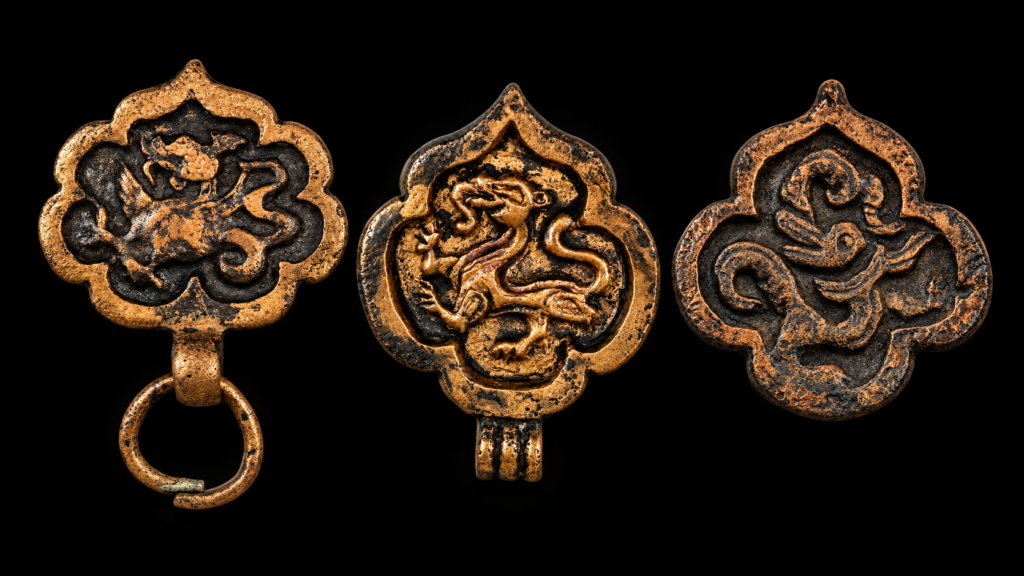
Three medieval bronze ornaments decorated with dragons and other fantastic creatures, discovered in the Russian city of Veliky Novgorod, may have originated in the Golden Horde, the powerful Mongol successor state that dominated much of Eastern Europe for centuries.
The three bronze fittings were discovered in 2023 during excavations at Troitsky XVII in the historic centre of Veliky Novgorod, in archaeological layers dating to the 14th and 15th centuries. Recently presented by the Novgorod State Museum-Reserve, the objects have attracted attention for their unusual decoration and metal composition.
Analysis revealed unusually high nickel levels, suggesting they were manufactured outside Novgorod, possibly in the Volga region, where similar ornaments were associated with the belts of Golden Horde warriors.
Three Dragons, Three Different Designs
Although all three bronze fittings have pointed outlines and shaped edges, each displays a distinct fantastic creature. Their surfaces also preserve evidence of different manufacturing techniques, allowing researchers to examine how medieval craftsmen produced and repaired these decorative objects.
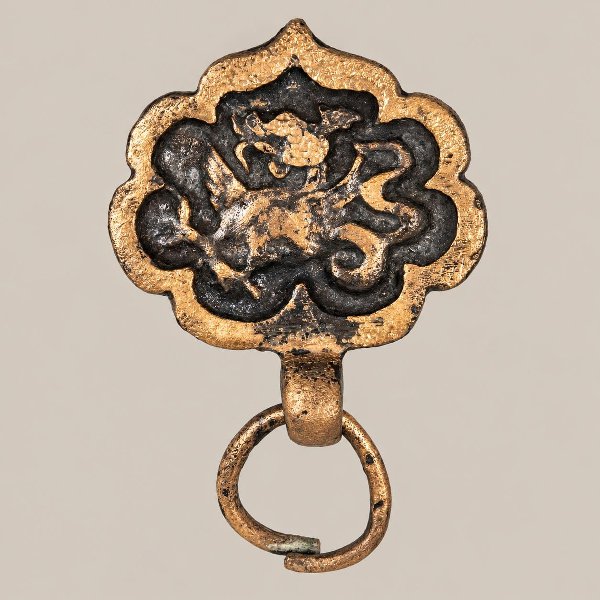
The first fitting depicts a dragon with a curved body and raised forelegs. Researchers determined that the craftsman used a clay mould made from an impression of an existing object. Repeated copying gradually reduced the sharpness of the smaller decorative details. Closely matching representations have been identified on the Karelian Isthmus and in Crimea.
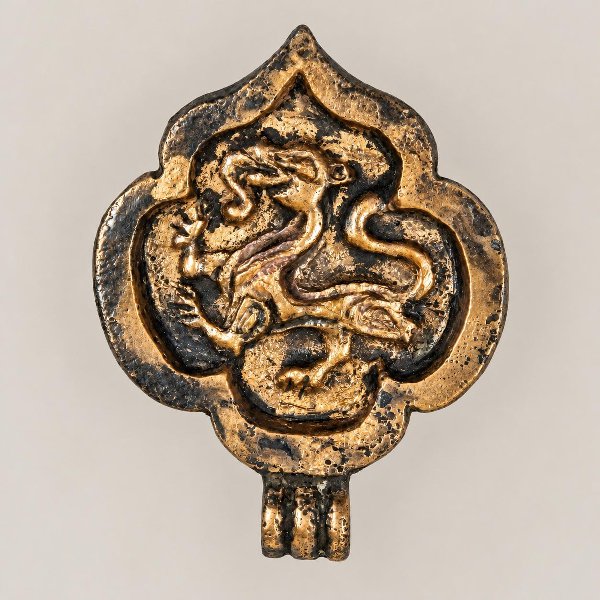
The second ornament shows a winged creature with a substantial body, a curling, serpent-like tail, and forelegs stretched forward. A metal ring remains attached through a loop along its lower edge. Comparable designs occur frequently in the Middle and Lower Volga regions.
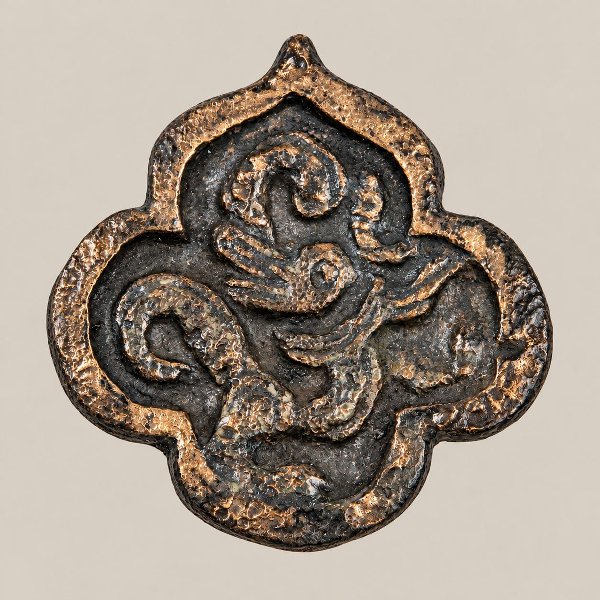
The third fitting preserves particularly clear details, including a long neck, small head, almond-shaped eye, rounded ears, curved tongue and raised tail. Its maker carefully finished the relief after casting. Marks on the reverse suggest that someone later attempted to repair or replace the attachment points.
Similar ornaments had previously been recovered during excavations at Novgorod’s Nutny IV and Alekseevsky II sites in 2011 and 2012, although the newly examined group remains an unusual discovery for the city.
Metal Analysis Suggests an Origin Beyond Novgorod
According to the Novgorod State Museum-Reserve, all three fittings were cast from tin-lead bronze and share almost identical chemical compositions. However, their unusually high nickel content distinguishes them from bronze objects produced by Novgorod’s own metalworkers, providing an important clue to their possible origins.
This difference led researchers to propose that the ornaments were manufactured elsewhere and subsequently brought into the city. Although the analysis does not identify a particular workshop, the combination of metallurgy and decorative parallels points towards connections with the Volga region.
Belt fittings decorated with dragons and other fantastic creatures appeared during the first half of the 13th century and became associated with the military culture of the Golden Horde. In the wider Turkic and Mongol world, dragons carried symbolic associations with power, protection and authority, while older Central Asian traditions also linked them to water, fertility and cosmic order.
Some researchers have proposed that the Golden Horde adopted dragon-decorated military belts from Chinese imperial traditions, although the motif also had an established place in Turkic and Central Asian visual culture. Numerous comparable fittings have been recovered across the Middle and Lower Volga regions, important centres of the Golden Horde.
These parallels suggest that the Novgorod ornaments may have arrived through contacts with territories controlled by the Golden Horde. Whether carried by warriors or circulated through exchange remains uncertain, but their discovery illustrates how decorative traditions travelled across medieval Eastern Europe.
The Golden Horde and Its Influence Across Eastern Europe
The Golden Horde emerged from the western territories of the Mongol Empire during the 13th century. Its ruling dynasty descended from Jochi, the eldest son of Genghis Khan, while Batu Khan expanded its power across the Eurasian steppe and into the Rus’ principalities.
At its height, the state controlled vast territories extending from the eastern European steppes towards western Siberia. Its political centres included Sarai on the Lower Volga, a region that developed into an important crossroads for commerce, administration and cultural exchange.
Although Mongol dynastic traditions remained central to its political organisation, the Golden Horde encompassed diverse populations and gradually developed a predominantly Turkic-speaking and Islamic character. During the reign of Öz Beg Khan in the early 14th century, Islam became increasingly prominent within the ruling establishment.
Its influence over the Rus’ principalities involved tribute collection, political appointments, and the recognition of local rulers. Novgorod retained its own institutions and commercial importance while operating within the wider political conditions created by Mongol supremacy.
Belts and their elaborate metal fittings formed part of the material culture of the Golden Horde’s military world. The decorations found in Novgorod offer a tangible example of how objects associated with that world could circulate far beyond their probable centres of manufacture.
The objects also illustrate the difficulty of identifying historical encounters through archaeology. A decorative fitting can establish the presence of a particular artistic or manufacturing tradition without necessarily revealing the identity of the person who carried it.
From a Medieval Excavation to the Museum Collection
The discoveries came from archaeological work led by Olga Tarabardina, head of the museum’s Archaeological Research Centre. Excavations at Troitsky XVII accompanied construction preparations for the Valentin Yanin National Historical and Archaeological Centre.
Novgorod’s archaeological deposits have yielded extensive evidence of medieval urban life, including objects associated with domestic activity, craftsmanship and exchange. The three dragon-decorated fittings add another element to this material record, linking the city’s archaeological heritage to artistic traditions documented across a much wider geographical area.
Their recent transfer to the Novgorod State Museum-Reserve will allow the objects to be preserved and presented alongside related medieval finds.
