
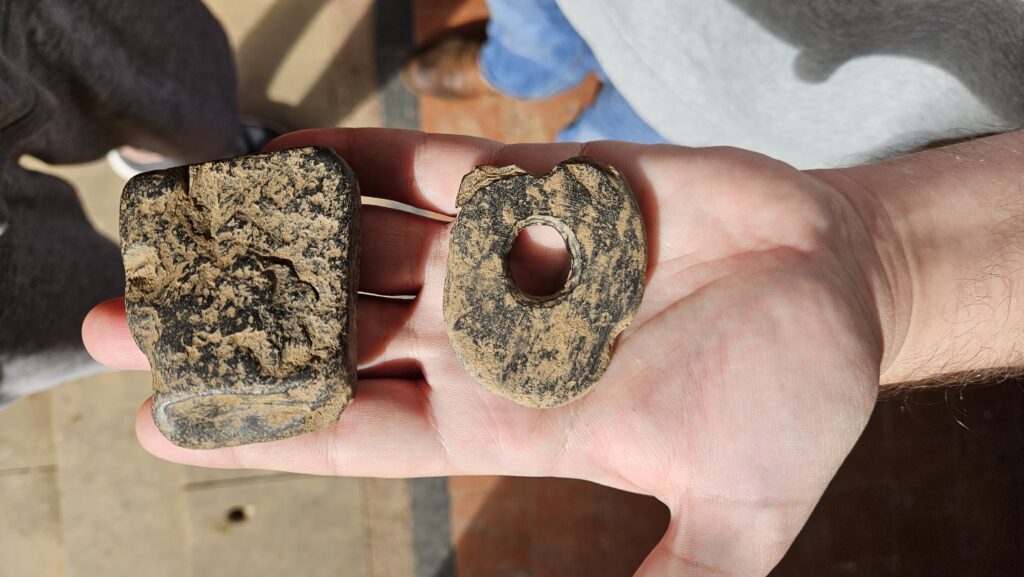
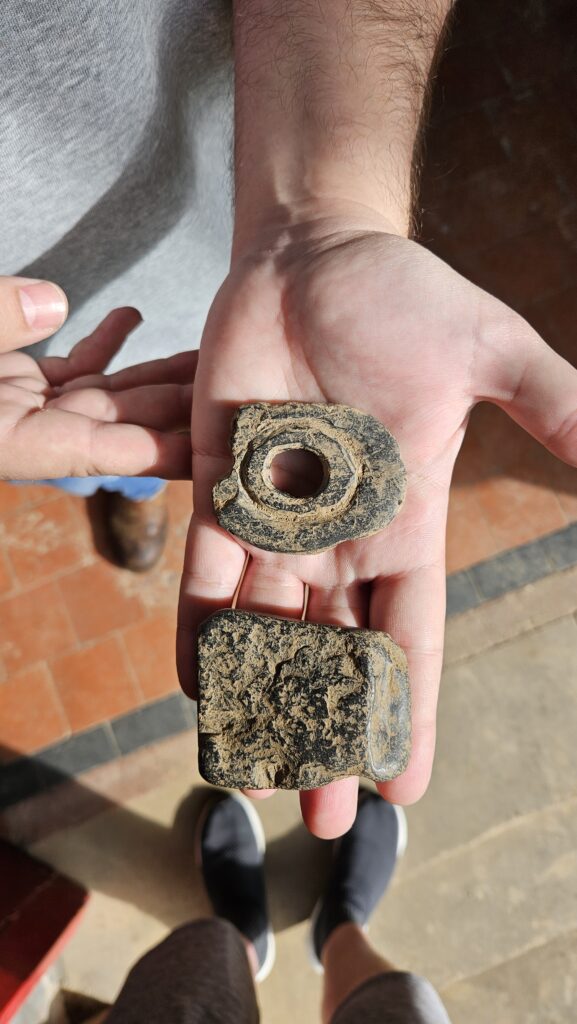
An unfinished shale ring discovered in a 1,500-year-old Glasgow churchyard has revealed evidence of an early medieval jewellery workshop at Govan Old, offering a rare glimpse into craft and elite life in the Kingdom of Strathclyde.
The ring was found during excavations at Govan Old, one of Scotland’s most important early medieval Christian sites. Rather than a finished piece of jewellery, archaeologists uncovered a “roughout” — a piece of shale that had already been shaped as part of the process of turning the stone into a finger ring. Together with other pieces recovered from the site, the object points to jewellery production taking place within the ancient ecclesiastical complex.
The find may look modest, but it offers something archaeologists rarely recover so clearly: evidence of an object caught in the middle of its manufacture.
Researchers believe shale rings were fashionable among the high-status inhabitants who lived around Govan between roughly 1,000 and 1,500 years ago. The dark stone may even have been chosen because it resembled jet, a rarer and more expensive material prized for jewellery. Similar objects appeared during excavations in the 1990s, but the new discoveries strengthen the case that such rings were not simply worn at Govan — they were being made there.
A workshop beside a royal church
That distinction matters because Govan was no ordinary settlement. Archaeological evidence indicates that the site had served as a Christian centre from around AD 500, while burials excavated beside the present church have been scientifically dated to the fifth and sixth centuries.
During the early medieval period, Govan became closely associated with the Clyde Britons, the Old Welsh-speaking people who controlled much of the Clyde valley. Their kingdom was originally centred on Dumbarton Rock, known as Alt Clut, until Viking forces captured the stronghold in AD 870 after a four-month siege. The royal dynasty subsequently appears to have shifted its political focus toward Partick, directly across the River Clyde from the already ancient church centre at Govan.
The presence of jewellery production fits that wider picture. High-status Christian and royal centres across early medieval Europe often supported specialist craftspeople, and archaeologists now see the growing collection of jewellery-working evidence at Govan as another indication of the site’s wealth and political importance.
Govan is already famous for the Govan Stones, one of Britain’s largest collections of early medieval carved sculpture. Produced during the period of the Kingdom of Strathclyde, the monuments include elaborately carved crosses, grave markers and the celebrated Govan Sarcophagus.
Archaeology beneath the churchyard
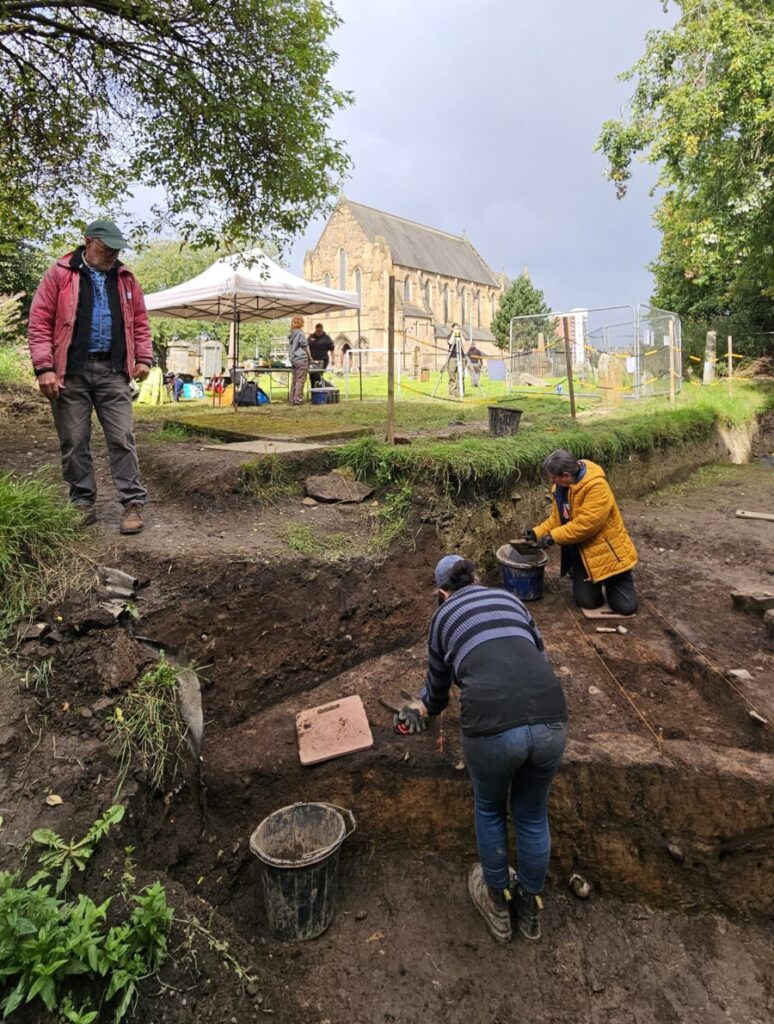
The latest work forms part of a community archaeology project that began in 2023. Led by Professor Stephen Driscoll of Govan Heritage Trust, with volunteers and Clyde Archaeology, the excavations have returned to areas of the churchyard first investigated during the 1990s.
Those earlier trenches revealed fragments of a roughly 1,300-year-old roadway believed to have connected the church precinct with Doomster Hill, once an important meeting and ceremonial site near Govan Cross. The same part of the churchyard lies close to where the Govan Sarcophagus was discovered in 1855; its missing lid has never been found and may still survive somewhere beneath the surrounding ground.
The unfinished shale ring now adds a more personal dimension to that landscape. Monumental sculpture records the power and beliefs of Govan’s early medieval community, but this small piece of worked stone captures something different: a craftsman shaping an object that someone, perhaps a member of the local elite, was expected to wear.
For archaeologists, that unfinished ring may therefore be more revealing than a completed piece of jewellery. It preserves a moment from the workshop itself — and strengthens the picture of Govan as a place where religion, royal authority and skilled craftsmanship came together more than a thousand years ago.
