

23 June 2026 The Future is the Product of the Past

Two Durham Archaeology Students, One from Türkiye, Earn Prestigious Awards for Research on Ancient Lycia

In a remarkable achievement for Anatolian studies, two Durham University-affiliated archaeology students have received prestigious awards for their research on ancient Lycia (Trm̃misa), a culturally rich region of southwestern Anatolia.

Durham’s world-leading Department of Archaeology celebrates the success of two postgraduate researchers recognised for their outstanding work on Lycian history and funerary art.

Durham University’s globally respected Department of Archaeology continues to solidify its reputation as a centre of academic excellence, with two of its affiliated PhD students receiving high-profile awards for their pioneering research into the ancient region of Lycia (Trm̃misa) in southwest Anatolia.

Batuhan Özdemir and Eloise Jones—both supervised by Dr Cathie Draycott, a leading expert in Anatolian art and archaeology—have been honoured for their research that explores different facets of Lycian identity, art, and cultural heritage.
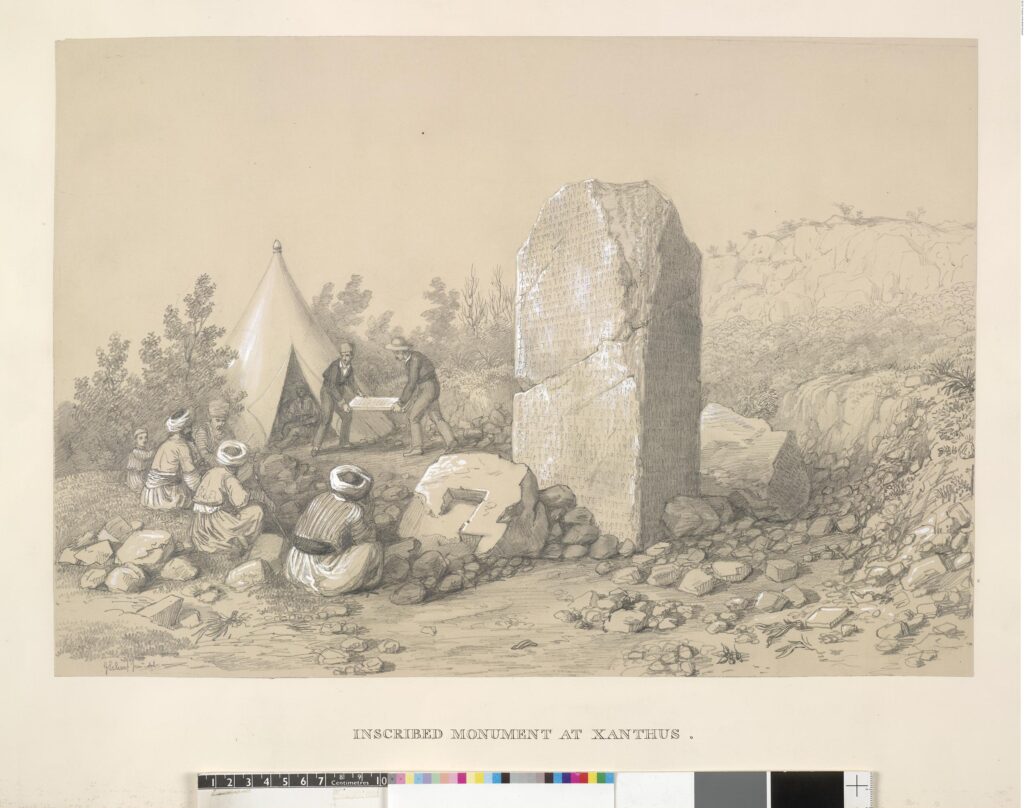
George Scharf Jr 1884, view of the Inscribed Pillar, Xanthos, with workers and onlookers. (c) The Trustees of the British Museum

Batuhan Özdemir: Revisiting the Politics of Lycian Antiquities

Batuhan Özdemir has been awarded a prestigious Post-doctoral Fellowship jointly hosted by the British Institute at Ankara (BIAA) and Bilkent University. This fellowship supports his continued work on the geopolitical and cultural narratives surrounding Lycian antiquities in 19th-century Britain.


📣 Our WhatsApp channel is now LIVE! Stay up-to-date with the latest news and updates, just click here to follow us on WhatsApp and never miss a thing!!


His recently submitted PhD dissertation, “Geopolitics and Cultural Identities in the 19th Century: Framing Charles Fellows’s Lycian Collection in the British Museum,” critically examines how Lycian artefacts were collected and displayed during a period of British imperial expansion. His research highlights how colonial attitudes shaped public perceptions of Lycia and continue to influence modern understandings.

Batuhan also co-authored a paper with his supervisor titled “Framing Lycia at the British Museum: Class, Colonialism, and the Clash Between the Picturesque-Hellenic Ideal and the Marginalised ‘Other’ in the 19th Century,” which will be presented at a major international conference—”The Ancient Mediterranean and the British Museum: Pasts and Futures”—in February 2026.

Sponsored by the Turkish Ministry of National Education during his doctoral studies, Batuhan is set to begin a permanent academic position at Ankara Hacı Bayram Veli University, further strengthening scholarly ties between the UK and Turkey.

Batuhan Özdemir. Credit: Durham University

Eloise Jones: Decoding Gender and Myth in Lycian Tomb Art

Eloise Jones has been awarded a highly competitive Leverhulme Trust Studentship, enabling her to continue field research in Istanbul. A Durham MA graduate (2021), Ellie is now pursuing her PhD at the University of Liverpool under the supervision of Dr Alan Greaves, with external supervision from Durham.

Her dissertation, “With Flashing Eyes: Femininity, Mythology, and Apotropaism in Lycian Funerary Iconography from the 6th–4th Century BCE,” investigates how Classical Lycian tombs incorporate symbolic representations of gender, myth, and protective motifs. Her work offers fresh interpretations of how ancient societies viewed femininity, death, and the afterlife.

Before beginning her PhD, Ellie worked as a research assistant at the British Institute at Ankara, further deepening her experience in Anatolian archaeology.

Eloise Jones. Credit: Durham University

World-Class Supervision and Global Recognition

Both students have been mentored by Dr Cathie Draycott, a prominent scholar in the art and archaeology of Iron Age and Classical Anatolia. Her latest research, “How do you describe what lies in-between? Bricolage, network thinking and Lycia-Trm̃misa,” will appear in Topoi. Orient-Occident (Issue 27, 2024).

Durham’s Department of Archaeology provides students with cutting-edge, research-led teaching and hands-on training, ensuring they are equipped with the academic and transferable skills required to excel on the global stage.

About Durham University

Durham University is a World Top 100 University (QS World University Rankings 2026) and a UK Top 5 university (Times and Sunday Times 2025; Complete University Guide 2026). It is ranked:

6th globally for Archaeology (QS 2025)

22nd globally for Sustainability

64th globally for Graduate Employability

With a strong academic reputation and a vibrant international community, Durham continues to foster world-class research and educational excellence.

Durham University

Related Articles

In French Necropolis 21 Roman “curse tablets” discovered including one written in the extinct Celtic language of Gaulish

18 January 2025

18 January 2025

During the excavation of an eighteenth-century hospital in north-western France by researchers from the Orléans Archaeological Service, a 2,000-year-old necropolis...

1,500-year-old baptistery found in Kadı Castle-Anaia Mound in western Turkey

3 December 2021

3 December 2021

A baptistery, estimated to have been built in the 5th century AD, was unearthed in the Kadı Castle-Anaia Mound in...

One of the Largest Prehistoric Burial Grounds Ever Found in Bavaria Unearthed During Power Line Work

11 September 2025

11 September 2025

Archaeologists call the discovery a “sensation” as 22 prehistoric skeletons and rare artifacts are uncovered near Regensburg. Archaeologists in Bavaria...

A large stone monument depicting the goddess Ishtar has been unearthed in the ancient Assyrian city of Nimrud

26 June 2023

26 June 2023

Archaeologists from the University of Pennsylvania Museum of Archeology and Anthropology, working with an Iraqi excavation team, have unearthed a...

Lost Viking Gold Pendant Unearthed in Norfolk Rewrites the Story of the Great Heathen Army’s Invasion

1 March 2026

1 March 2026

A rare gold coin pendant believed to have been worn by a Viking Great Army warrior during the 865 invasion...

Discovery Shedding Light on the Mysteries of Anatolia: 3500-year-old Double-Headed Eagle Seal

21 October 2024

21 October 2024

A grain silo and two different seal impressions, one of which is a double-headed eagle, were found during the excavation...

Petalodus shark teeth found for the first time in China

29 August 2021

29 August 2021

A 290 million-year-old fossil of a shark with petal-shaped teeth has been discovered in China. Seven well-preserved Petalodus teeth were...

Hidden 13th-century carving of ‘face of Christ’ discovered in Ballymore, Ireland

12 May 2022

12 May 2022

At Ballymore, in the county of Westmeath, Ireland, sunlight led to an interesting and special discovery. The sunlight revealed that...

Stone Age Boy in Sweden Buried in Spectacular Fur and Woodpecker Feather Headgear

5 March 2026

5 March 2026

Advanced soil analysis uncovers hidden details of Mesolithic clothing at Skateholm cemetery More than 7,000 years ago, along the southern...

Underwater Archaeologists discovered World’s Largest and Oldest ancient shipyard on Dana Island, Türkiye

31 October 2023

31 October 2023

The ruins of the world’s largest and oldest ancient shipyard were found in the north of the island of Dana,...

Underground Tunnels Discovered in Cusco, Reviving Inca Legends

31 January 2025

31 January 2025

Underground tunnels, long rumored in local legends, have been discovered beneath Cusco, Peru, the former capital of the Inca Empire....

Largest ever Roman silver hoard in Germany found in Augsburg

12 November 2021

12 November 2021

Archaeologists in Augsburg, Germany, revealed unearthed a historical hoard including 15 kg of silver coins from the Roman Empire’s era....

Maya Farmers May Have Planned Population Growth Contrary to Thought

19 November 2021

19 November 2021

Contrary to what was thought, Maya farmers may have planned for population growth, says a new study. According to a...

New Research Reveals Previously Unknown Aspects of the Construction, Use, and Ritual Significance of a Neolithic Rondel Found in Poland

12 December 2024

12 December 2024

An archaeological excavation at Nowe Objezierze in north-western Poland has uncovered a rondel dating to around 4800 BC, offering new...

3D Technology Reveals 2,000-Year-Old Gladiator Graffiti and Love Messages in Pompeii

21 January 2026

21 January 2026

For more than two centuries, the walls of Pompeii have been studied, photographed, and catalogued. Yet new research shows that...