
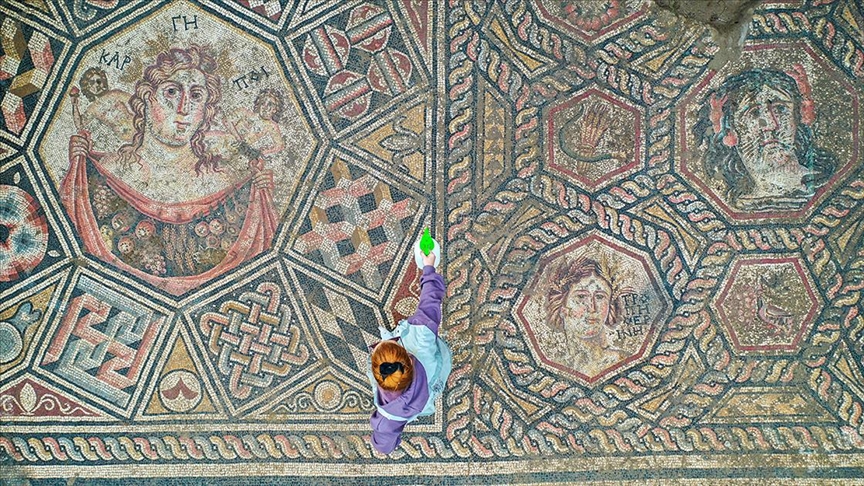
An extraordinary archaeological discovery in the town of İznik, Türkiye, is reshaping modern understanding of Roman art and regional mythology. After lying concealed beneath a residential street for more than a decade, a vibrant 3rd-century floor mosaic has finally been uncovered in full scale.
The artwork, preserved with remarkable clarity, features highly detailed mythological figures and geometric compositions. Yet the most captivating revelation is a symbolic portrait of Lake İznik itself, represented as a woman. As archaeologist Yusuf Kahveci explained, “They depicted Lake İznik as an ancient woman,” an artistic decision that gives the mosaic both cultural depth and historical uniqueness.
From a Chance Discovery to a Major Excavation
The mosaic’s existence first came to light in 2014 during routine sewer construction in Beyler Mahallesi. Workers uncovered a small section of a face crafted from colored stone tesserae, prompting authorities to immediately halt construction.
The area was temporarily sealed and protected while expropriation procedures and excavation permits proceeded—a process that took several years to complete. Only in 2024 did the İznik Museum Directorate officially begin a full-scale archaeological excavation, transforming what started as an accidental find into one of the most significant heritage projects of recent years.
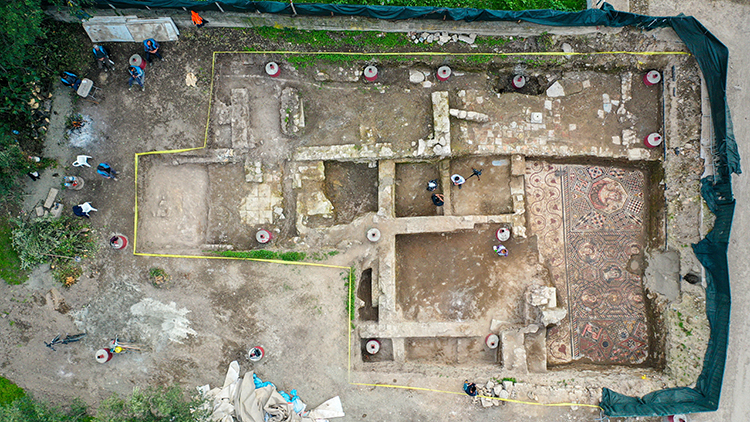
A Glimpse Into Roman İznik Through 50 Square Meters of Art
As the layers of soil were gradually removed, archaeologists revealed a breathtaking 50-square-meter section of mosaic flooring. The style, materials, and associated ceramic and coin findings place the structure firmly in the 3rd century CE, during the Roman period when İznik—then known as Nicaea—was a major cultural and administrative center. Early interpretations suggest that the mosaic belonged either to an official public building or to a luxurious private residence, possibly even a Roman bath complex, given the refined workmanship and thematic references to water.
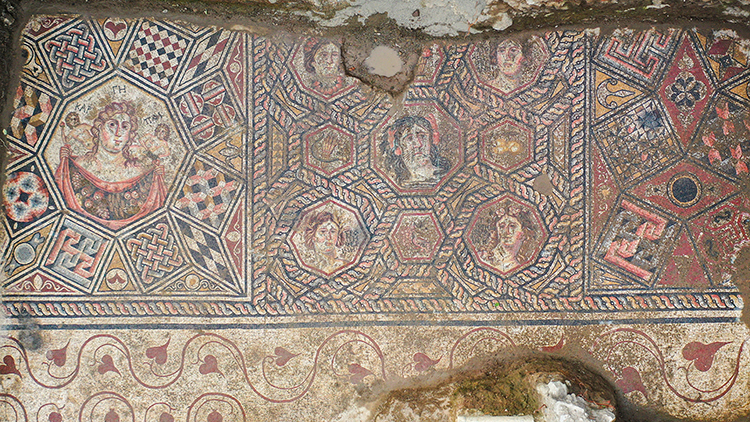
The uncovered portion consists of three large panels framed by an elegant border decorated with pomegranate and ivy leaves, symbols often linked to fertility, continuity, and divine protection in Roman artistic traditions. Although parts of the original architecture were damaged or removed over the centuries, the surviving mosaic panels remain strikingly intact, preserving their vivid colors and meticulously arranged tesserae.
Mythology, Abundance, and Local Identity Expressed in Stone
One of the mosaic’s key panels features a goddess of abundance cradling a basket filled with fruits believed to represent produce traditionally cultivated around İznik. Her figure is framed by other mythological characters and partially preserved inscriptions that researchers plan to analyze during upcoming epigraphic studies. Surrounding her extend complex geometric patterns, three-dimensional illusions, and harmonious color gradations achieved through the use of marble, natural stone, and glass tesserae. The level of skill suggests that master craftsmen were commissioned for this work, likely serving the region’s elite or a state-funded project.
Yet the mosaic’s most astonishing element lies in the central panel: a serene female portrait labeled with the word “Askania,” the ancient name for Lake İznik. The figure is crafted with symbolic details that unmistakably reference water. Her hair flows like underwater algae; a crown fashioned from crab claws sits atop her head; her neckline mimics gentle waves. These artistic choices reveal a deliberate attempt to personify the lake not as a landscape but as a sentient entity. Kahveci highlights the significance: “They depicted Lake İznik as an ancient woman,” suggesting a deep cultural connection to the waters that sustained the city.
A Cultural Perspective on Nature in Roman Art
The personification of lakes and rivers as female deities was not uncommon in Roman iconography, yet the İznik mosaic stands out thanks to its intricacy and its specific reference to a local body of water.
This indicates that Lake İznik played a symbolic and possibly spiritual role in the community, beyond its practical importance for trade, agriculture, and daily life. The mosaic’s artistic language blends mythology and geography, suggesting a worldview in which natural elements were woven into human identity and divine narratives.
A Site Layered With Centuries of History
The excavation did not only reveal a Roman masterpiece. Researchers found clear signs that the same location continued to be used for construction and habitation for more than a millennium. Traces of structures from the 4th, 5th, 8th, 10th, and 11th centuries were identified, along with Byzantine floorings and walls in the southern part of the site.
The upper layers contained early Ottoman ceramics, confirming that the area remained active through the 15th and 16th centuries. This stratigraphic record presents a rare opportunity to study the historical continuity of İznik, a city that has served Romans, Byzantines, Seljuks, and Ottomans throughout its long and layered past.

What Lies Beneath: The Mosaic May Be Even Larger
Although 350 square meters of the area have been excavated so far, archaeologists suspect that the mosaic extends beyond the currently exposed borders.
A pair of sandal motifs discovered near a threshold suggests the presence of a monumental entrance, hinting at a much larger interior space that could still be hidden beneath modern structures and roads. Future excavation phases aim to uncover the full extent of the mosaic and determine the building’s original function with greater certainty.
An Artwork That Rewrites İznik’s Past
The newly uncovered mosaic is more than an archaeological find—it is a work of art that redefines the cultural narrative of İznik. Its depiction of mythological figures, its sophisticated craftsmanship, and above all its symbolic representation of Lake İznik as a wise, ancient woman offer invaluable insights into the artistic and spiritual world of the Roman era.
As studies continue, experts believe the mosaic may emerge as one of the most important heritage discoveries in Türkiye in recent decades, shedding new light on how ancient societies understood nature, identity, and the divine.
Cover Image Credit: Mustafa Yılmaz / AA
