31 January 2026 The Future is the Product of the Past

The Oldest Odin Inscription in the World Found in the Vindelev treasure

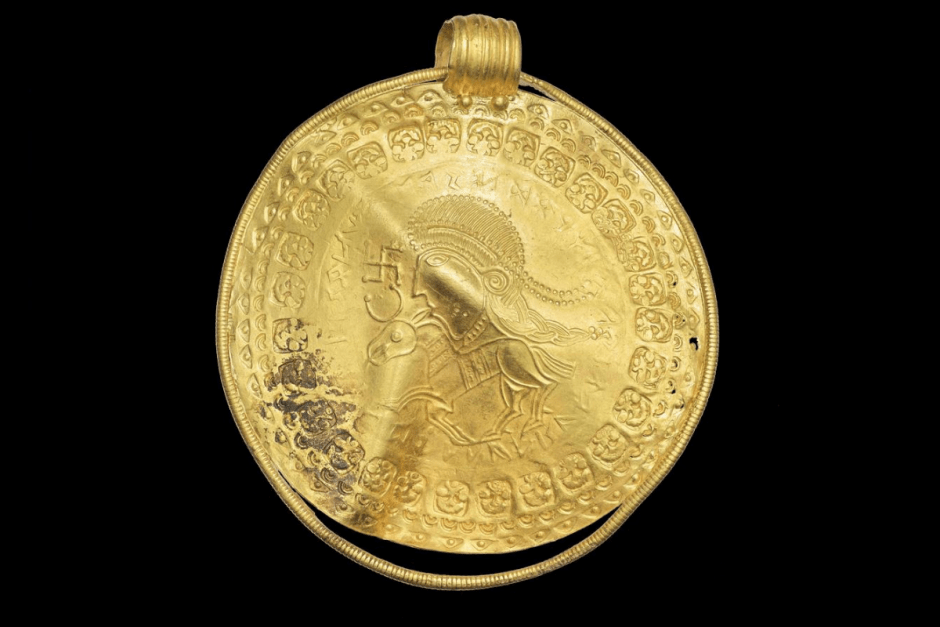
Scientists have identified the earliest known inscription referring to the Norse god Odin on part of a gold disc unearthed in the Vindelev treasure found by two amateur archaeologists in 2020.

One of the largest treasures recently discovered, the Vindelev treasure contains 800 grams of actual gold. Found by two old friends and amateur archaeologists in a field in Jelling, Denmark, the ancient artifacts now reveal secrets from the past and re-write ancient history!

The discovery is crucial because we now have evidence of Norse mythology 150 years earlier than previously – at the start of the 4th century.

The disc discovered in Denmark was including large medallions the size of saucers and Roman coins made into jewelry. It was unearthed in the village of Vindelev, central Jutland, and dubbed the Vindelev Hoard.

Experts believe the cache was buried 1,500 years ago, either to protect it from enemies or to appease the gods.


📣 Our WhatsApp channel is now LIVE! Stay up-to-date with the latest news and updates, just click here to follow us on WhatsApp and never miss a thing!!
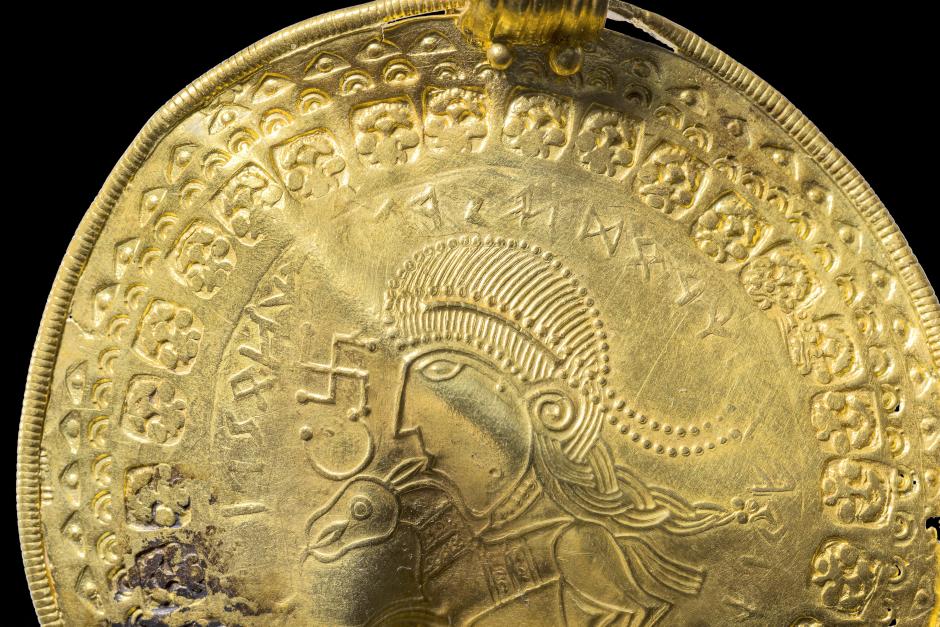


The motifs of the bracteates were produced in matrices (stamps) of bronze, which were stamped into plates of gold. That way, you could make several bracts with the same motif. The inscription runs from right to left on the bracteate and was originally written from left to right in the matrix. Photo: Arnold Mikkelsen, National Museum, Denmark

Studies of two 1,600-year-old gold medallions that are part of the treasure led to the discovery of very long runic inscriptions in which the name of the supreme god of the Aesir, Odin, appears.

A golden bracteate, a thin, ornamental pendant, bore the inscription “He is Odin’s man,” most likely referring to an unknown king or overlord. On the gold medallion, there is also a portrait of an unknown king or great man, who may have had the (nick)name “Jaga” or “Jagaz,”.

The inscription runs in a circle around the motif of the bracteate, which shows a king’s face seen in profile and with a nice hairstyle. In front of the face are a swastika and a semicircle that perhaps symbolizes the sun and the moon. Under its face stands a four-legged animal, presumably a horse, with a marked harness and something sticking out of its mouth. The horse’s ear points towards the king’s open mouth.

A long inscription appears to have been copied on one of the other pendants on the other gold medallion. It is, however, a poorly executed reproduction.
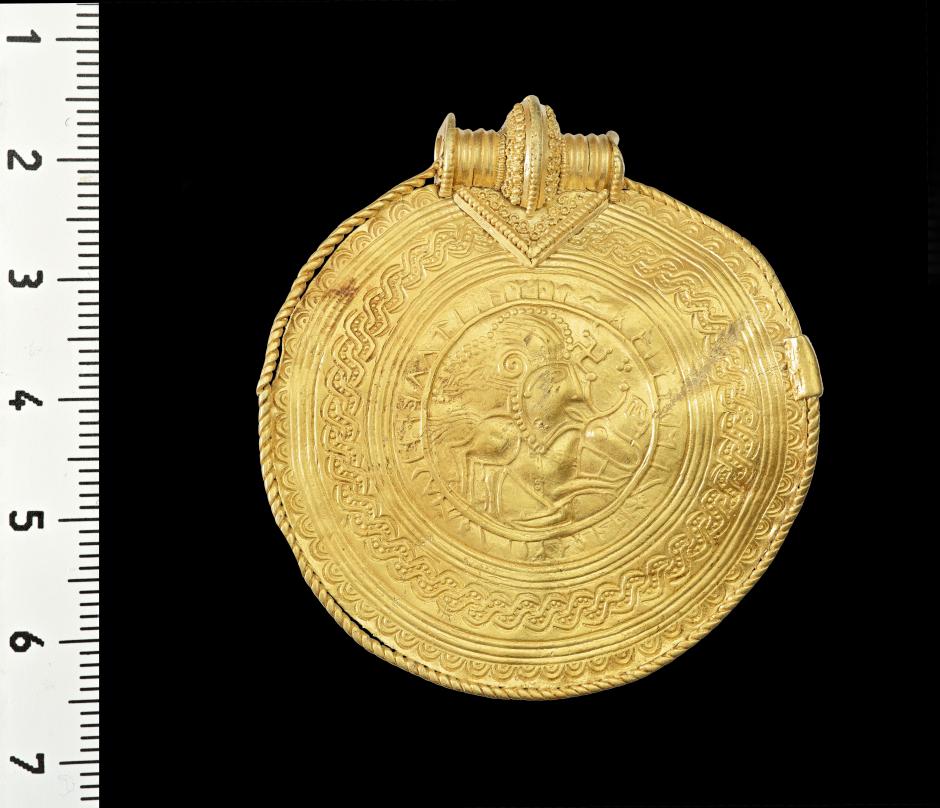
The long inscription on another bracteate from the Vindelev treasure is a poorly executed copy of the beautifully executed one. Photo: Arnold Mikkelsen, The National Museum of Denmark

This amazing discovery was made by linguist Krister Vasshus from the National Museum in Denmark and runologist and script researcher Lisbeth Imer.

“It’s one of the best-executed runic inscriptions that I have ever seen,” Imer said.

Runes are symbols that were used by early Northern European tribes to communicate in writing.

According to the National Museum in Copenhagen, where the Vindelev Hoard is on display, more than 1,000 bracteates have been discovered in Northern Europe.
National Museum of Denmark

Related Articles

Two Archaic Sculptures was Unearthed in Milas Euromos 2021 Excavations

2 July 2021

2 July 2021

Milas Euromos 2021 archaeological excavations continue. During the excavations of Milas Euromos 2021, archaeologists unearthed two archaic period statues (kuros)...

3700 years old Brain and skin remnants discovered at Bronze Age settlement in western Türkiye

5 September 2023

5 September 2023

Archaeologists discovered, well-preserved brain and skin remnants of two individuals dating to the Bronze Age during excavations at Tavşanlı Höyük...

46 Eagles in vivid color revealed on Ancient Egyptian temple ceiling

15 May 2022

15 May 2022

A joint German/Egyptian archaeological mission at the Temple of Esna on the west bank of the Nile, 35 miles south...

Who will solve the puzzle of Bronze Age tin? Origin of tin ingots from Uluburun shipwreck disputed – the metal may have come from Cornwall

3 October 2023

3 October 2023

The exact origin of tin in the Bronze Age is the Holy Grail of archaeometallurgists: For 150 years, experts have...

Urartian-Era Fortress with 50 Rooms Discovered at 3,000 Meters in Eastern Türkiye

5 August 2025

5 August 2025

Archaeologists uncover a massive high-altitude fortress believed to date back to the Iron Age, with ties to the ancient Urartian...

The excavations in Selinunte, Italy, which has the largest Agora in the Ancient World, “The results have gone well beyond expectations”

29 July 2022

29 July 2022

In the Selinunte, one of the most important archaeological sites of the Greek period in Italy, the outlines of the...

A 1,700-Year-Old Roman Merchant Ship Lies Just Two Meters Below the Surface off Mallorca’s Playa de Palma

4 November 2025

4 November 2025

Just two meters beneath the turquoise waters of Playa de Palma, archaeologists have uncovered a remarkably preserved Roman merchant ship...

2,050-Year-Old Assembly Building Discovered in Ancient City of Laodicea Marks Architectural First in Anatolia

2 August 2025

2 August 2025

During the 2025 excavation season, archaeologists in the ancient city of Laodicea have unearthed a 2,050-year-old Roman-era assembly building with...

Apocalypse Ship of the Vikings

26 April 2021

26 April 2021

Researchers discovered a stone boat made by Vikings and surprising gifts inside a cave in Iceland. Aside from the cave,...

1,500-Year-Old Sasanian Ossuary Inscription Discovered at Naqsh-e Rostam, Iran

13 August 2025

13 August 2025

Archaeologists have recently discovered a significant funerary inscription associated with an ossuary dating back to the late Sasanian period at...

Shackled skeleton identified as rare evidence of slavery found in Rutland

7 June 2021

7 June 2021

In Rutland, archaeologists discovered an ‘unusual’ skeleton of a Roman slave, who might have been a criminal sentenced to death....

Rare bronze hand discovered in Roman Vindolanda, England

11 July 2023

11 July 2023

One of Europe’s most important Roman archeological sites is the Fort of Vindolanda, one of the earliest Roman garrisons built...

A rural necropolis from Late Antiquity discovered in northeastern France

5 November 2022

5 November 2022

Inrap archaeologists have unearthed a small rural necropolis from the late 5th century (Late Antiquity) at Sainte-Marie-aux-Chênes in northeastern France....

Exceptional Iron Age Artifacts Discovered at Celtic Necropolis in France

18 April 2025

18 April 2025

An archaeological excavation in Creuzier-le-Neuf, a small town located six miles north of Vichy, has unveiled a remarkable Celtic necropolis,...

Archaeologists Discover Northernmost Hellenistic Elite Residence Featuring Ionic Architecture and Graffito in North Macedonia

2 July 2025

2 July 2025

In a groundbreaking archaeological campaign, the NL Museum of Kumanovo has unearthed a remarkable Hellenistic-era residence near the village of...