
A symbol that crossed the ancient Mediterranean
Among the ruins of the ancient Mediterranean, some gods survive through marble statues, temple foundations or stories written by poets. Tanit survived through something far more elusive: a sign.
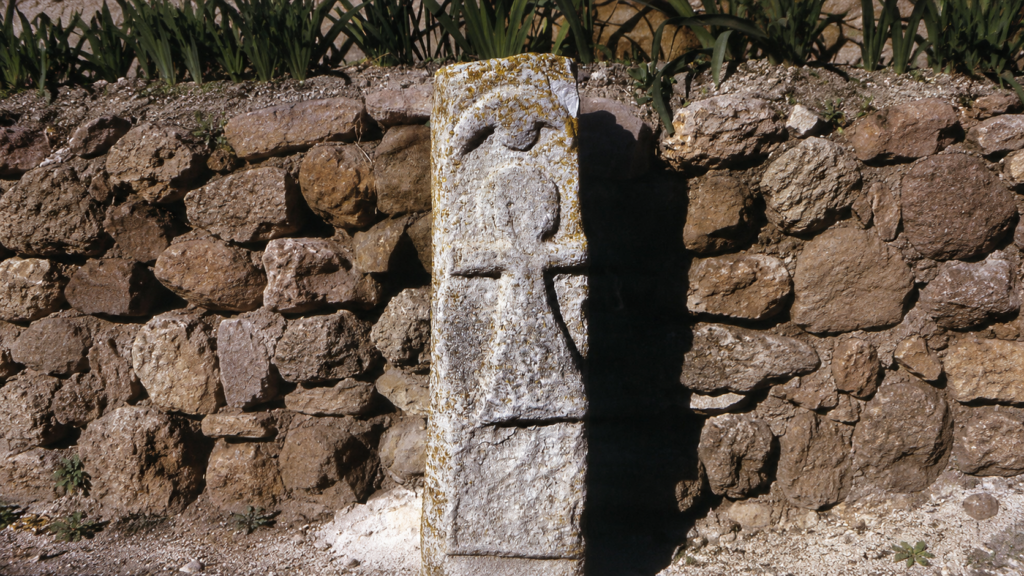
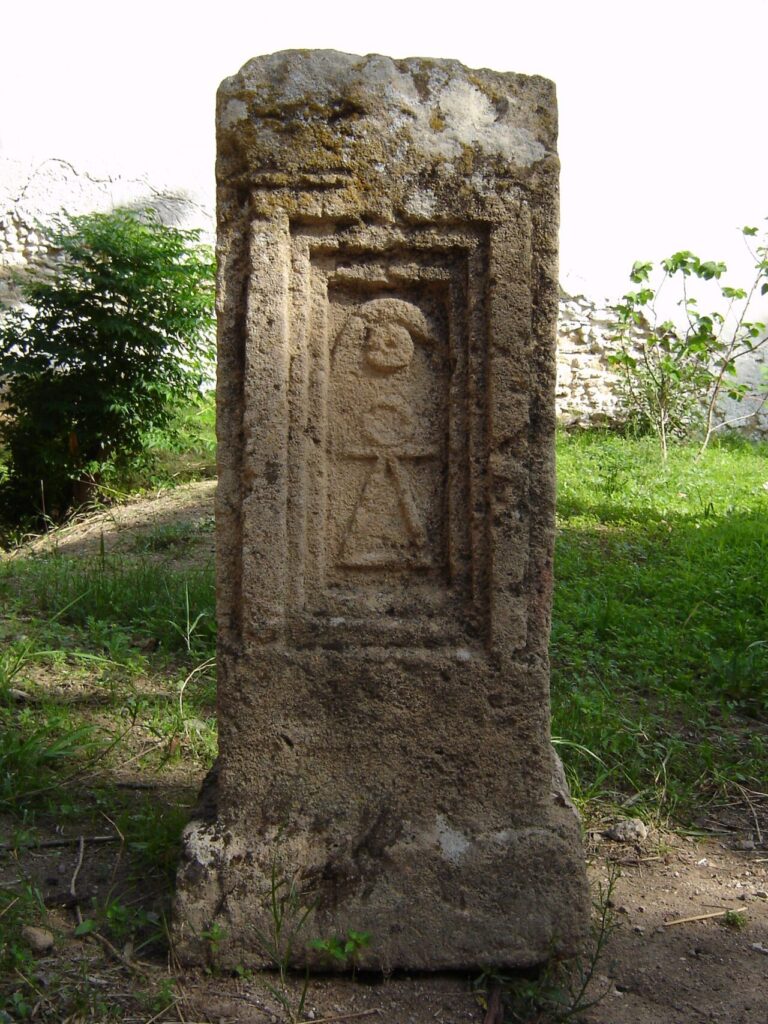
It is simple enough to look almost modern. A triangular body, a horizontal bar, and a circular disc above it. Sometimes the form resembles a human figure with raised arms. Sometimes it looks more like a sacred diagram. For archaeologists, it is known as the Sign of Tanit, one of the most recognizable symbols of the Phoenician and Punic world.
This small abstract image appears on votive stelae, coins, amulets and ritual objects from North Africa to Sicily, Sardinia, Malta, Ibiza and southern Spain. It belonged to Tanit, the great goddess of Carthage, whose influence reached far beyond one city and one coastline.
Tanit left behind no complete mythology like the gods of Greece and Rome. There is no long epic explaining her birth, her loves or her divine battles. Instead, her story must be read from stone, inscription and symbol. That is what makes her so compelling. She is not a goddess preserved by literature, but by archaeology.
Carthage’s powerful divine protector
Tanit rose to prominence in Carthage, the Phoenician-founded city that became the leading power of the western Mediterranean. In Punic religion, she was closely associated with Baal Hammon and appears in inscriptions as a high-ranking divine figure, often addressed with titles that emphasize her authority and protective role.
Her identity was complex. She was linked with fertility, motherhood, protection, celestial power and the fate of the community. In Carthage, she was not a distant ornament of religion. She was part of civic life, maritime ambition and family devotion.
The people who invoked Tanit lived in a world shaped by sea routes, trade, war and uncertainty. Carthage was a city of merchants and sailors, but also a city surrounded by rivals. A goddess who could protect life, land, ships, children and the wider community would have held immense emotional power.
This may explain why Tanit’s cult spread so widely. As Punic communities moved across the Mediterranean, they carried not only goods and language, but also religious memory. Tanit travelled with them.
The goddess without a fixed face
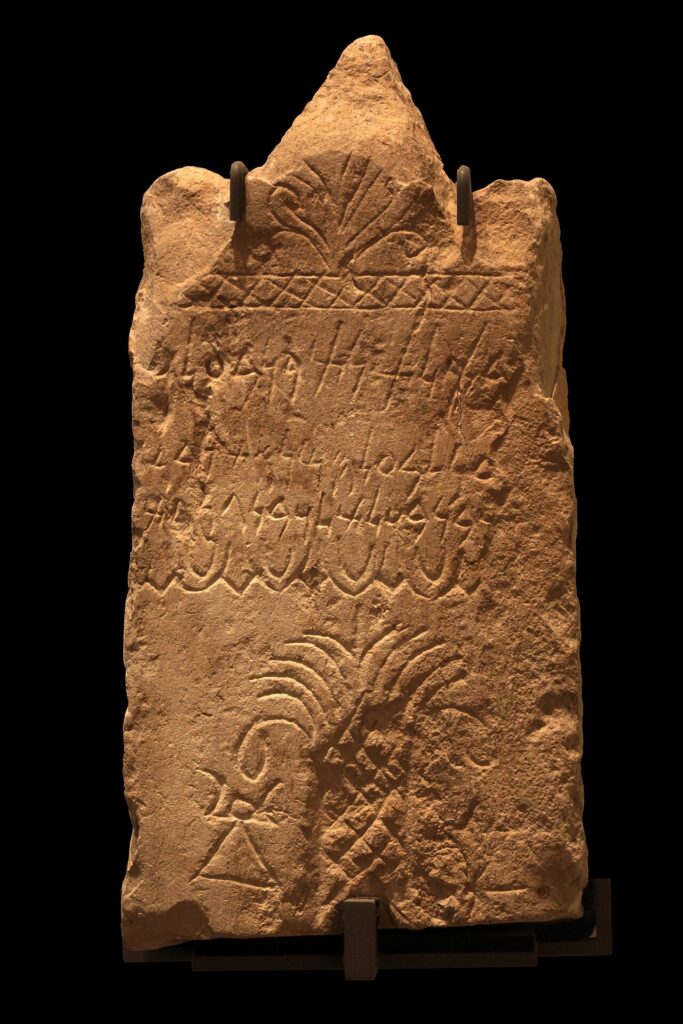
Unlike many ancient deities, Tanit does not have one stable visual identity. She can appear through inscriptions, symbols, stylized forms and ritual objects rather than through a single human image.
The Sign of Tanit is central to that mystery. Its meaning is still debated. The triangular shape may suggest a body or sacred garment. The horizontal line may represent arms. The disc above may refer to the head, the sun, the moon or a celestial sphere. The symbol may have combined several layers of meaning at once.
This ambiguity helped Tanit endure. A detailed statue can be damaged, reinterpreted or forgotten. A simple sign can migrate. It can be carved on stone, stamped on metal, worn as a charm, copied by artisans and revived by modern designers.
Tanit’s symbol is ancient, but it does not feel distant. Its clean geometry allows it to move between archaeology and contemporary culture without losing its sense of power.
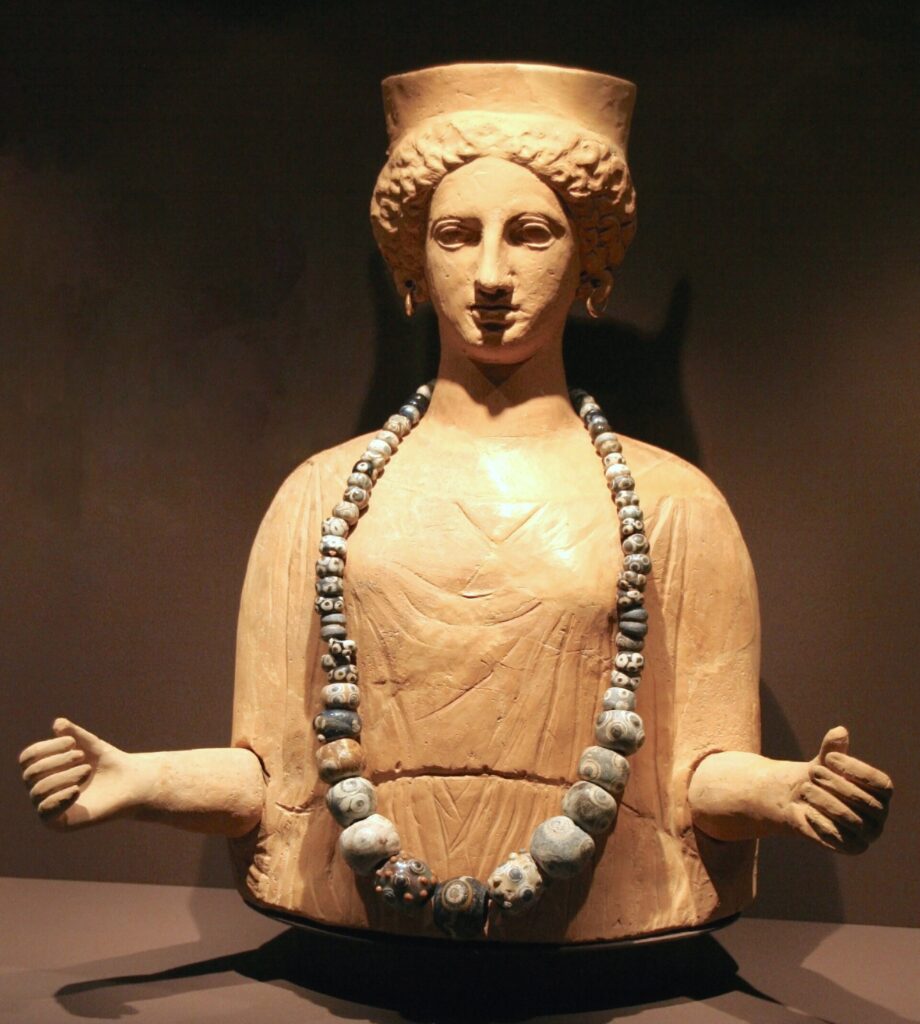
Adorned statue of the Punic goddess Tanit, 5th–3rd centuries BC, from the necropolis of Puig des Molins, Ibiza (Spain), now housed in the Archaeology Museum of Catalonia (Barcelona). Credit: Public Domain
A difficult archaeological debate
No discussion of Tanit can avoid the Tophet of Carthage, one of the most debated archaeological sites in the Mediterranean. Excavations there uncovered urns, votive stelae and inscriptions dedicated to Tanit and Baal Hammon.
The site has long been associated with a difficult question: did Carthaginians sacrifice children to their gods, as hostile Greek and Roman writers claimed, or were the urns part of a special burial practice for infants who died naturally before or soon after birth?
Scholars remain divided. Some argue that archaeological evidence supports ritual sacrifice in at least some cases. Others warn that the ancient literary sources were shaped by anti-Carthaginian propaganda and that the material record is more complex than the old accusation suggests.
The safest reading is also the most responsible one. The Tophet shows that Tanit stood at the center of deeply emotional religious practices involving death, vows, protection and divine appeal. It does not allow a simple sensational conclusion.
That uncertainty, however, adds to Tanit’s power as a subject. She stands at the meeting point of faith, archaeology, propaganda and memory.
From Carthage to Ibiza and beyond
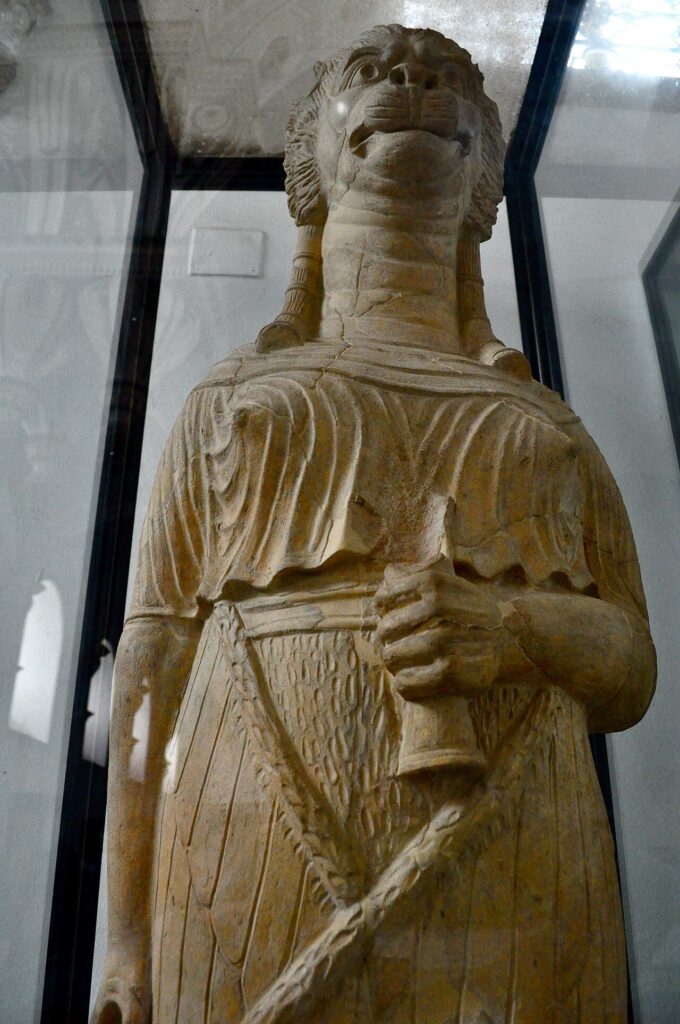
Tanit’s influence was not confined to Carthage. One of the most important traces of her cult was found on Ibiza, at the cave sanctuary of Es Culleram. Hundreds of terracotta figurines discovered there show how strongly Punic religious traditions took root on the island.
In the western Mediterranean, Tanit became part of a shared sacred geography. Her name and symbols linked ports, colonies, islands and trading communities. She was a goddess of movement as much as belonging.
After Rome destroyed Carthage in 146 BC, Punic religion did not disappear overnight. Older beliefs often survived by changing form. In Roman North Africa, elements associated with Tanit were absorbed into the worship of Caelestis or Juno Caelestis. The goddess took on new names, but traces of her authority continued.
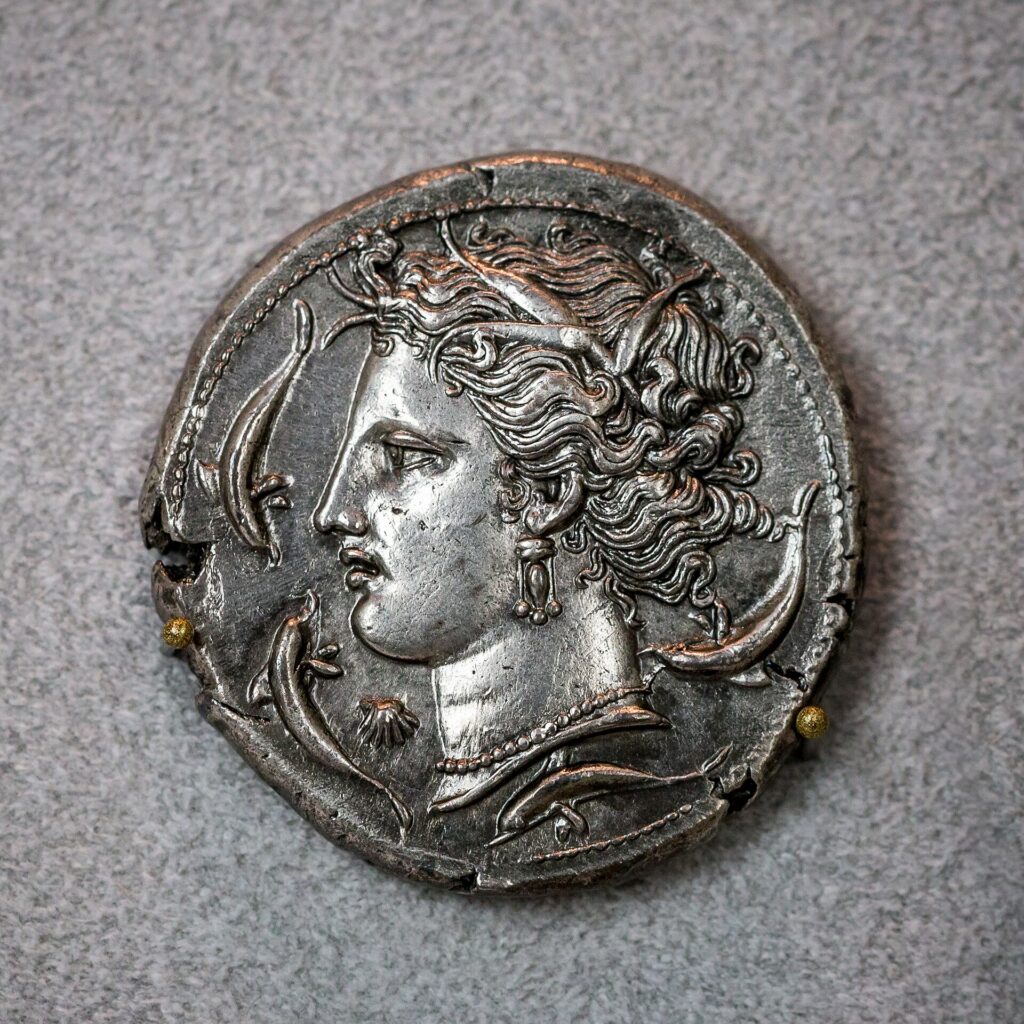
Why Tanit still fascinates
Tanit remains fascinating because she resists easy classification. She was a mother goddess, but not only that. A celestial goddess, but not only that. A protector of Carthage, but not limited to Carthage. A figure of fertility, death, power and continuity.
She also represents something larger: the survival of Phoenician and Punic culture beyond the destruction of its greatest city. Rome defeated Carthage militarily, but it did not erase every sign, every ritual memory or every sacred form.
The Sign of Tanit is the strongest proof of that survival. It is not merely decoration. It is a compressed memory of a maritime civilization whose written voices were largely lost, but whose symbols kept speaking.
Tanit endures because she never depended on one temple, one myth or one city. She became a mark. And sometimes, a mark can outlive an empire.
Amadasi Guzzo, M. G., & Zamora López, J. Á. (2012–2013). The epigraphy of the tophet. Studi Epigrafici e Linguistici, 29–30, 159–192.
Clifford, R. J. (1990). Phoenician Religion. Bulletin of the American Schools of Oriental Research, (279), 55–64. https://doi.org/10.2307/1357208
Xella P, Quinn J, Melchiorri V, Dommelen P van. Cemetery or sacrifice? Infant burials at the Carthage Tophet: Phoenician bones of contention. Antiquity. 2013;87(338):1199-1207. doi:10.1017/S0003598X00049966
Cover Image Credit: Wikipedia Commons
