

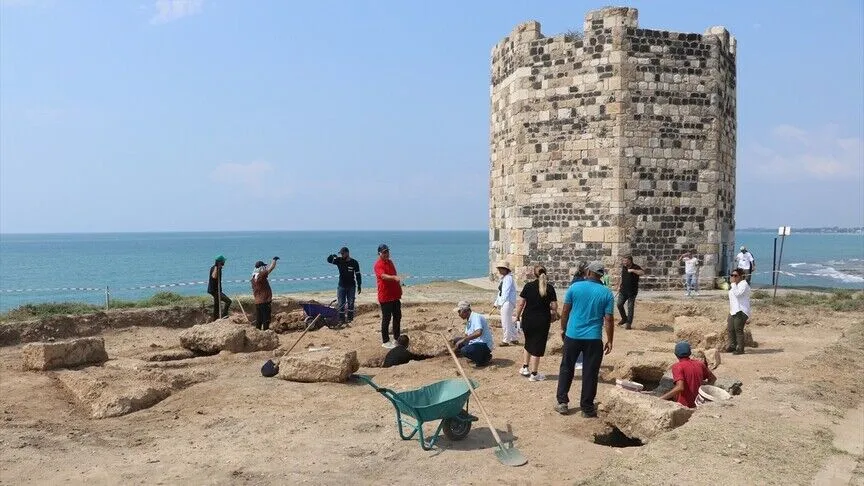
A cemetery overlooking the history of one of ancient Cilicia’s important ports is beginning to emerge in southern Türkiye, where archaeologists have uncovered 10 Hellenistic and Roman-era tombs at Aigeai, a city with long-standing connections to the Macedonian world.
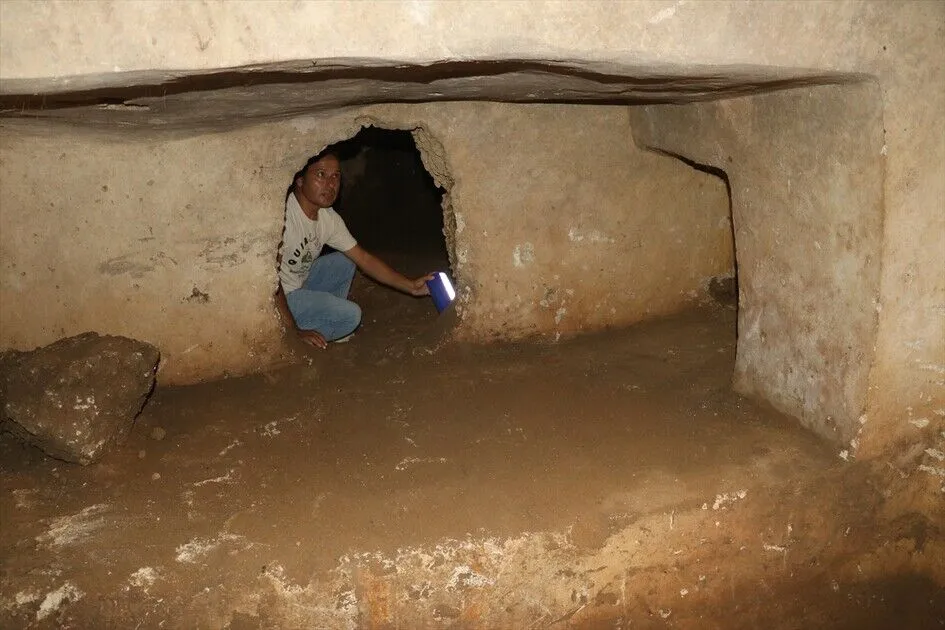
The newly exposed burials include rock-cut tombs reached by corridors and stairways, as well as rectangular cist graves whose interiors were finished with lime mortar. Some retain rosette decorations, while the excavation has also yielded terracotta sarcophagi, pottery fragments and small vessels placed with the dead.
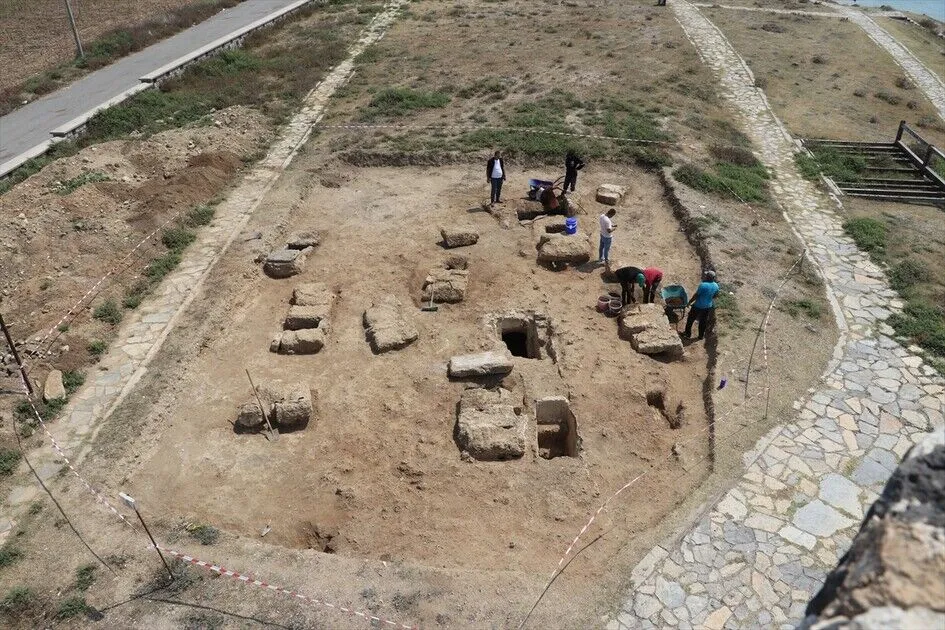
The work is taking place in Yumurtalık, in Türkiye’s Adana Province, within a necropolis covering roughly 33 dönüms, or 3.3 hectares. Archaeologists have identified about 30 graves in the area so far, but only a third have been excavated, leaving much of the cemetery still beneath the ground.
The rescue excavation is being conducted by the Adana Museum Directorate under the scientific supervision of Associate Professor Faris Demir of Osmaniye Korkut Ata University.
A cemetery used across generations
Although the necropolis has its origins in the Hellenistic period, it continued to be used during Roman times. That extended chronology is reflected in a burial landscape where different forms of graves appear side by side.
The rock-cut examples required chambers, access corridors and steps to be carved directly into the bedrock. Inside, platforms were cut from the living rock to receive the deceased. Cist graves followed a different approach: rectangular burial compartments were constructed or defined with stone, creating compact graves that could then be covered.
At Aigeai, several of these cist graves were given more attention than their relatively simple construction might suggest. Their sides were coated with lime mortar, and in some cases rosette motifs were applied over the plaster, providing a rare surviving element of the cemetery’s original appearance. Demir said the graves had suffered repeated damage from the Middle Ages onward, making the surviving architectural details particularly important.
The excavation team is now developing a project to protect the tombs. Finds removed from the graves are also undergoing conservation, with plans for suitable objects to eventually be displayed at the Adana Museum.
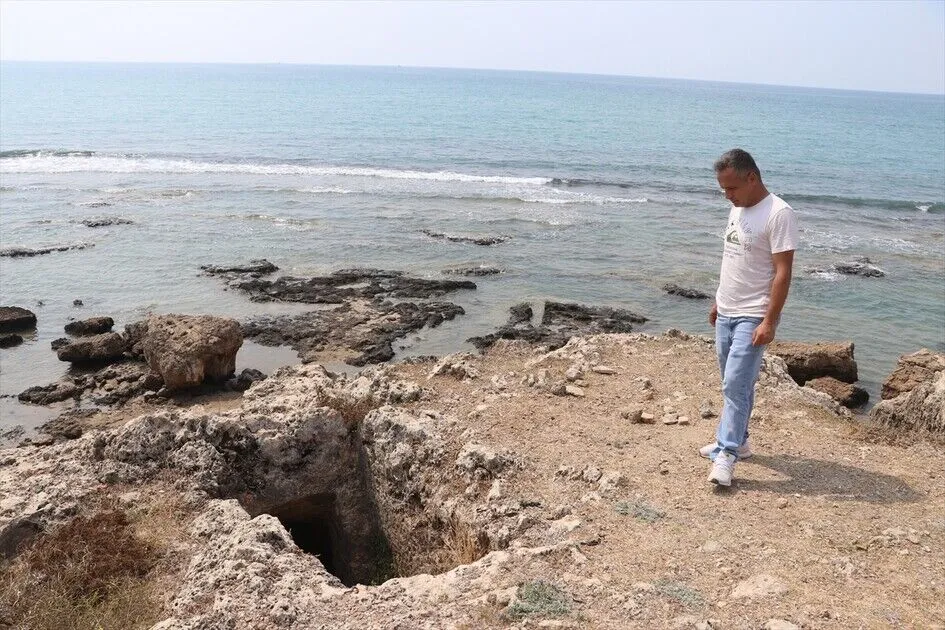
One of the cist graves uncovered in the necropolis of ancient Aigeai in Adana, southern Türkiye. Credit: AA
A Macedonian connection behind the graves
The cemetery becomes more intriguing when placed against Aigeai’s early history. Demir told Anadolu Agency that “Aigeai was founded by Macedonian soldiers in memory of Alexander the Great,” and said some of the Hellenistic graves may have belonged to those soldiers.
The connection fits into a broader historical picture surrounding the city. Alexander defeated Darius III at the Battle of Issus in 333 BCE, not far from this part of the northeastern Mediterranean. Demir’s earlier academic research dates the foundation of Aigeai to around 300 BCE, during the age of Alexander’s successors, when the city developed into an important naval base and cultural center.
Aigeai continued to cultivate its Macedonian background long after the Hellenistic kingdoms disappeared. Demir notes in his study of the city’s Roman houses that Aigeai asserted Macedonian origins and kinship with Argos, connections that became part of its civic identity and political standing. The same research describes the city’s elites as presenting themselves as Macedonian in origin centuries after its foundation.
Against that background, the newly excavated necropolis offers a rare opportunity to investigate the population of Aigeai closer to the period when the city itself was taking shape.
Small objects left with the dead
The graves also yielded pottery fragments, terracotta sarcophagi and small vessels described in the excavation announcement as “tear bottles.” Archaeologists generally refer to these narrow containers as unguentaria.
Unguentaria were common throughout the Hellenistic and Roman Mediterranean. They usually held perfumes, scented oils, ointments or other valuable liquids and often accompanied the dead as part of funerary offerings. Although the name “tear bottle” remains popular, there is no firm evidence that mourners used such vessels to collect tears.
At Aigeai, these objects add another layer to the cemetery’s story. Together with the tomb architecture, pottery and sarcophagi, they may help researchers distinguish different phases of burial activity as conservation and study continue.
From Hellenistic naval base to Roman healing center
The dead were buried beside a city whose fortunes were closely tied to the sea. Ancient Aigeai occupied a strategic position in Cilicia Pedias, or Cilicia Campestris, east of the Ceyhan River and on the western side of the Gulf of İskenderun. It developed as an important harbor and naval center during the Hellenistic period and retained considerable political and religious importance under Rome.
By the second and third centuries CE, Aigeai had become particularly famous for its Asklepieion, a sanctuary associated with Asclepius and healing. The city’s maritime and religious importance helped sustain a prosperous urban community whose wealth is visible in discoveries made during earlier rescue excavations.
Between 2013 and 2018, excavations on the city’s southern coast uncovered Roman-period residences with elaborate mosaic floors. One depicts Erotes fishing while riding opposing hippocamps, surrounded by fish and other sea creatures. Another, known as the Spring Festival Mosaic, shows figures against a view of Aigeai itself, with the sea and a lighthouse appearing in the background.
The mosaics, dated to around the late second century CE, belonged to houses arranged around peristyles with rooms for dining, sleeping and leisure, along with kitchens, storage areas, cisterns and workshops. Their scale and decoration offer a very different view of Aigeai from the cemetery now under excavation: one records the lives of prosperous Roman residents, while the other is beginning to expose the ways earlier generations commemorated their dead.
Only 10 of the roughly 30 identified graves have been opened so far. With the current excavation expected to continue until early September, the necropolis may yet provide a much fuller picture of the people who inhabited this Cilician port during the centuries when its Macedonian heritage, maritime position and later Roman prosperity shaped the identity of Aigeai.
