
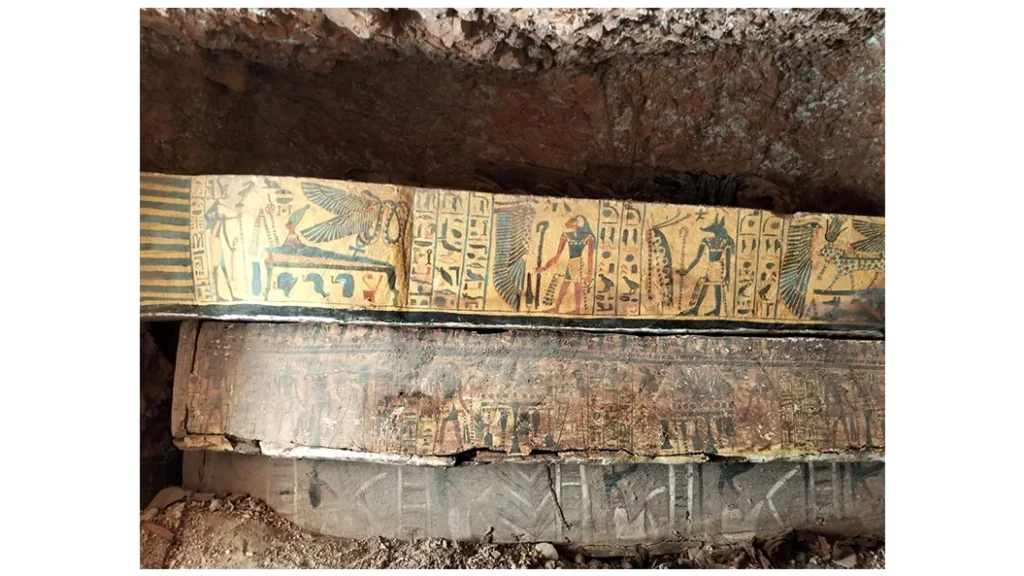
A tightly packed rock-cut chamber in the Asasif necropolis on Luxor’s West Bank has revealed a remarkable funerary cache dating to Egypt’s Third Intermediate Period. Egyptian archaeologists have uncovered 22 vividly painted wooden coffins—many associated with women bearing the title “Singer of Amun”—alongside eight rare papyri sealed inside ceramic vessels, offering fresh insight into temple life in ancient Thebes.
The discovery was announced by Egypt’s Ministry of Tourism and Antiquities following excavations conducted by a joint mission of the Supreme Council of Antiquities and the Zahi Hawass Foundation for Archaeology and Heritage. The cache was found in the southwestern sector of the courtyard of the tomb of Sennep in the Qurna area, part of the broader Theban necropolis that stretches across Luxor’s western desert.
A Carefully Engineered Funerary Cache
Archaeologists identified a rectangular chamber carved directly into bedrock. Rather than serving as an original burial place, the space appears to have functioned as a secondary repository—a secure storage chamber for coffins relocated from earlier tombs.
Inside, 22 painted coffins were arranged in an unusually systematic manner. They were stacked in multiple layers across ten horizontal rows, with lids separated from coffin boxes to maximize space. This was not a hurried reburial. The arrangement reflects logistical planning and controlled placement, suggesting institutional oversight—likely connected to temple authorities.
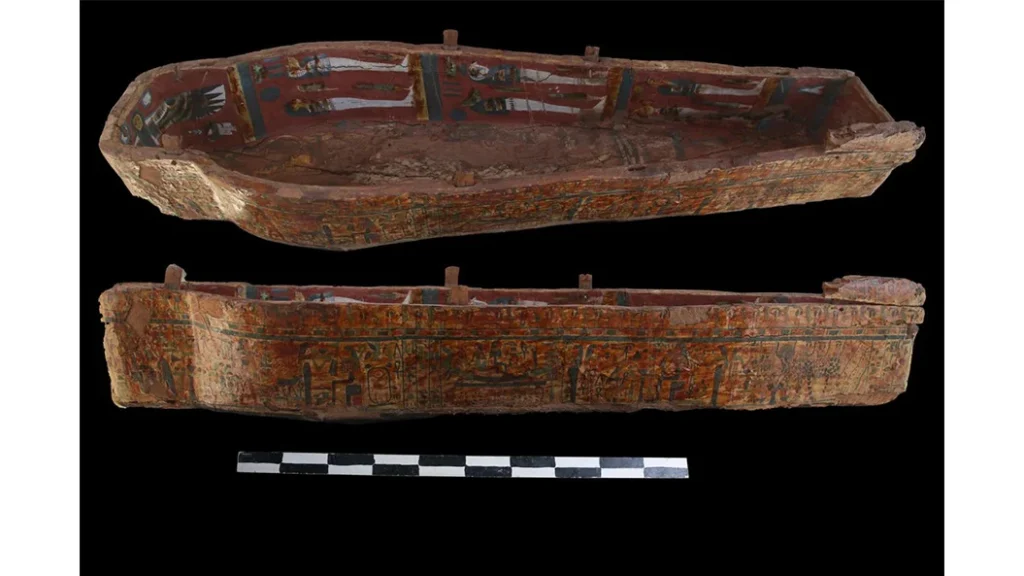
The coffins still contained mummified remains, an important detail since many Third Intermediate Period reburials were emptied or disturbed in antiquity. Despite the absence of personal names on most coffins, numerous examples prominently display professional titles.
The most frequent designation reads: “Singer of Amun.”
The Religious World of the “Singers of Amun”
During the Third Intermediate Period (c. 1070–664 BCE, Dynasties 21–25), Egypt experienced political fragmentation following the New Kingdom. While northern power centers rose in Tanis, Thebes in Upper Egypt remained dominated by the powerful priesthood of Amun.
Women titled “Singer of Amun” were not marginal figures. They formed part of the temple’s ritual structure, participating in sacred music, chanting, and ceremonial performance at the great temple complex of Karnak Temple. Their roles were embedded within the liturgical life of Amun’s cult, which controlled vast landholdings and wielded significant economic influence.
The repeated appearance of this title—rather than personal names—suggests that religious identity may have taken precedence over individual lineage in funerary presentation. The newly discovered cache provides rare material evidence of a collective burial practice tied to temple service, shedding light on the social status and institutional networks of female religious officials in Thebes.
Eight Sealed Papyri: A Potential Archive from the Third Intermediate Period
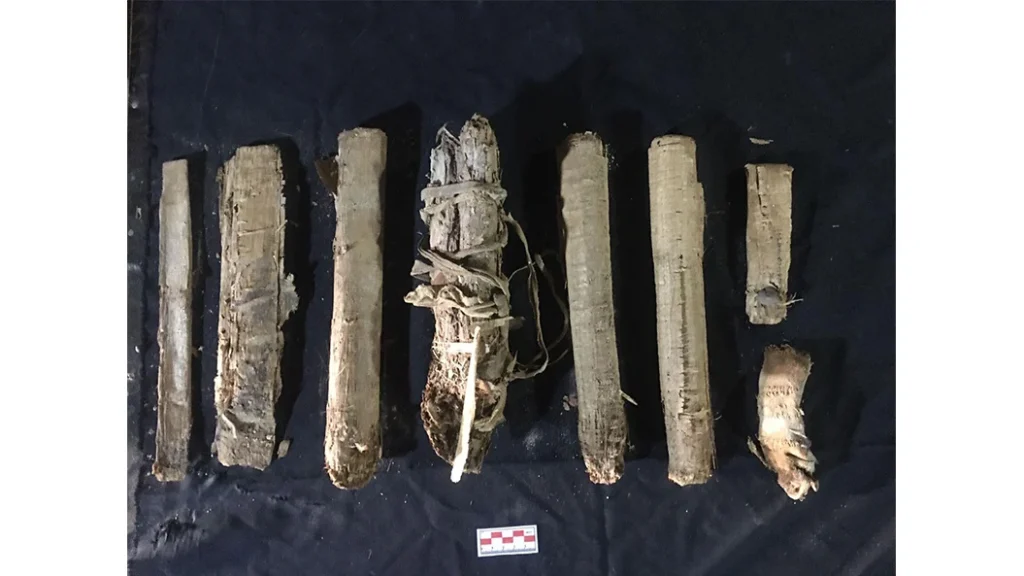
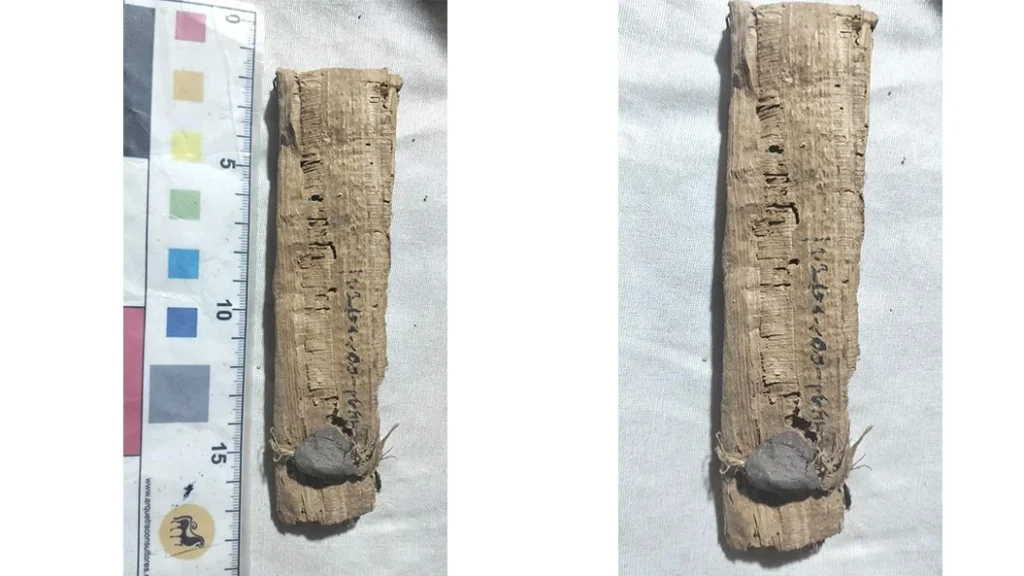
Perhaps even more intriguing are eight papyri discovered inside a large pottery vessel within the chamber. Several of these papyri remain sealed with their original clay closures intact. Their varying sizes and preserved seals indicate they were carefully deposited.
Officials have described the papyri as an “information treasure” awaiting conservation and translation. If the seals protected organic contents or written texts from deterioration, the documents could provide unprecedented insights into temple administration, funerary liturgy, embalming practices, or even economic records associated with the Amun priesthood.
Because sealed papyri from secure archaeological contexts are relatively rare, their scientific value extends beyond textual analysis. Residue studies and material examinations may illuminate storage methods and document handling practices in ancient Thebes.
Evidence of Embalming Practices
In addition to the coffins and papyri, archaeologists recovered pottery vessels believed to have been used in mummification rituals. These containers may have stored natron, oils, resins, or linen fragments associated with embalming procedures.
The coexistence of coffins, mummies, ritual vessels, and sealed papyri in a single chamber reinforces the interpretation that this was not an isolated burial, but a carefully organized funerary consolidation—possibly conducted during a period of instability or systematic tomb reorganization.
Conservation and Ongoing Research
Due to the fragile condition of the wood, immediate conservation measures were implemented on site. Restoration specialists stabilized weakened wooden fibers, consolidated flaking plaster layers, and performed precise mechanical cleaning to preserve the vibrant painted surfaces. Comprehensive photographic and architectural documentation was completed before transfer to storage facilities.
Excavations are continuing as the mission seeks the original tombs from which these coffins were relocated. Identifying their primary burial locations could clarify whether these women were originally interred together as a temple cohort or gathered later for protection.
The Broader Context of Asasif
The Asasif necropolis lies within the larger Theban funerary landscape on Luxor’s West Bank—often described as one of the world’s most extensive open-air archaeological zones. The area includes monumental tombs of high officials from the Middle Kingdom and later periods, as well as complex reburial activities spanning centuries.
Finds from Asasif have increasingly highlighted the importance of temple institutions during the Third Intermediate Period. Far from representing a “decline,” this era reveals dynamic religious administration and sophisticated funerary management strategies.
The painted coffins of the Singers of Amun add vivid new evidence to that picture. Their preserved colors, formal arrangement, and association with sealed papyri underscore the organizational capabilities of Theban temple authorities at a time when centralized royal power had shifted.
As conservation and translation work progresses, the sealed papyri may ultimately prove as transformative as the coffins themselves—potentially restoring forgotten voices from a period long overshadowed by Egypt’s earlier imperial zenith.
Egypt’s Ministry of Tourism and Antiquities
Cover Image Credit: Ministry of Tourism and Antiquities
