

A Roman mass grave discovered beneath a soccer field in Vienna is revealing new details about a violent clash that killed scores of young men nearly 2,000 years ago. An updated analysis has found that injuries were unusually concentrated around the pelvis, where projectile wounds appear far more frequently than researchers would normally expect.
The discovery, made in Vienna’s Simmering district, has already been linked to the Roman military through weapons and equipment recovered among the bodies. Yet one of the biggest questions remains unanswered: what battle left so many men dead in a single pit on the outskirts of ancient Vindobona?
A Mass Grave Beneath a Modern Soccer Field
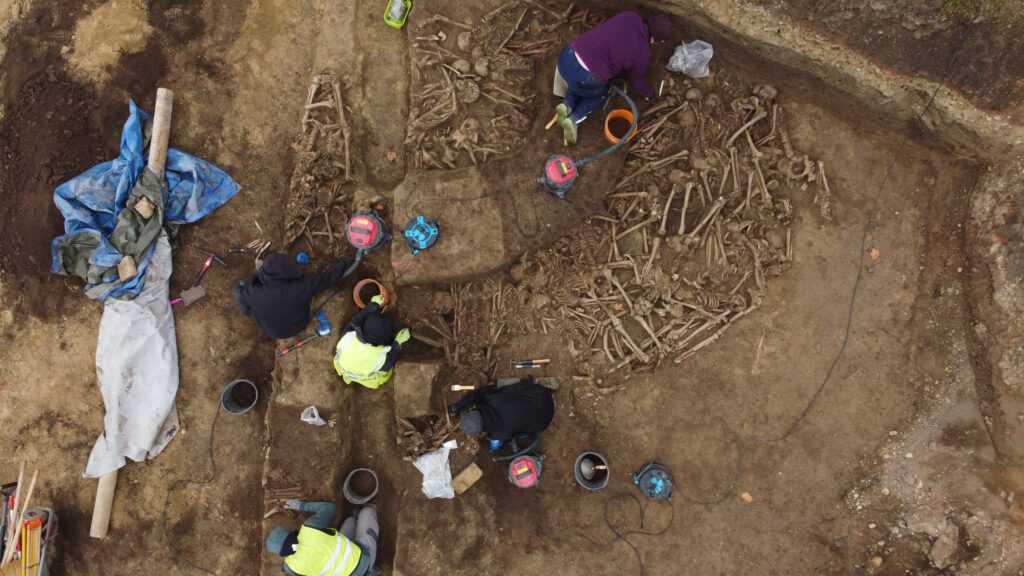
Construction workers encountered the remains in October 2024 while renovating the Ostbahn-XI sports ground on Hasenleitengasse. Archaeologists subsequently excavated 129 complete or partially complete skeletons from a shallow pit measuring roughly five by 4.5 meters. Additional displaced bones suggest that the original number of dead may have reached around 150.
The burial bore little resemblance to an ordinary cemetery. Bodies had been placed in as many as four layers, without a consistent orientation, and many limbs were intertwined. There were no sediment layers separating the bodies, indicating that they entered the grave during a single event. The absence of scavenging also suggests that the dead were covered soon after they were deposited.
Bioarchaeologists could reliably estimate sex and age for 92 of the 129 individuals examined in the 2025 study. All were biologically male, and most died between roughly 20 and 35 years of age. Their demographic profile, the burial context and the objects found with them strongly point to a military group.
Those objects include two iron lance heads, fragments of Roman scale armour, a cheek piece from a Roman helmet, military shoe nails and a heavily corroded dagger. X-rays revealed silver-wire decoration on the dagger sheath that dates its production to between the middle of the 1st and early 2nd century AD. One of the lance heads was still embedded in the sacrum of one individual.
Together with radiocarbon dating, the finds place the burial in the late 1st or early 2nd century AD.
Why Were So Many Injuries Concentrated Around the Pelvis?
The skeletons provide the clearest evidence that the men died violently.
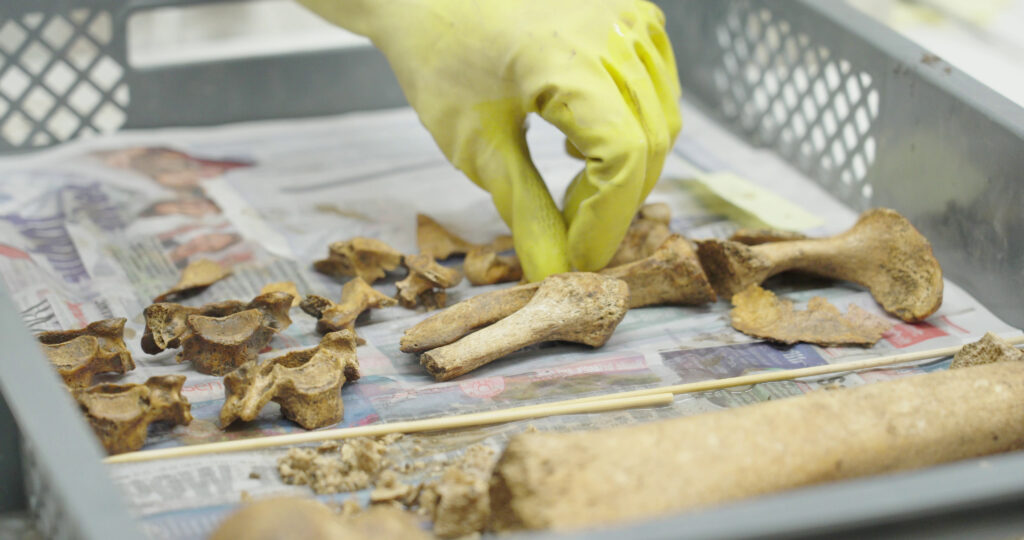
The first published analysis documented perimortem injuries caused by sharp weapons, blunt force, and projectiles. Researchers found sharp-force wounds particularly often on the skull, especially the face and frontal bones. But when they examined the overall distribution of trauma, one area stood out: around 40 percent of recorded injuries occurred on or around the pelvis. Many of these were projectile wounds consistent with weapons such as lances and Roman pila.
A more detailed analysis presented by Sheridan Strang and Michaela Binder at the 25th European Meeting of the Paleopathology Association in Berlin in August 2026 reinforces that pattern.
Their updated assessment identified trauma in 48 individuals. Among those with traumatic lesions, 85 percent showed injuries inflicted around the time of death. The highest concentration again appeared around the pelvis, accounting for about 40 percent of the recorded trauma.
This does not necessarily mean that every blow targeted the groin, as some reports have suggested. The scientific evidence is more precise: projectile injuries were unusually concentrated across the pelvic region.
That pattern raises an important question about the fighting itself. Parts of the lower torso may have been less protected than the chest and upper body, making them vulnerable to spears, lances or other projectiles. Researchers have discussed the possibility that some blows deliberately exploited gaps in body protection, but the skeletons alone cannot establish exactly how the fighters were positioned or whether attackers intentionally aimed at a specific anatomical target.
What researchers can say with much greater confidence is that the variety and distribution of wounds fit battlefield violence far better than a controlled execution.
Why Did a Major Clash Take Place Near Vindobona?
The location may help explain why such a violent encounter happened here.
Around the time the men died, Hasenleitengasse lay only about three kilometers southwest of the Danube, which formed Rome’s frontier with populations living to the north. More importantly, the site occupied largely uninhabited territory between two Roman military installations: the still-small camp at Vindobona lay about five kilometers to the northwest, while Ala Nova, near modern Schwechat, stood roughly four kilometers to the southeast.
In other words, the grave was not inside the Vindobona legionary fortress. It lay within a militarized frontier landscape connecting Roman positions along the Danube.
That distinction matters.
During the late 1st century AD, the middle Danube became a volatile military zone. Under Emperor Domitian, Roman forces fought repeated conflicts involving Sarmatians as well as the Germanic Marcomanni and Quadi. Historical sources record serious fighting in the region, including campaigns in the 80s and 90s AD, but they do not describe a battle at Hasenleitengasse.
The mass grave therefore may represent the physical remains of an event that escaped the surviving written record.
Its position between military installations also offers a plausible strategic context. Troops moving between forts, defending approaches to the Danube or responding to incursions could all have passed through this landscape. Archaeology cannot yet identify which of these scenarios produced the dead, but the location makes a military confrontation far less mysterious than the modern soccer field above it might initially suggest.
A Forgotten Battle That May Have Changed Roman Vienna
Vienna’s archaeological authorities have proposed an even larger historical possibility.
At the end of the 1st century, Vindobona was still a relatively small military base. In the following decades, Rome strengthened the Danube frontier, and Vindobona developed into a major legionary fortress. Martin Mosser of Vienna City Archaeology has suggested that the defeat represented by the Hasenleitengasse grave may have been one of the events that encouraged Rome to reinforce its presence in the area.
For now, that remains a hypothesis rather than a demonstrated historical connection. Researchers cannot securely associate the grave with Domitian’s Danube wars, a particular Germanic or Sarmatian attack, or any named Roman campaign.
The burial itself reflects the scale of the crisis. Cremation was still the normal funerary practice across much of the European Roman Empire during this period, making the hurried burial of such a large number of complete bodies highly unusual. The chaotic arrangement suggests that whoever disposed of the dead had neither the time nor the resources for normal funerary rites.
DNA and stable-isotope research may eventually provide another piece of the puzzle by revealing where the men grew up and whether they formed a single military group. Researchers also plan further investigation of the surrounding landscape, ancient Danube channels and the historical circumstances of the burial.
Until then, Hasenleitengasse preserves the aftermath of a battle whose name and participants have disappeared from history. Nearly two millennia later, the wounds left on the dead are beginning to tell the story that surviving Roman sources did not.
Binder, M., Adler-Wölfl, K., Kronberger, M., Mosser, M., Öllerer, C., Strang, S., & Slonek, A. (2025). A first glimpse into the Roman-period mass grave from Wien-Simmering. Archaeologia Austriaca, 109, 11–15. https://doi.org/10.1553/archaeologia109s11
City of Vienna – Vienna City Archaeology (Stadtarchäologie Wien). (2025, April 2). Römischer Sensationsfund in Simmering.
