
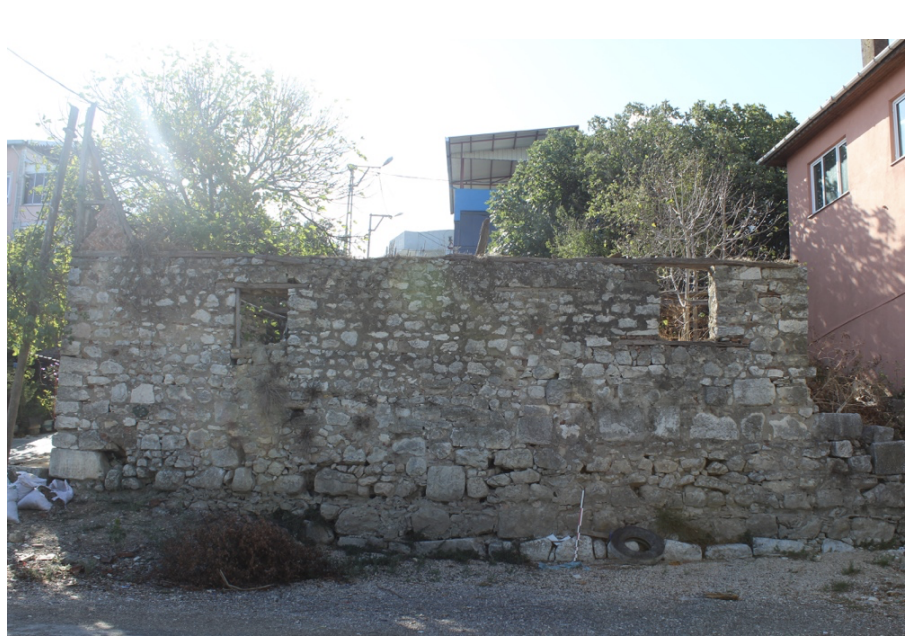
An ancient game board carved into a marble block at Apollonia ad Rhyndacum in northwestern Türkiye is offering a rare glimpse into how people spent their leisure time in one of Bithynia’s important lakeside cities.
The stone, now identified as a Nine Men’s Morris, or Merels, game board, was found reused as a building block in the fortification wall of Apollonia ad Rhyndacum, today’s Gölyazı near Lake Uluabat in Bursa. Although the block had later become part of the city’s defensive architecture, its carefully worked surface shows that it once served a very different purpose: a board for one of the ancient world’s most enduring strategy games.
The find was examined by Gonca Gülsefa of Bursa Uludağ University and published in the Nevşehir Hacı Bektaş Veli University Journal of Social Sciences. According to the study, the board is significant not only because of its form, but also because it adds Apollonia to the still limited list of documented ancient gaming sites in Bithynia.
A board hidden inside a city wall
The game board was recorded in the western part of the ancient settlement, on the southern face of a fortification wall. The block had been placed in the lowest section of the wall as spolia, a reused architectural element taken from an earlier structure or object.
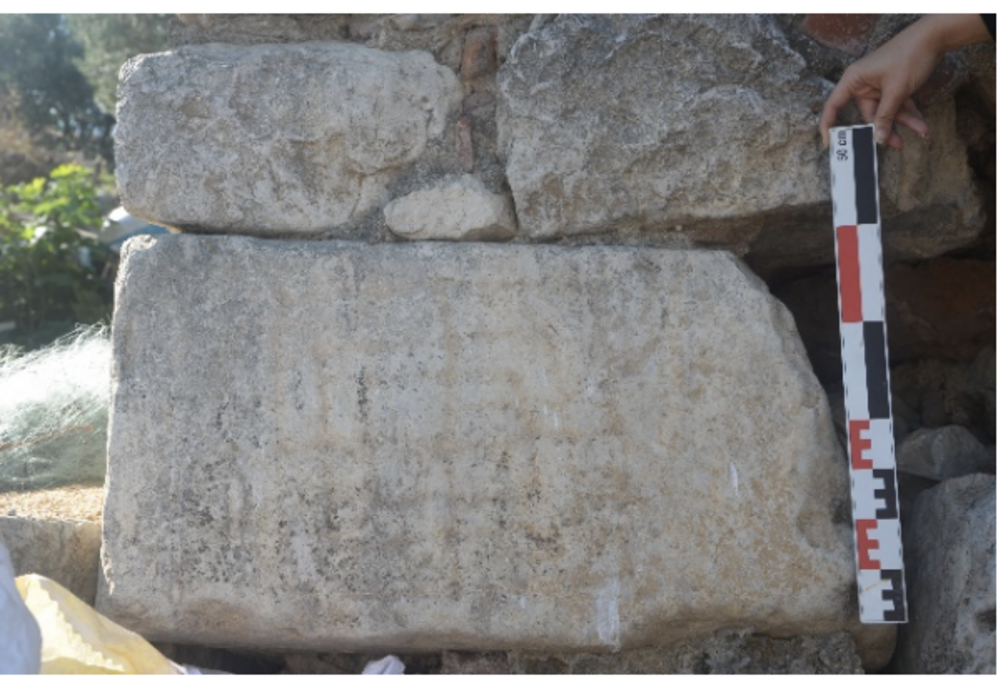
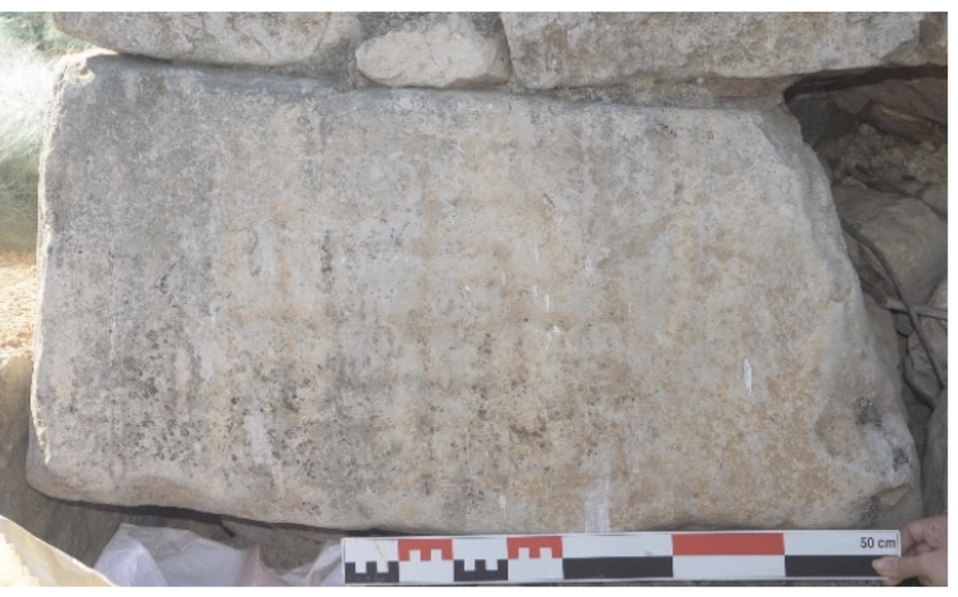
The stone is made of good-quality marble and measures about 77 centimeters long, 38 centimeters high, and 41 centimeters deep. Its side and lower surfaces were roughly tooled, but the upper face was carefully smoothed and polished. That difference matters. It suggests the surface was intentionally prepared for use before the block was built into the wall.
On the front face, researchers identified the familiar pattern of Nine Men’s Morris: three concentric squares connected by lines at their midpoints. The left side of the board is now worn, but the layout remains recognizable. This was not random scratching. It was a deliberate geometric design made for play.
Apollonia ad Rhyndacum, a city between lake and mountain
Apollonia ad Rhyndacum stood between the ancient Propontis, today’s Sea of Marmara, and Mount Olympos, now Uludağ. The city was located on the shores of Apolloniatis, modern Lake Uluabat, and gave its name to the lake itself.
Like modern Gölyazı, the ancient city occupied a chain of three peninsulas extending into the water. The outer section could become an island when lake levels rose. In antiquity, access was probably controlled by a wooden bridge, while today a concrete bridge connects the settlement.
The city’s most protected area, sometimes described as an acropolis-like zone, was surrounded by a fortification wall believed to belong to Late Antiquity. The central peninsula formed one of the main settlement zones. Early travelers and historical plans indicate the presence of major public buildings, including a stadium, a theater, and temples.
These details make the game board more than an isolated object. It belonged to a city with monumental architecture, public spaces, defensive walls, and a long urban life stretching from antiquity into the Byzantine and medieval periods.
A strategy game without dice
Nine Men’s Morris was a two-player strategy game. Each player used nine pieces and tried to form rows of three, known as “mills.” When a player created a mill, they could remove one of the opponent’s pieces. Unlike racing games, which depended heavily on dice, Nine Men’s Morris relied on planning, blocking, and tactical movement.
That makes the Apollonia board especially revealing. It points to a form of entertainment based not on chance, but on calculation and foresight. In a city often studied through walls, temples, inscriptions, and political history, the board brings the focus down to a more human scale: two people seated by a stone surface, testing each other’s patience and skill.
The game was known by many names across different cultures, including Merels, Mills, The Mill Game, and Nine Men’s Morris. Its variants used three, six, nine, or even twelve pieces. The Apollonia example follows the classic nine-piece form.
A game with deep roots across the ancient world
The origins of Nine Men’s Morris are debated, but similar board patterns are known across a wide geography. Some researchers have linked early forms to ancient Egypt, while secure archaeological examples appear across the Mediterranean, Anatolia, and medieval Europe.
Anatolia has produced important parallels. A board from Gordion has long been discussed as one of the early Anatolian examples. Other game boards are known from Stratonikeia, Klaros, Aphrodisias, Amorium, Pergamon, and Ayasuluk. The Apollonia board now strengthens the evidence for the game’s presence in northwestern Anatolia, especially in Bithynia, where documented examples remain relatively few.
The game also appears far beyond the Roman world. One well-known example comes from the Gokstad Viking ship burial in Norway, where a board fragment was found among elite grave goods. Its survival in such varied settings shows that this simple geometric game had unusual staying power.
What the board tells us about daily life
Ancient cities are often remembered through power: walls, wars, rulers, inscriptions, and temples. The Apollonia board tells a quieter but equally important story. It shows that the people of the city had spaces for leisure, social exchange, and intellectual competition.
The board’s reuse in the fortification wall adds another layer. At some point, a stone object once used for play lost its original function and became building material. That change reflects the architectural transformations of Apollonia, especially during later periods when older public buildings supplied material for repairs and defenses.
Yet the game survived on the stone. Even after being absorbed into a wall, the board preserved a trace of civic life that written sources rarely record.
The Apollonia ad Rhyndacum game board is therefore more than a carved pattern. It is evidence of a shared gaming culture that linked Roman Anatolia with the wider Mediterranean and, perhaps, broader Eurasian traditions. It reminds us that ancient urban life was not only shaped by politics, religion, and defense. It was also shaped by waiting, thinking, competing, and playing.
Gülsefa, G. (2026). Apollonia ad Rhyndacum kentinden dokuz taş oyun tablası. Nevşehir Hacı Bektaş Veli Üniversitesi SBE Dergisi, 16(1), 125-140. https://doi.org/10.30783/nevsosbilen.1827612
Cover Image Credit: General view of the area where the ancient game board was discovered. (Excavation Archive). Gülsefa, G. (2026)
