
24 June 2026 The Future is the Product of the Past

Researchers Discover a 40-Million-Year-Old Ant in Amber Once Owned by Johann Wolfgang von Goethe

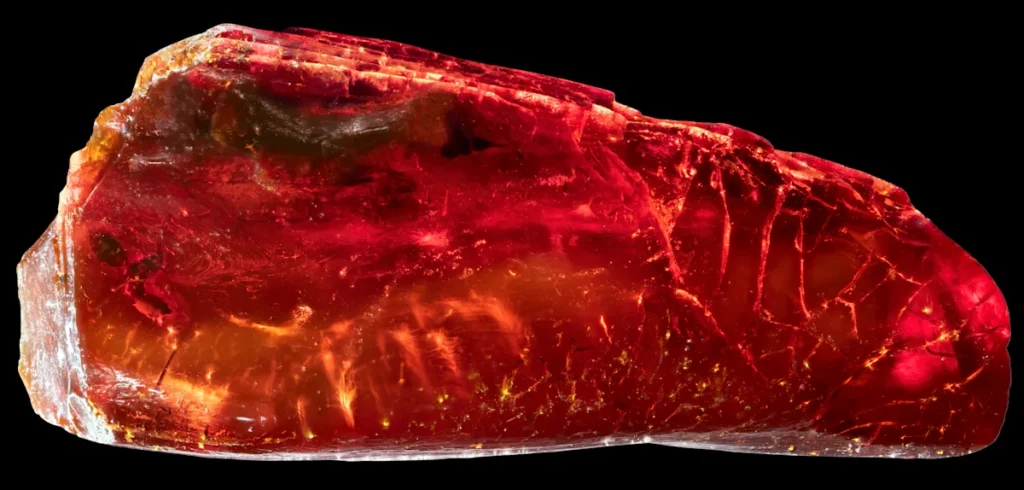
Johann Wolfgang von Goethe is best known as one of the greatest literary figures in history, but the German poet, philosopher, and statesman was also a passionate naturalist and collector. More than 200 years after his death, Goethe’s personal amber collection has revealed an extraordinary scientific discovery: a 40-million-year-old fossil ant hidden inside a piece of Baltic amber once held in his hands.

The remarkable finding was made by an international team of researchers led by scientists from Friedrich Schiller University Jena. Using state-of-the-art imaging technologies, the team identified the fossil in an unpolished amber specimen from Goethe’s collection—despite the fact that the insect is invisible to the naked eye.

Advanced Imaging Unlocks a Hidden Fossil

The fossil ant was discovered using synchrotron radiation–based micro-computed tomography (SR-µ-CT), a cutting-edge technique that allows scientists to look inside opaque materials without damaging them. This non-invasive method enabled researchers to digitally reconstruct the insect in three dimensions with unprecedented precision.

The ant was identified as †Ctenobethylus goepperti, an extinct species that lived during the Eocene epoch, approximately 47–34 million years ago. Although this species is relatively common in Baltic amber, the newly discovered specimen stands out due to its exceptional state of preservation and the level of anatomical detail revealed.

A First Look Inside an Ancient Ant

One of the most significant aspects of the discovery is that scientists were able to examine the internal anatomy of a fossil ant for the first time. Structures inside the head and thorax—normally lost during fossilization—were clearly visualized through 3D reconstruction.


📣 Our WhatsApp channel is now LIVE! Stay up-to-date with the latest news and updates, just click here to follow us on WhatsApp and never miss a thing!!


According to researcher Bernhard Bock from the Phyletic Museum in Jena, the study goes far beyond simply identifying a fossil: “This specimen allowed us to redescribe the species in much greater detail and to gain new insights into its evolutionary relationships.”

The findings suggest that †Ctenobethylus goepperti may be closely related to the modern ant genus Liometopum, which today includes tree-dwelling species known for forming large colonies.
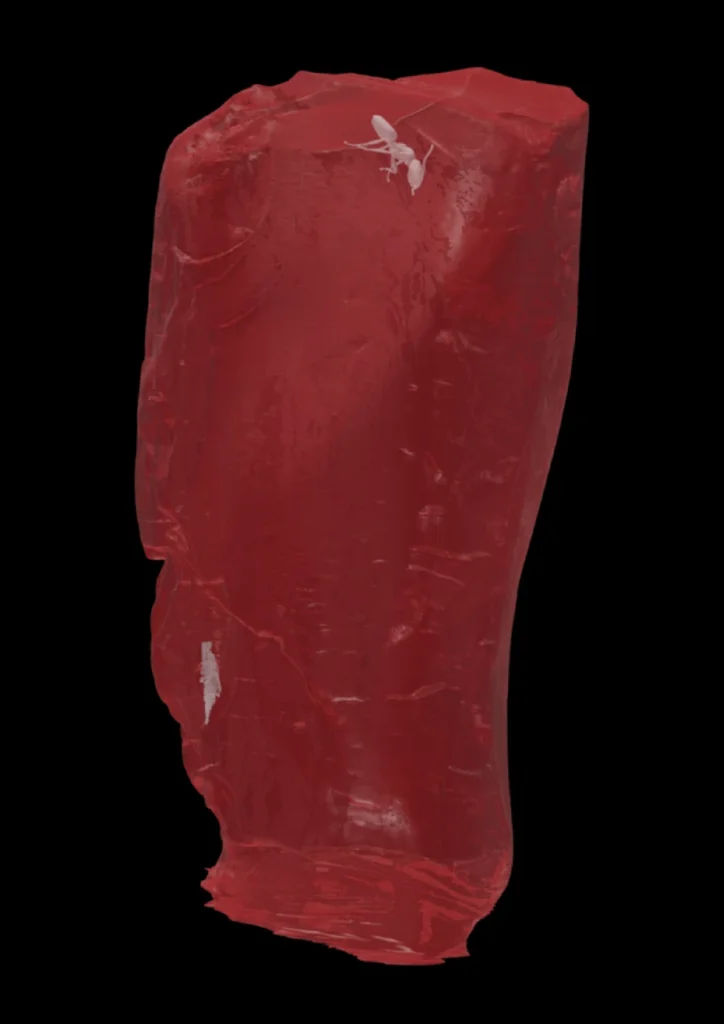
3D render of amber piece 1552.b with its corresponding bioinclusions in their position. Top: †Ctenobethylus goepperti. Arrow: sciarid gnat coated close to the rear surface of the backside of the amber piece in this view. Credit: Boudinot et al., 2026

Insights into Eocene Forest Ecosystems

Based on its morphology and evolutionary relationships, researchers believe that †Ctenobethylus goepperti was likely an arboreal ant, living in warm, humid, conifer-dominated forests that once covered large parts of Europe during the Eocene. Its abundance in Baltic amber suggests it may have been one of the dominant ant species of its time.

This discovery provides valuable information about ancient ecosystems and climate conditions, reinforcing amber’s reputation as a biological time capsule capable of preserving delicate life forms for tens of millions of years.

Goethe’s Amber Collection Revisited

Goethe’s amber collection consists of around 40 pieces, primarily sourced from the Baltic Sea region. Today, these artifacts are housed at the Goethe National Museum in Weimar, where they have been preserved largely in their original condition.

During the recent investigation, scientists examined all 40 amber pieces using modern imaging techniques. In addition to the fossil ant, they identified two other insect inclusions: a fungus gnat and a blackfly. It is believed that Goethe himself was unaware of the microscopic life trapped inside these amber specimens, as systematic studies of amber inclusions only became common toward the end of his lifetime.

Old Collections, New Discoveries

The study highlights the immense scientific value of historical museum collections, especially when revisited with modern technology. Objects once collected for aesthetic, philosophical, or personal reasons can still yield groundbreaking scientific insights centuries later.

To support further research, the team created interactive 3D models of the fossil ant, which are now available online. These models allow scientists worldwide to compare similar fossils and improve the identification of extinct ant species.
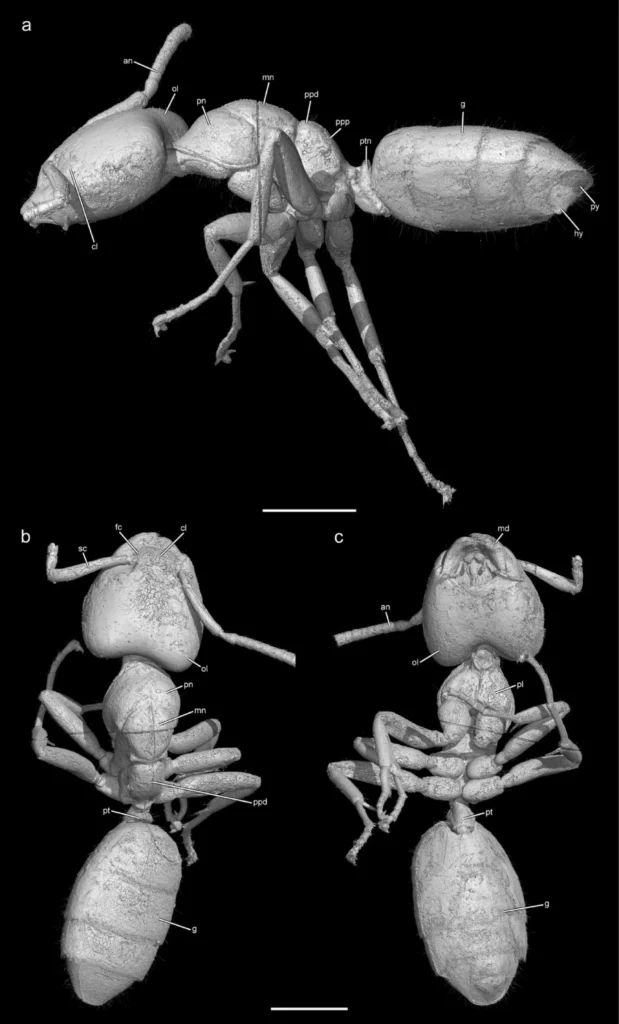
3D renders of †Ctenobethylus goepperti in amber piece 1552.b. a Lateral view. b Dorsal view. c Ventral view. Credit: Boudinot et al., 2026

Where Science, History, and Culture Converge

For researchers, the discovery is more than a paleontological milestone—it is also a powerful symbol of continuity between past and present. A specimen collected during the Enlightenment era, at a time when modern natural science was still emerging, now contributes to cutting-edge evolutionary research.

As Bernhard Bock notes, “It is fascinating that an object from Goethe’s time—handled by someone who helped shape modern thought—can still expand our scientific knowledge today.”

The 40-million-year-old ant preserved in Goethe’s amber stands as a testament to the enduring value of curiosity, careful observation, and the timeless dialogue between science, culture, and nature.

Boudinot, B.E., Bock, B.L., Tröger, D. et al. Discovery of Goethe’s amber ant: its phylogenetic and evolutionary implications. Sci Rep 16, 2880 (2026). https://doi.org/10.1038/s41598-026-36004-4

Cover Image Credit: Boudinot et al., 2026

3D model available on Sketchfab

Related Articles

4,500-Year-Old Gold Brooch Unearthed in Troy: One of Only Three Known Examples Worldwide

27 September 2025

27 September 2025

Archaeological excavations at the legendary city of Troy have once again made global headlines. In 2025, ongoing digs at the...

Archaeologists find 2,000-year-old eyeshadow and blush in ancient Roman city of Aizanoi

24 September 2023

24 September 2023

Archaeologists discovered rare makeup products of 10 different colors and different sorts of hair accessories and jewelry during excavations at...

3,000-year-old necropolis found in southeast of Türkiye

16 October 2023

16 October 2023

A 3,000-year-old necropolis was unearthed during the excavations carried out in the Cehennem Deresi (Hell Creek) in Bağözü village of...

3D printing technology was used for the restored relic restoration of an ancient palace in Liangzhu Archaeological Site

11 July 2021

11 July 2021

Six rebuilt massive wooden pillars of an old palace have been exposed to the public for the first time at...

Ancient Hittite Bronze Helmet Unearthed: A Rare Glimpse into the Warrior Culture of a Forgotten Empire

5 June 2025

5 June 2025

3,300-Year-Old War Helmet Reveals the Power, Beliefs, and Craftsmanship of the Hittite Civilization A rare 3,300-year-old bronze helmet discovered in...

The Lion of Venice was Made in China: : Isotopic Analyses and Stylistic Comparisons Prove it

16 September 2024

16 September 2024

Recent scientific studies have revealed that the famous bronze-winged lion above one of the two columns in Piazzetta San Marco,...

2,200-Year-Old Satyr Mask Unearthed in Phanagoria Confirms Existence of Ancient Greek Theater

26 September 2025

26 September 2025

First tangible evidence of Greek theater in the Black Sea colony sheds light on the cultural life of the Bosporan...

The Carthaginian Elephant in the Oppidum: New Archaeological Evidence of War Elephants in the Second Punic War

27 January 2026

27 January 2026

Archaeologists in Córdoba uncover the first physical evidence of Carthaginian war elephants in Western Europe, shedding new light on the...

Ancient Greek Marble Workshop Unearthed on Paros Island

20 May 2025

20 May 2025

The world of ancient Greek art continues to amaze modern scholars, with recent excavations on Paros Island unveiling a long-lost...

The 9,000-Year-Old Bad Dürrenberg Shaman Reveals New Clues to Europe’s Earliest Ritual Traditions

12 December 2025

12 December 2025

On a quiet rise above the Saale River, long before agriculture reshaped the landscapes of Europe, a woman was laid...

Scientists Reconstruct Face Of 16th Century Italian ‘Vampire’ Buried With Brick In Mouth

23 March 2024

23 March 2024

A 16th-century ‘vampire‘ who was buried with a stone brick jammed in her mouth over fears she would feed on...

Unearthing One of the Earliest Examples of Roman Monumental Architecture: Ancient Basin Discovered in Gabii

21 October 2025

21 October 2025

Hidden beneath the soil of an ancient city just east of Rome, archaeologists from the University of Missouri have uncovered...

5,500-Year-Old Settlement Discovered on Lake Titicaca’s Island of the Sun, Bolivia—Far Earlier Than Thought

19 March 2026

19 March 2026

A windswept island in the middle of Lake Titicaca—long revered as a sacred landscape in Andean cosmology—has just yielded evidence...

Archaeologists Discover Complete 13th-Century Rare Benahoarit Vase in Tijarafe Funerary Cave on La Palma

30 August 2025

30 August 2025

A remarkable archaeological discovery in Tijarafe, a municipality on the northwestern coast of La Palma in Spain’s Canary Islands, has...

3,000-Year-Old Grave of a Woman Wearing 19 Bracelets and 8 Rings Discovered in Chechnya

26 March 2026

26 March 2026

A remarkable archaeological discovery in the Chechen Republic is drawing global attention—not only for its scientific significance, but for the...