
20 June 2026 The Future is the Product of the Past

Rare Viking Gold Hoard Found Near Rold Becomes Denmark’s Third-Largest Viking-Age Gold Discovery

A flash of gold in the soil beside a forest track has led archaeologists in northern Denmark to one of the country’s most important Viking-age gold discoveries.

The find, now known as the Rold Hoard, consists of six intact gold arm rings with a combined weight of 762.5 grams. According to Nordjyske Museer, the discovery makes it the third-largest Viking-age gold hoard ever recorded in Denmark, surpassed only by the Tissø ring found in West Zealand in 1977 and the Fæsted Hoard near Ribe in 2016.

A discovery beside a forest road

The first two rings were discovered near Rold in Himmerland by a local man, who noticed them partly visible in the ground beside a field road in a wooded area. He handed the objects to Nordjyske Museer on April 22 for danefæ assessment, the Danish process for evaluating treasure finds of national importance. Museum archaeologists quickly realized that the heavy objects were solid gold arm rings from the Viking Age.

“It is a completely exceptional find. We have simply never experienced anything like it before here at the museum,” said Torben Sarauw, head of cultural heritage and archaeologist at Nordjyske Museer.

After receiving the first rings, archaeologists moved rapidly to investigate the site. A systematic metal-detecting survey revealed another twisted gold arm ring almost exactly where the first two had appeared. About 15 meters away, the team then found three more gold arm rings, lying close together. All six were intact and made of solid gold.


📣 Our WhatsApp channel is now LIVE! Stay up-to-date with the latest news and updates, just click here to follow us on WhatsApp and never miss a thing!!


The final three rings may be especially important. Because they were found stacked on top of one another, archaeologists interpret that spot as the likely original place where part of the hoard was deliberately deposited. The find area lies on private land with no public access, and both the finder and landowner have chosen to remain anonymous.
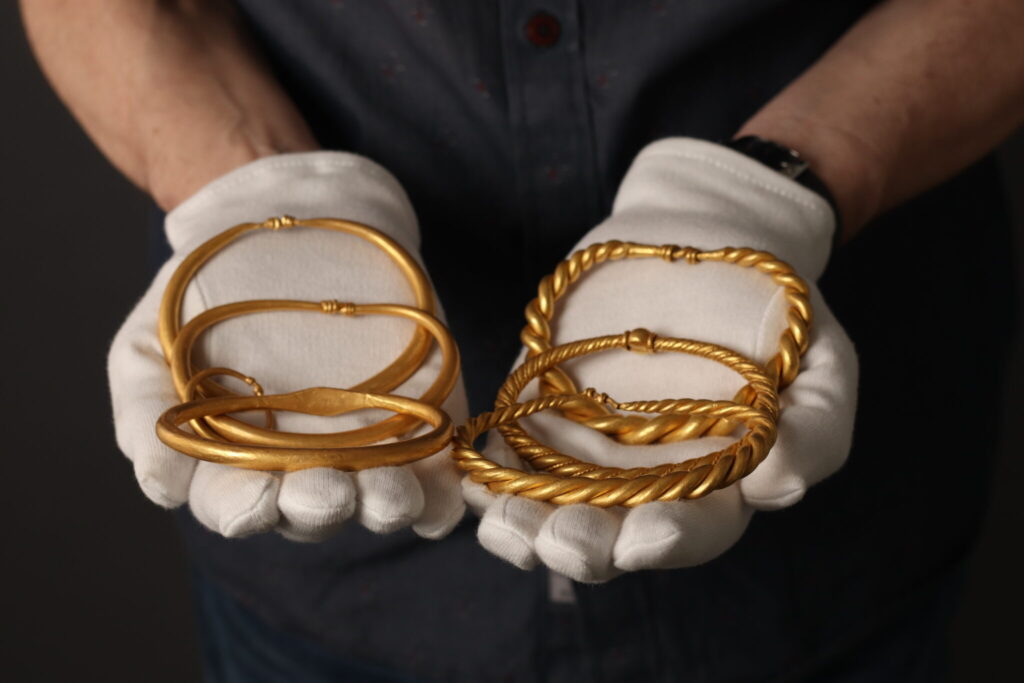
The find, now known as the Rold Hoard, consists of six intact gold arm rings with a combined weight of 762.5 grams. Credit: Nordjyske Museer

Gold, power and the late Viking Age

The Rold Hoard dates to the late Viking Age, around A.D. 900 to 1000, a period when power in Denmark was changing rapidly. During these generations, the Danish realm began to take clearer political shape, a process reflected in the Jelling Stone, where Harald Bluetooth announced around A.D. 965 that he had won all Denmark and Norway and made the Danes Christian.

Gold arm rings of this kind were not simple ornaments. In the Viking world, rings could signal rank, allegiance, wealth and political connection. Their weight and visibility made them powerful statements on the body, but they also carried meanings beyond decoration. They could be gifts from leaders to followers, objects exchanged to mark loyalty, or signs of a person’s place within elite networks.

Sarauw said gold in the Viking Age was concentrated among “society’s absolute elite,” which makes discoveries of this type extremely rare. Similar Scandinavian arm rings are known from the period, but examples in gold are far less common than those made of silver.
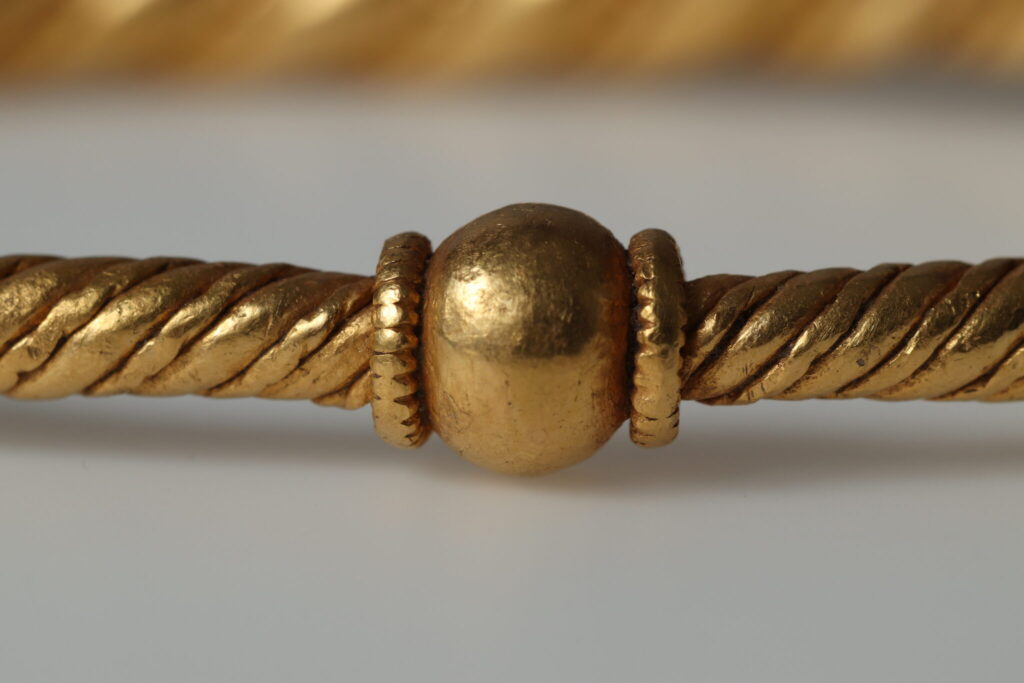
Two of the rings are nearly identical, made from two solid twisted rods and finished with simple wrapped closures known as running knots. A third follows the same basic design but has a bead-like terminal and a thin twisted gold wire set into the groove between the heavier strands. Credit: Nordjyske Museer

A hoard of intact prestige objects

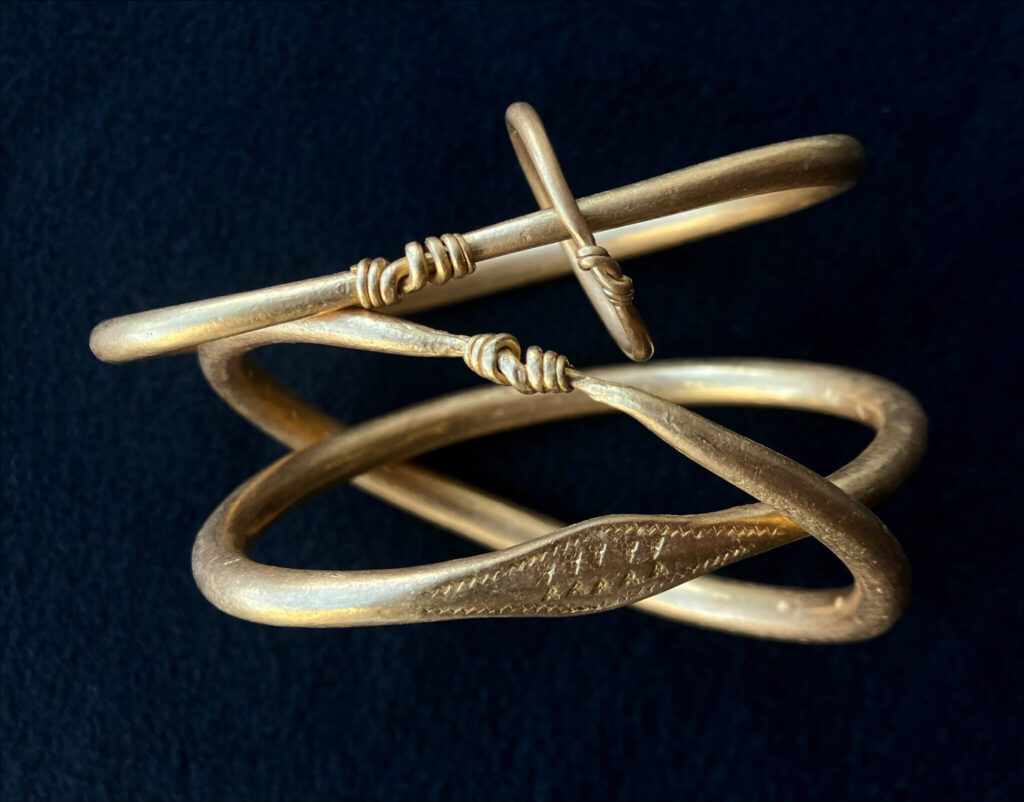
The craftsmanship also stands out. Three rings are twisted from two rods, including one with a thin gold wire inlay and a knob-shaped fastening. The others are smooth rings formed from solid rods or wire. Several have wrapped closures known as running knots, and one ring carries a smaller ring of the same type. Another differs from the rest, with flat-hammered ends decorated with zigzag patterns and triangles.

Taken together, the six objects point to highly specialized goldsmithing. Their intact condition is equally significant. Viking silver and gold are often found cut, weighed or broken into pieces that could be used as bullion. These rings were not treated that way. Their survival as complete objects suggests that they functioned less as ordinary payment metal and more as prestige items, political gifts, or visible signs of power.

When valuable objects were buried together in the Viking Age, archaeologists often consider two main possibilities. They may have been hidden for safekeeping in uncertain times, or deposited as part of a ritual act whose full meaning is now difficult to reconstruct. The Rold Hoard offers a rare glimpse into a world where wealth, belief and authority were closely connected.

The archaeological investigation has now been completed, and all six rings have been submitted as danefæ. They will undergo further analysis before being sent to the National Museum of Denmark.

Nordjyske Museer hopes the arm rings can be displayed at Aalborg Historical Museum before the summer holiday, allowing the public to see one of Denmark’s most remarkable Viking gold finds near the landscape where it lay hidden for more than a thousand years.

Nordjyske Museer

Cover Image Credit: Three of the Viking gold arm rings are smooth, while one stands out with zigzag and triangular decoration. Another ring contains a smaller ring of the same type. Nordjyske Museer


Related Articles

Roman era total of 46 early settler burials discovered in Germany

17 September 2023

17 September 2023

Students from Goethe University Frankfurt, in collaboration with the Hesse archeology department at the Darmstadt branch of the State Monument...

16th-Century Cádiz Bay Shipwreck Reveals a Genoese Vessel Sunk in Francis Drake’s Famous Raid

28 April 2026

28 April 2026

A 16th-century shipwreck in Cádiz Bay has been identified as the Genoese vessel San Giorgio e Sant’Elmo Buonaventura, sunk during...

Paleontologists Unearth 139 Million-Year-Old Pregnant Dinosaur Fossil in Chile

10 May 2022

10 May 2022

Archeologists in Chile have unearthed the fossilized remains of a 13ft-long pregnant ichthyosaur from a melting glacier -marking the first...

Egypt dig unearths 41 mln-year-old Whale in desert -Tutcetus rayanensis-

12 August 2023

12 August 2023

Paleontologists in Egypt announced the discovery of a new species of extinct whale that inhabited the sea covering present-day Egypt...

The first settlement of the Cimmerians in Anatolia may be Büklükale

7 June 2022

7 June 2022

Archaeologists estimated that the first settlement in Anatolia of the Cimmerians, who left Southern Ukraine before Christ (about 8th century...

A new study shows that the cave paintings at Cueva Ardales are the work of Neanderthals

21 August 2021

21 August 2021

A study of pigments used in murals in the Cueva Ardales caves in southern Spain has revealed that Neanderthals, long...

New discoveries have been made at a 9,000-year-old Amida mound in Turkey

1 January 2022

1 January 2022

The most recent archeological investigations at the 9,000-year-old Amida Mound in southeastern Turkey’s Diyarbakir province have uncovered fresh finds that...

Unique and very well-preserved prehistoric engravings found in southwestern Catalonia

23 March 2023

23 March 2023

Significant prehistoric rock art has been discovered in La Febro, in southwestern Catalonia. The team that discovered the art inside...

Second Heracles Kynagidas Inscription Found at Heraclea Sintica in Bulgaria

19 June 2026

19 June 2026

A second inscription naming Heracles Kynagidas, or “Heracles the Hunter,” has been uncovered at the ancient city of Heraclea Sintica...

Altar site for Greek goddess Demeter unearthed in Turkey’s ancient city of Blaundus

21 December 2021

21 December 2021

An altar site for the Greek goddess Demeter was unearthed during the ongoing excavations in the ancient city of Blaundus,...

Rare and Unusual Fossil Shows Small Mammal Attacking Larger Dinosaur

20 July 2023

20 July 2023

An unusual fossil from about 125 million years ago that depicts a dramatic event when a carnivorous mammal attacked a...

Ancient settlements that challenge traditional thinking “Karahantepe and Taş Tepeler”

5 December 2021

5 December 2021

After Göbeklitepe in Şanlıurfa, which sheds light on 12,000 years ago in human history and is considered one of the...

1,800-Year-Old Gold Ring with ‘Venus the Victorious’ Carving and Carolingian Coins Discovered in France

25 December 2024

25 December 2024

Archaeologists from the French National Institute for Preventive Archaeological Research (INRAP) have discovered a 1,800-year-old gold ring with a chiseled...

One of the largest mass burial pits ever discovered in the UK has been unearthed next to Leicester Cathedral

21 November 2024

21 November 2024

While excavating the gardens of Leicester Cathedral for the future construction of a learning center, archaeologists uncovered one of the...

Treasure of 1,290 Ancient Roman Coins Discovered by Amateur Archaeologist in Switzerland

16 April 2022

16 April 2022

An amateur archeologist has found a big treasure trove of over 1,290 priceless, ancient Roman coins dating back to the...