

Archaeologists excavating Early Iron Age burial mounds in Khakassia, southern Siberia, have discovered rare engravings of horses on a stone slab reused in a Tagar culture kurgan. The images may do more than add to the region’s prehistoric art: their placement suggests that the burial monument itself was modified and reused over time.
The discovery was made near the aal of Domozhakov in the Ust-Abakan District of the Republic of Khakassia, where a joint expedition from the Institute of Archaeology and Ethnography of the Siberian Branch of the Russian Academy of Sciences and the Federal Research Center of Coal and Coal Chemistry is conducting rescue excavations.
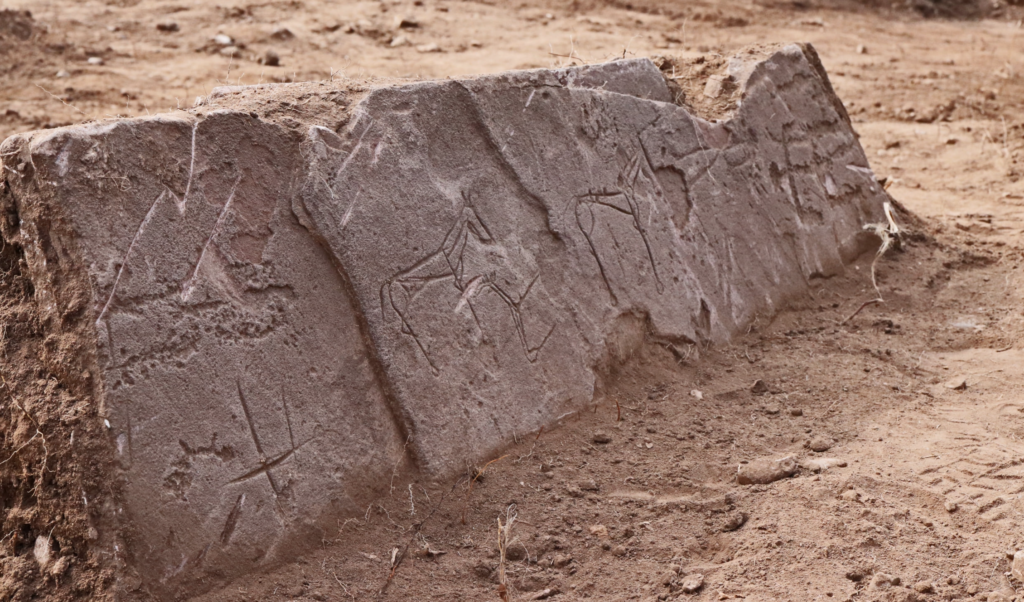
According to the Institute of Archaeology and Ethnography, the project covers approximately 10,000 square meters and includes three Tagar burial mounds. The newly identified images were found on one of the stone slabs forming the enclosure around a burial area.
Two horses, a goat, and older human figures
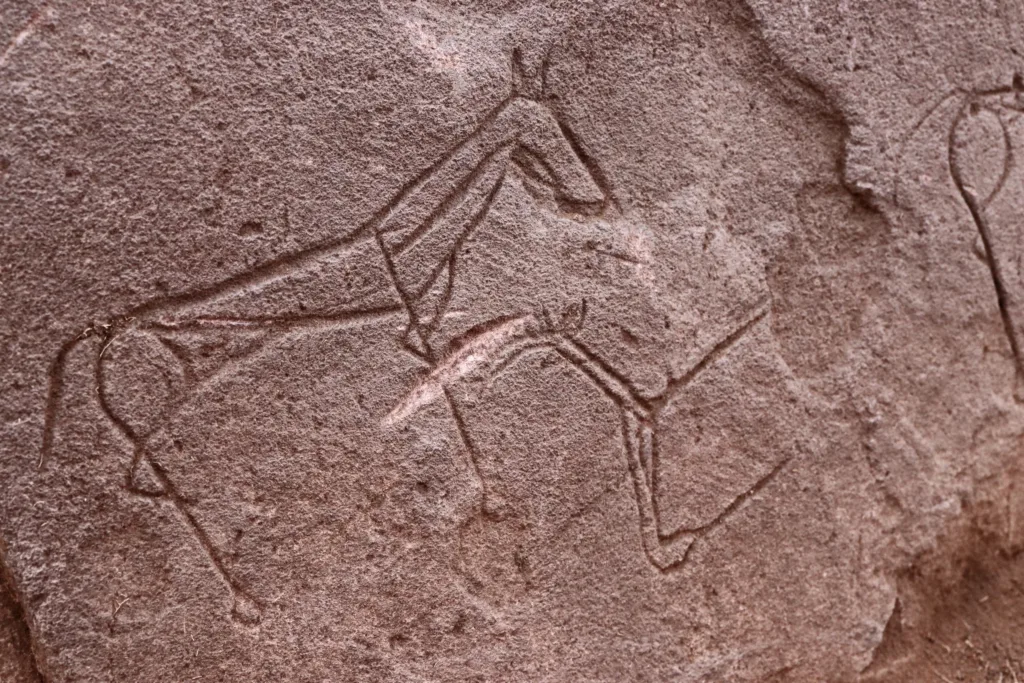
The stone preserves several images, but archaeologists believe they were not created at the same time.
Two horses and a goat were produced by engraving, while nearby anthropomorphic, or human-like, figures were made using a different technique in which the stone surface was pecked. Differences in technique, orientation, and composition have led researchers to propose that the images belong to separate phases in the history of the monument.
For now, archaeologists consider the anthropomorphic figures to be the earliest images on the slab. Comparable human-like representations are known from slabs and corner stelae associated with Tagar burial mounds elsewhere in the region.
Their orientation provides another clue. Researchers believe the stone may originally have stood upright, probably as part of an earlier version of the funerary enclosure. At some later stage, when the boundaries of the kurgan were expanded or reconstructed, the slab appears to have been reused in a new position. The engraved horses may have been added during this later phase.
That sequence makes the stone especially important. Engraved representations of horses are relatively rare in Khakassia, according to the institute, although examples are closely associated with the artistic traditions of the Tagar culture.
A monument that may have changed over generations
The discovery could help archaeologists reconstruct how the kurgan developed rather than simply determining when it was first built.
Tagar communities buried their dead in timber-built chambers, which were covered with stone and surrounded by enclosures constructed from large stone slabs. The Domozhakov excavations suggest that such monuments were not necessarily completed in a single episode. Some may have been returned to, expanded, and altered as additional burials or commemorative activities took place.
The presence of images from different periods on a single reused slab supports that interpretation. If the anthropomorphic figures were carved while the stone stood in its original position and the horses were engraved after it was incorporated into an enlarged enclosure, the slab effectively preserves more than one stage in the life of the burial monument.
Researchers are now clearing the stone coverings over the graves and preparing to investigate the structures inside the burial chambers. Those excavations should provide evidence needed to test the proposed sequence, and the institute cautions that the relative dating of the petroglyphs could change as new information emerges.
Credit: Joint expedition of the Federal Research Center of Coal and Coal Chemistry, SB RAS, and the Institute of Archaeology and Ethnography, SB RAS.
Who were the people of the Tagar culture?
The Tagar culture occupied the Minusinsk Basin and surrounding parts of southern Siberia for much of the first millennium BC. Archaeological research generally places its development from around the eighth century BC into the final centuries of the millennium, although chronological boundaries vary according to periodization and site. The new Khakassia announcement places the communities represented by the excavated monuments broadly between the eighth and third centuries BC.
The Minusinsk Basin, formed around the middle Yenisei and surrounded by the Sayan mountain system, lay on the northeastern edge of the vast Eurasian steppe zone. Tagar communities are regarded as one of the best archaeologically documented groups of early nomads in southern Siberia, with several thousand burials and numerous other archaeological sites already investigated across the region.
Their long history also overlapped with major cultural developments across the Eurasian steppe during the pre-Scythian and Scythian periods. Research indicates that Tagar material culture and funerary practices changed through successive Early, Middle and Late phases, making the chronology of individual burial monuments particularly important for understanding how those communities evolved.
The horse engravings from Domozhakov therefore offer more than another example of Iron Age animal imagery. If the current interpretation survives further excavation, a single stone slab may record two separate moments in the history of a Tagar kurgan, showing how people returned to an existing burial place, reshaped it and added new images to a monument already carrying the marks of an earlier generation.
Institute of Archaeology and Ethnography of the Siberian Branch of the Russian Academy of Sciences
