

A rare Roman inscription discovered at Hadrian’s Villa in Tivoli has preserved evidence of what happened when lightning struck one of the ancient world’s most famous imperial residences.
Archaeologists working in the area traditionally known as the “Amphitheatre” uncovered a marble slab bearing the words FVLGVR SVBMANIVM. The inscription refers to a nighttime lightning strike associated with Summanus, the Roman deity linked to nocturnal thunder and lightning. Most importantly, the slab remains in its original position within the structure to which it belonged.
The discovery emerged during investigations led by the Department of Humanities (DISTUM) at the University of Urbino Carlo Bo, under authorization from Italy’s Ministry of Culture and in collaboration with the Villa Adriana and Villa d’Este Institute.
When a lightning strike changed a place
For the Romans, lightning could carry consequences far beyond physical damage. A place struck by a thunderbolt could acquire a special religious status and become the focus of carefully prescribed rituals.
Archaeologists believe the newly identified structure may have marked or enclosed a bidental, a sacred space associated with a lightning strike. The practice belonged to a wider ritual tradition known as fulgur conditum, in which a place affected by lightning was ritually treated and separated from ordinary space.
“Finding the material sign of the sacralization of a place struck by lightning allows us to directly approach the meticulous ritual procedures of the time,” said Alberto Samonà, director of the Villa Adriana and Villa d’Este Institute. He described the discovery as having exceptional scientific value.
The survival of the inscription in its original architectural setting makes the find particularly significant. Instead of an isolated object removed from its context, archaeologists can study the inscription together with the structure and surrounding archaeological layers.
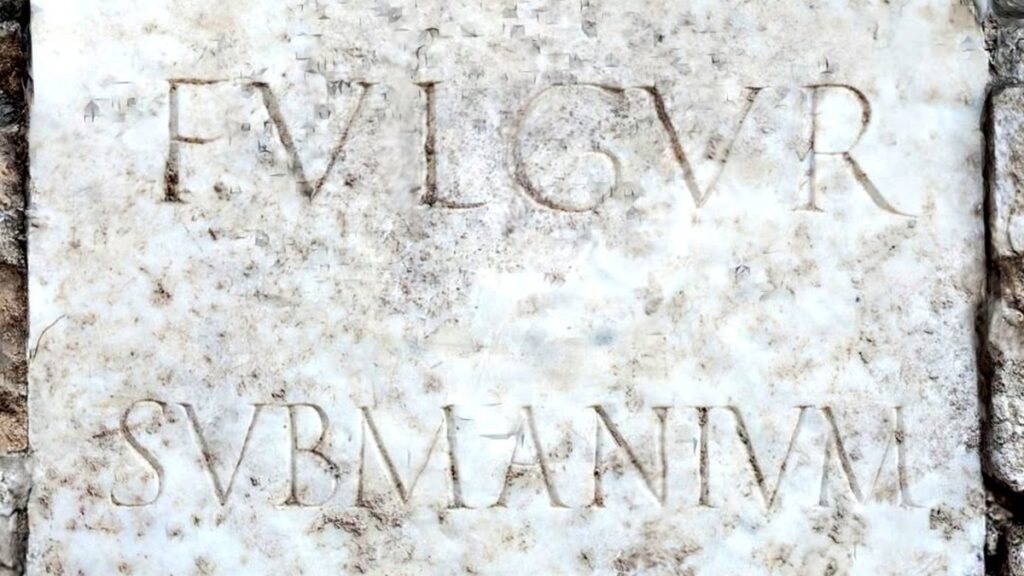
A message to the god of nighttime lightning
The inscription reads:
FVLGVR
SVBMANIVM
It identifies the lightning with Summanus, an obscure Roman deity traditionally connected with nocturnal thunder. Roman religious traditions could distinguish lightning according to when and how it occurred, with nighttime phenomena receiving their own divine associations.
The inscription therefore records more than a dramatic natural event. It preserves the Roman response to an occurrence interpreted through religion, ritual and the perceived intervention of divine forces.
Italy’s Culture Minister Alessandro Giuli, who visited the excavation, described the find as a rare and unusually evocative testimony to Roman religious life, particularly because it remains preserved in its original context.
A new clue to Hadrian’s Villa
The discovery may also change archaeologists’ understanding of this particular part of the enormous imperial complex.
Excavation director Fabio Giorgio Cavallero said the find opens new perspectives on the history of the area and on the possible role of the fulgur conditum ritual in the reorganization of its spaces. Researchers can now examine how the sacred feature related to other structures and later phases of activity within the villa.
That question matters at a site as complex as Hadrian’s Villa. Built largely during the reign of Emperor Hadrian, who ruled from AD 117 to 138, the sprawling residence at Tivoli combined palaces, gardens, baths, ceremonial buildings and architectural references to places across the Roman world.
The new discovery reveals a much smaller and more intimate layer of that landscape. Somewhere within the emperor’s vast residence, lightning struck. The Romans did not simply repair the place and move on. They marked it, ritualized it, and preserved the memory of what they believed had happened there.
Nearly two thousand years later, the inscription still identifies the spot where a moment in the sky became part of the sacred geography of Hadrian’s Villa.
