
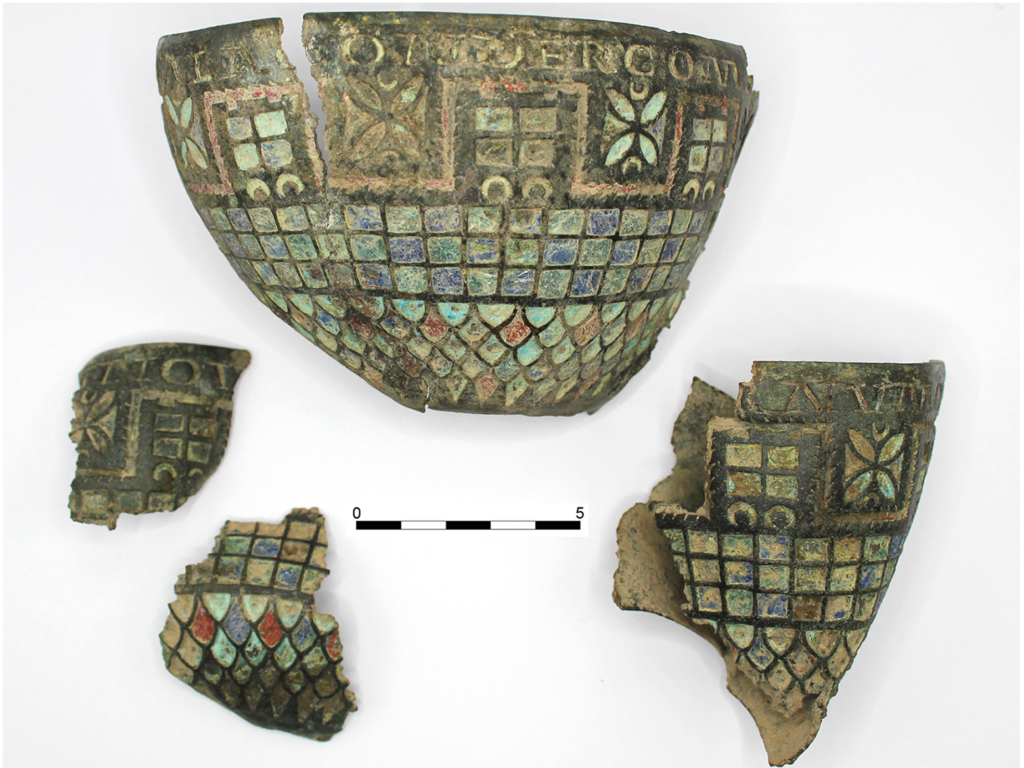
A rare Roman bronze vessel known as the Berlanga Cup—one of only a handful of its kind ever found—has been discovered in central Spain, offering a striking glimpse into the movements and memories of soldiers stationed along one of the Roman Empire’s most formidable frontiers: Hadrian’s Wall.
The object, dating to the 2nd century AD, was uncovered near Berlanga de Duero in the province of Soria. Researchers now believe it may have belonged to a Celtiberian soldier who once served in Roman Britain and later returned home, carrying with him a finely crafted reminder of life on the empire’s northern edge.
A Rare Addition to an Elite Group of Artifacts
The Berlanga Cup belongs to a small and highly specialized group of enamelled bronze vessels known as “Hadrian’s Wall Pans.” These objects are exceptionally rare—fewer than ten comparable examples exist—and have long fascinated scholars for their combination of artistry and historical information.
First identified over two centuries ago with the discovery of the Rudge Cup in England, these vessels typically feature inscriptions naming forts along Hadrian’s Wall, along with decorative motifs representing the structure itself.
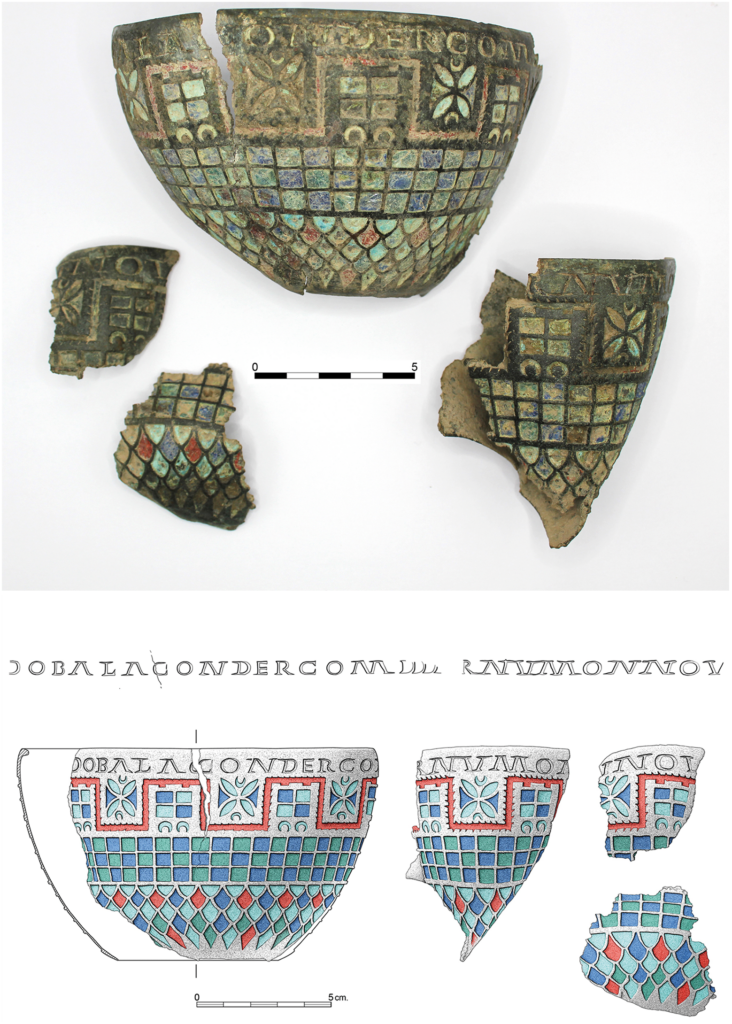
What sets the Berlanga Cup apart is its unique inscription. While earlier examples reference forts in the central or western sections of the Wall, this newly discovered piece is the first known artifact to list forts from the eastern sector, including Cilurnum, Onno, Vindobala, and Condercum.
This detail significantly expands archaeological understanding of how these objects functioned and what they represented.
Hadrian’s Wall: A Frontier of Power and Danger
Constructed between AD 122 and 128 under Emperor Hadrian, the Wall stretched roughly 117 kilometers across northern Britain, from the River Tyne to the Solway Firth. Rising up to four meters high and reinforced with towers and forts, it marked the empire’s northern boundary and served as a defensive barrier against groups such as the Picts.
More than just a military structure, the Wall was a complex frontier system, staffed by auxiliary troops drawn from across the Roman world—including units recruited in Hispania.
The Berlanga Cup’s inscription mirrors this geography. The sequence of fort names follows their real-world order along the Wall, suggesting that the maker—or the owner—had direct knowledge of the frontier landscape.
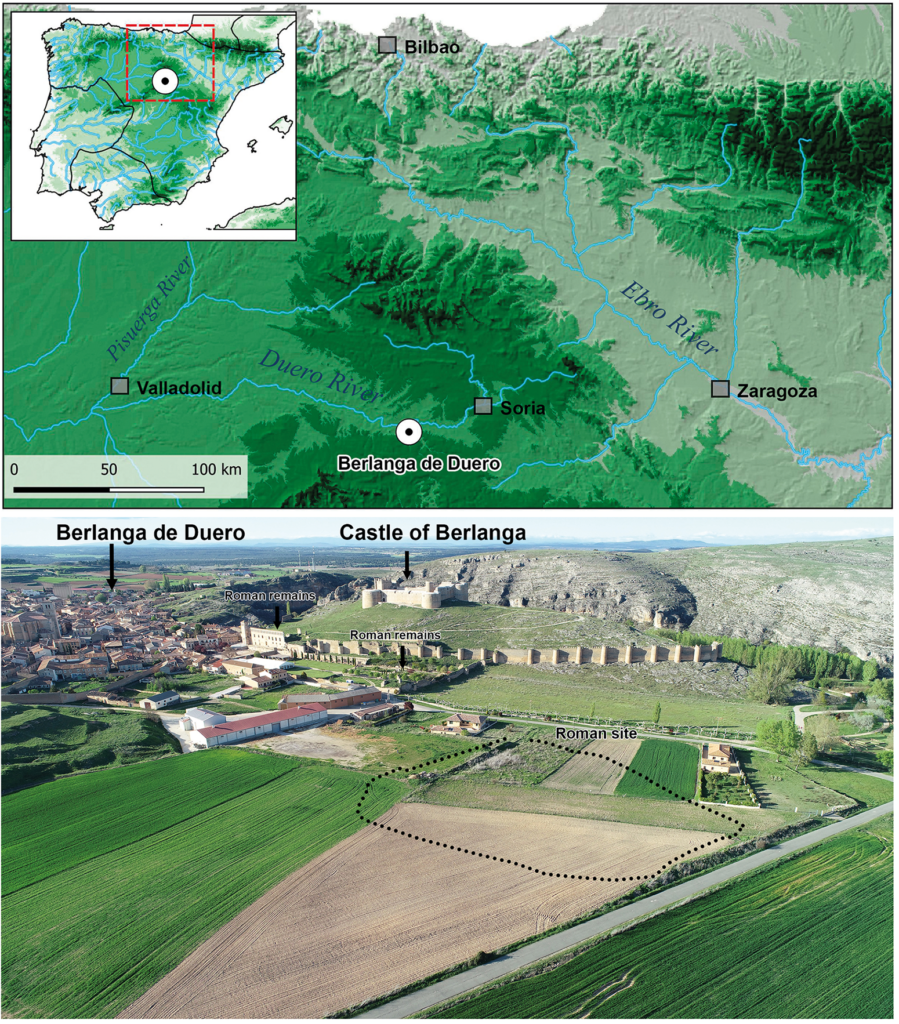
Location of Berlanga de Duero (Soria) on the Iberian Peninsula and aerial view of the La Cerrada de Arroyo site, where the ‘Berlanga Cup’ was found, with the town of Berlanga in the background. (Roberto De Pablo, Susana De Luis, Jesús García). Credit: De Pablo Martínez et al. 2026, Britannia
A Soldier’s Souvenir—or a Military Decoration?
Scholars increasingly interpret these cups not as ordinary objects, but as prestige items linked to military service. According to the study published in Britannia, they may have functioned as either commemorative souvenirs or even honorary distinctions awarded to soldiers after completing their service on the Wall.
The Berlanga Cup strengthens this interpretation. Its presence nearly 2,000 kilometers away from Britain strongly suggests it traveled with its owner—most likely a soldier returning home after years on the frontier.
Archaeological and epigraphic evidence supports this theory. Units such as the Cohors I Celtiberorum, composed of recruits from central Spain, are known to have served in Britain during the 2nd century AD.
The cup may have belonged to one such soldier, who carried it back to his homeland as a personal memento of his military career.
Advanced Science Confirms Its Origins
Scientific analysis has provided further clues about the artifact’s story. Using portable X-ray fluorescence and lead isotope analysis, researchers determined that the cup’s metal likely originated from mines in Britain, particularly in regions such as Wales or northern England.
This finding reinforces the idea that the vessel was produced near Hadrian’s Wall itself before being transported to Spain.
The enamel decoration—featuring red, green, blue, and turquoise glass—matches known Roman techniques from the same period. These colorful designs depict stylized towers and geometric patterns, widely interpreted as symbolic representations of the Wall and its fortifications.
Digital Reconstruction Reveals the Original Form
When discovered, the Berlanga Cup was fragmented and partially deformed. To better understand its original shape, researchers created a detailed 3D digital reconstruction, achieving sub-millimeter accuracy.
This virtual model allowed them to determine the vessel’s dimensions—approximately 11.3 cm in diameter and nearly 8 cm in height—making it one of the largest examples in its category.
The reconstruction also enabled scholars to “unfold” the cup’s surface, providing a clearer view of its inscription and decorative program.
The Discovery Site: A Roman-Era Settlement
The cup was originally recovered as a chance find in an area known as La Cerrada de Arroyo, just outside Berlanga de Duero. Although it was not unearthed during a recent excavation, its full significance has only now emerged through detailed scientific study.
Subsequent archaeological surveys of the site revealed buried structures, likely part of a Roman rural settlement or villa complex. Ground-penetrating radar identified building remains, while surface surveys uncovered pottery, glass fragments, and other materials dating from the 2nd to 4th centuries AD.
Together, these findings suggest that the cup was not lost in isolation, but belonged to a wider inhabited landscape—possibly linked to the residence or estate of its original owner.
A New Perspective on Roman Mobility
Beyond its rarity, the Berlanga Cup offers something more profound: a tangible connection between distant regions of the Roman Empire.
It illustrates how soldiers from Hispania could be stationed in Britain, serve on a dangerous frontier, and later return home—bringing with them objects that preserved their experiences.
In this sense, the cup is more than an artifact. It is evidence of mobility, identity, and memory within the Roman world.
The First Artifact to Name Hadrian’s Wall’s Eastern Forts
For decades, scholars debated whether Hadrian’s Wall pans were produced as coordinated sets or individual commissions. The Berlanga discovery challenges earlier assumptions, suggesting that these objects were custom-made items, likely tailored to individual buyers rather than standardized series.
It also fills a critical gap in the archaeological record by documenting the eastern section of the Wall—previously absent from known examples.
As research continues, the Berlanga Cup may reshape how historians understand Roman military life, personal identity, and the circulation of objects across the empire.
De Pablo Martínez R, De Luis Mariño S, Garcia Sanchez J, Montero Ruiz I, Aparicio Resco P. The Berlanga Cup. New Evidence of Hadrian’s Wall Pans Found in Hispania Citerior (Spain). Britannia. Published online 2026:1-28. doi:10.1017/S0068113X26100701
Cover Image Credit: Berlanga Cup. Photograph: Roberto De Pablo. Credit: De Pablo Martínez et al. 2026, Britannia
