
A 1,500-year-old gold brooch discovered in Denmark has turned an ordinary metal-detecting signal into a rare glimpse of elite adornment in the late Germanic Iron Age.
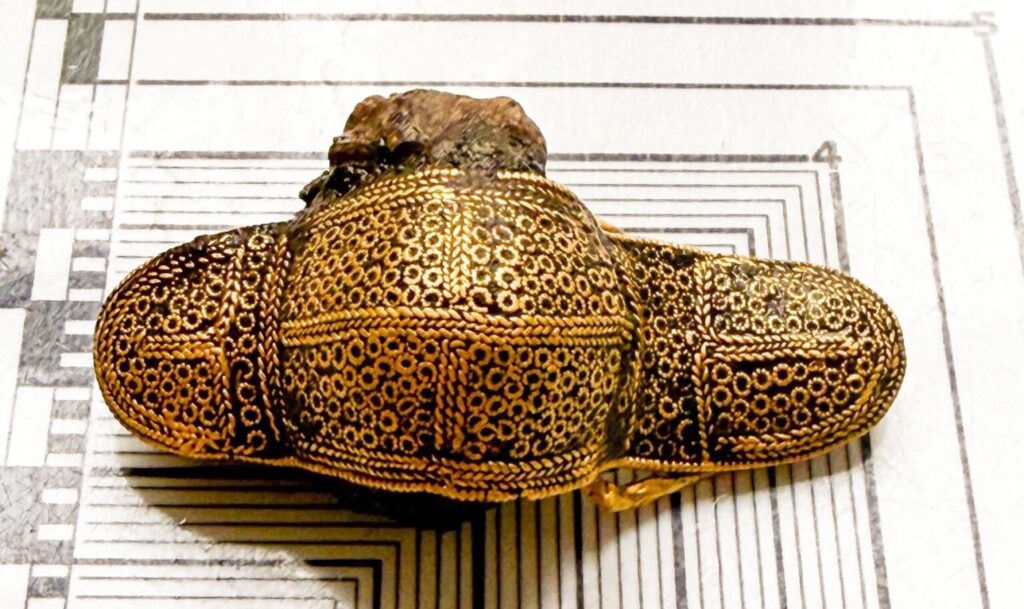
The small object, measuring a little over four centimeters, was found by Danish metal detectorist Mikkel Warming after his detector produced a signal he first associated with modern rubbish. Instead of twisted aluminum foil or an old bottle cap, Warming uncovered a densely decorated gold fibula, a fastening pin used to secure clothing, provisionally dated to the middle of the 6th century AD.
The discovery is striking not only because of the metal. Gold brooches from this period are rare, and this example appears to preserve an unusually elaborate surface, packed with circular motifs and minute ornament. Its decoration, proportions and fastening system suggest an object made for both practical use and public display.
A signal that sounded like modern trash
For detectorists, important finds often begin with disappointment. Warming said the tone from his detector did not immediately suggest a precious artifact. It sounded strange and vague, much like the signals produced by metal debris that fill many shallow holes: crumpled aluminum, discarded caps and other modern refuse.
Then the color changed everything. Warming recalled the moment when gold appeared in the heavy soil after nearly fifteen centuries underground as difficult to describe. It was, in his words, a direct connection with the past. The immediate question was human rather than technical: who had once worn such a jewel?
That question now sits at the center of the find. The object does not yet come from a clearly identified burial, settlement or ritual deposit. Archaeologists are examining the surrounding area to determine whether possible graves, buildings or associated deposits survive nearby. For now, one explanation remains simple and plausible: the brooch may have been lost.
A rare brooch from the late Germanic Iron Age
The brooch is being provisionally dated to around the mid-6th century AD, during the late Germanic Iron Age in northern Europe. This was a period of political and cultural change. In the generations after the collapse of Western Roman imperial authority, communities in Scandinavia and northern Germany were reorganizing around regional power centers, warrior elites and long-distance exchange networks.
Although present-day Denmark lay outside the Roman Empire, it was not isolated from the wider world. Roman coins, glass, metalwork and prestige goods moved north through trade, diplomacy, gift exchange and imitation. Local craftspeople then adapted foreign materials and ideas to northern tastes.
Fibulae played an important role in that world. They fastened garments, but they also communicated identity. The metal, form and decoration of a brooch could signal wealth, rank, affiliation or access to skilled makers. A gold example with dense ornament was not merely a clothing accessory. It was a visible statement.
Fine goldwork on a miniature surface
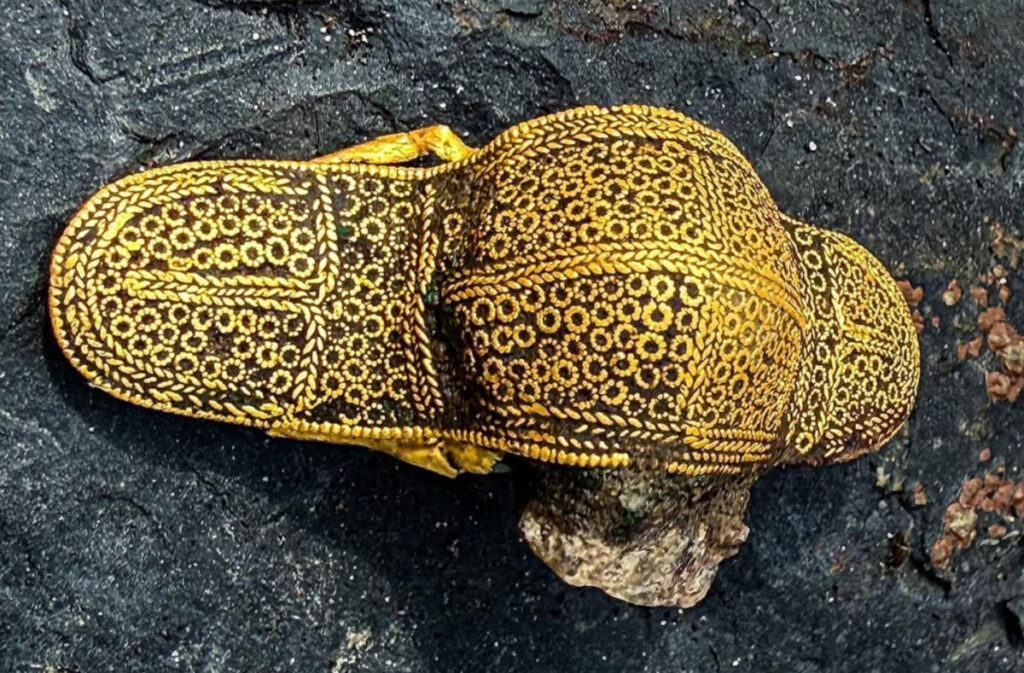
The surface of the Danish brooch is covered with repeated circular elements arranged in a highly ordered pattern. Such decoration recalls techniques associated with filigree and granulation, two demanding forms of precious-metal work.
Granulation involves applying tiny gold spheres to a surface, while filigree uses fine wires to build delicate decorative patterns. Whether the newly found brooch proves to use one or both techniques will require closer technical study, but the uniformity of its ornament already suggests controlled production and considerable expertise.
The craftsmanship matters. A piece only four centimeters long leaves little room for error. The maker had to combine structural strength, visual rhythm and precise fastening technology at a scale that magnifies every imperfection. Its overall form shares features with so-called short-arm fibulae known from the late Germanic Iron Age, although its proportions and decoration do not fit neatly into established typologies.
The brooch’s fastening mechanism also preserves important evidence. Its pin was made of iron, and centuries of corrosion have transformed it into a compact mass of oxides on the reverse side. This damaged material obscures much of the original construction, but it confirms that the object functioned as a true garment fastener. A small stone attached to the underside through mineral accretion suggests that the brooch lay relatively stable in the soil and was not heavily disturbed by later farming.

The meaning of a golden object
The brooch’s exact imagery is harder to read than its function. Its elongated form and dense rounded decoration have invited different visual comparisons, from organic shapes to symbolic body imagery. Such uncertainty is not unusual in early medieval northern art, where forms could be deliberately composite, suggestive and open to more than one reading.
A cautious interpretation is best. The object may have carried meanings linked to power, speech, fertility, status or protection, but those readings cannot yet be proven. What can be said with more confidence is that the brooch belonged to a visual culture in which precious materials and skilled ornament helped create authority.
For the person who wore it, gold was not silent. It caught light, moved with the body and marked the wearer as someone with access to wealth and social networks.
That is what makes the Danish discovery so compelling. It began as a signal that sounded like scrap metal. It ended as a small but eloquent survival from a society where clothing, craftsmanship and status were closely bound together.
Cover Image Credit: Mikkel Warming / Linda Warming
