
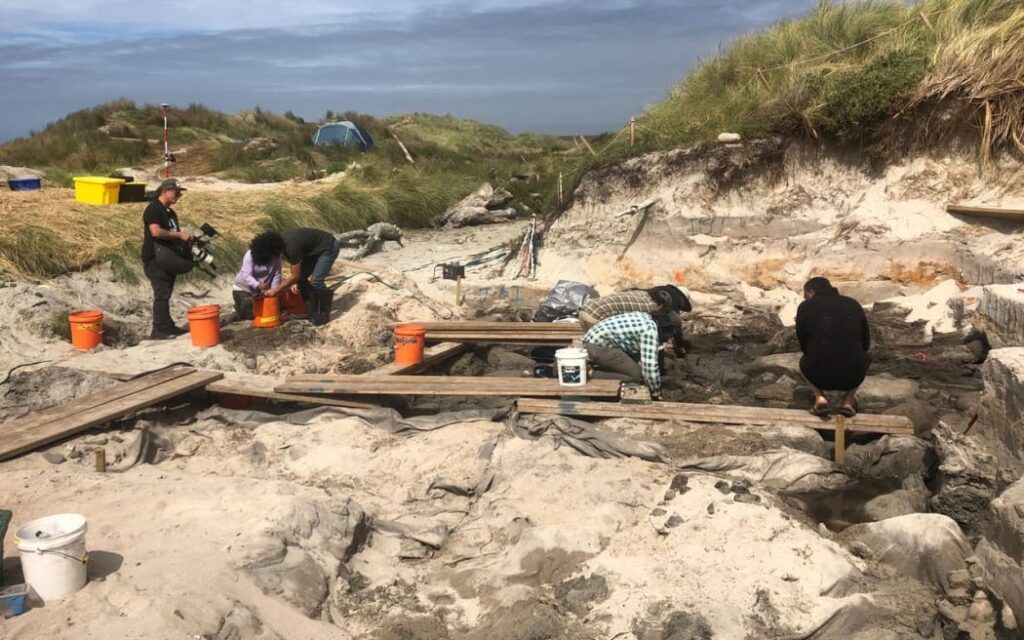
Rēkohu — internationally known as the Chatham Islands, located 800 kilometres east of mainland New Zealand in the South Pacific — has yielded one of its most consequential archaeological discoveries to date. Interim radiocarbon testing on a partially excavated waka suggests the canoe arrived on the remote archipelago between 1440 and 1470 AD, providing rare physical evidence of mid-15th-century Polynesian exploration reaching one of the most isolated island groups in the region.
A Waka Is More Than a Canoe
In Polynesian cultures, a waka is a foundational symbol: a vessel of migration, ancestry and engineering. These ocean-going craft transported people, plants, tools and traditions across thousands of kilometres of open sea. Waka identities also anchor Māori genealogies, forming the basis of tribal origin narratives (waka whakapapa).
A waka found on Rēkohu therefore signals something far greater than the survival of timber — it is the residue of a deliberate voyage, a planned movement of people into a distant and challenging environment.
Refining the Settlement Timeline
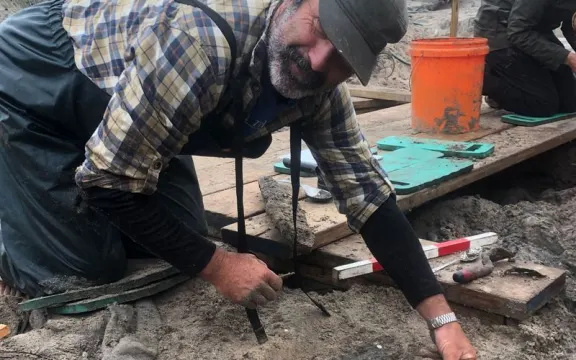
The waka was discovered by father and son Vincent and Nikau Dix, and analysis has been led by Dr Justin Maxwell of Sunrise Archaeology. While earlier work placed the initial settlement of Rēkohu between 1450 and 1650 AD, the new radiocarbon results sharply narrow this window.
Maxwell notes that environmental studies, including ancient peat analyses, show significant ecological changes only after 1500 AD, consistent with early human land use. The waka’s dating falls just before this threshold — a crucial point in reconstructing the first arrival timeline.
What the Dating Shows
The research team focused on short-lived organic materials surrounding the waka rather than the timber itself. This is essential: trees can live centuries, and dating the wood often yields ages unrelated to the canoe’s actual use.
Key findings include:
Short-lived plant materials: Cluster tightly between 1440–1470 AD, indicating the cultural layer formed soon after the waka’s arrival.
Cordage (rope): One fibre sample predates 1415 AD, suggesting older materials were reused — a common practice during long voyages.
Bottle gourd (hue/calabash): Dated to c. 1400 AD or earlier. This is the first confirmed bottle gourd found archaeologically on the Chatham Islands.
Maxwell emphasises why these results matter: “Short-lived samples give us the clearest picture of when the waka was actually in use. Wood dates can be centuries older than the event we’re trying to understand.”
The presence of bottle gourd is particularly significant. Hue were essential in Polynesian life — used as containers, floats, storage vessels and sometimes in ritual contexts. Their appearance on Rēkohu demonstrates transported horticulture rather than accidental drift, strengthening the case for a purposeful voyage.
A Deliberate Journey to a Remote Archipelago
The Chatham Islands sit alone in the South Pacific, exposed to harsh winds, powerful currents and vast distances. Reaching them required advanced navigation knowledge and intentional planning.
The radiocarbon evidence supports a scenario in which a Polynesian voyaging group — still culturally connected to Aotearoa and the wider Eastern Polynesian world — made landfall in the mid-15th century. Some of the artefacts found with the waka appear older, meaning the canoe or its components may have been maintained, re-lashed or repurposed over generations before arriving on Rēkohu.
Institutional Response and Next Steps
Glenis Philip-Barbara, Pou Mataaho o Te Hua Deputy Secretary Delivery and Investment at Manatū Taonga (Ministry for Culture and Heritage), described the findings as a key milestone:
“These interim results deepen our understanding of early settlement and cultural history on Rēkohu Wharekauri Chatham Island. The final report will provide further analysis and context.”
The full archaeological report, expected by February 2026, will refine the radiocarbon dates, present stratigraphic studies and offer a more detailed interpretation of how the waka fits into the broader settlement sequence of the islands.
A Rare Window Into Early Pacific Mobility
The discovery and dating of the Rēkohu waka create a rare intersection of material evidence, environmental data and voyaging tradition. Few archaeological contexts in the Pacific preserve waka remains with datable short-lived materials. This site therefore contributes not only to Chatham Islands history, but to wider discussions about Polynesian mobility, experimentation and expansion during the late Medieval period.
The mid-1400s date range positions the waka at a pivotal moment — a time when Eastern Polynesian societies were still deeply interconnected, before later cultural divergence produced distinct regional identities such as the Moriori of Rēkohu.
Cover Image Credit: Sunrise Archaeology
