
11 February 2026 The Future is the Product of the Past

Anaweka Waka: New Zealand’s Most Significant Archaeological Find Gets a Permanent Home

Discovered in 2012, New Zealand’s most significant archaeological find may soon become the centerpiece of a purpose-built wharewaka in Golden Bay.

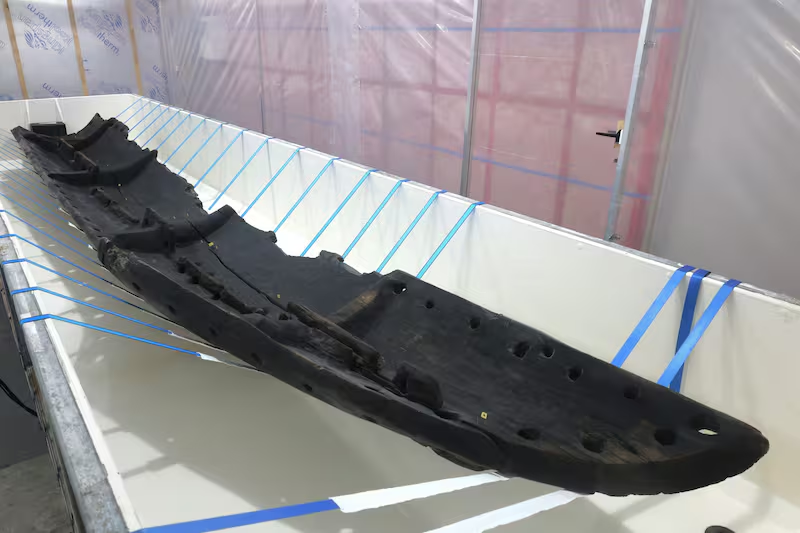
Plans are now underway to give a permanent home to the Anaweka waka, a 700-year-old Polynesian canoe fragment hailed as New Zealand’s most important archaeological discovery.

The six-metre section of a double-hulled, ocean-going waka was discovered in 2012 on Golden Bay’s remote west coast by a family on a picnic. Believed to date back to around AD 1400, the canoe is thought to have been built by early Polynesian navigators who settled Aotearoa.

Since its discovery, the Anaweka waka has undergone careful preservation in polyethylene glycol to prevent deterioration. Now, after more than a decade, the canoe is nearly ready to be displayed—and Tākaka has been chosen as its likely final destination.

Wharewaka to House the Waka in Golden Bay

Local iwi groups—Te Ātiawa, Ngāti Rārua, Ngāti Tama and Ngāti Kuia—have proposed building a wharewaka (canoe house) adjacent to the Golden Bay Museum, located at the corner of Commercial and Reilly Streets. The site, currently known as Pioneer Park, has already been zoned for museum use.


📣 Our WhatsApp channel is now LIVE! Stay up-to-date with the latest news and updates, just click here to follow us on WhatsApp and never miss a thing!!


The Tasman District Council approved the location in principle in July, with full community consultation expected before construction begins.

“We’re looking for something that the community can be really proud of and also in awe of,” said Butch Little, chair of the Ngāti Tama ki Te Waipounamu Trust. “It’s more than just a waka—it’s an opportunity to tell our stories, share our mātauranga [knowledge], and inspire generations.”
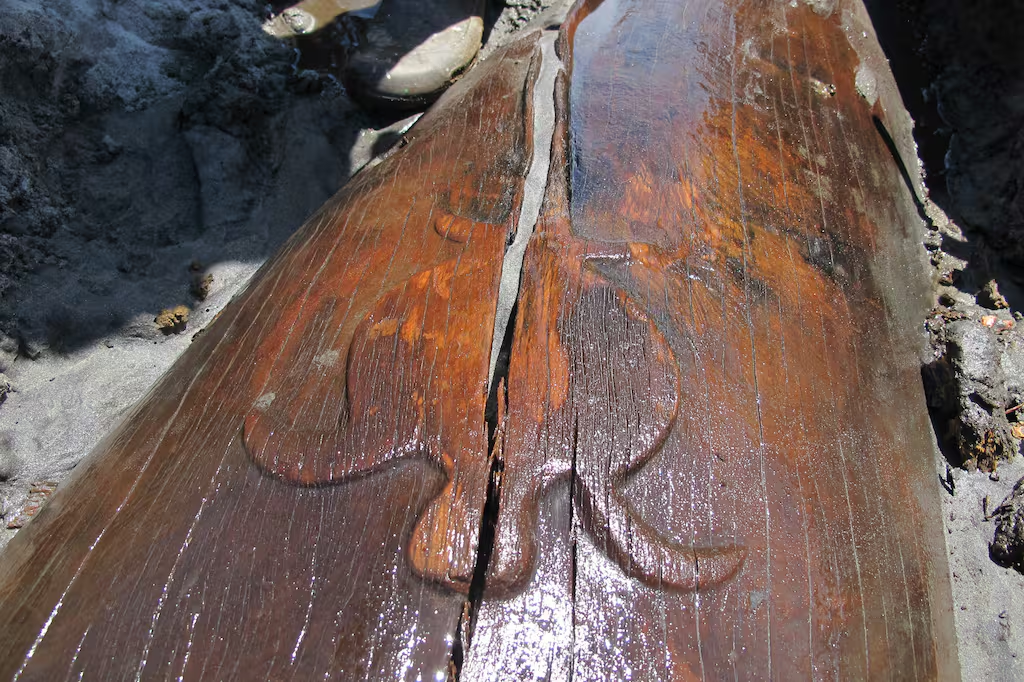
A relief of a turtle on the waka indicated that it was an ocean-going, voyaging waka that was intended to return to the Pacific. Credit: Supplied/Ngāti Tama- Local Democracy Reporting

A Symbol of Polynesian Seafaring and Māori Heritage

The Anaweka waka is one of only two known ocean-voyaging Polynesian canoes to survive in modern times. The first was discovered in 1978 on the island of Huahine, in French Polynesia. A third possible canoe was recently unearthed in the Chatham Islands, further highlighting the importance of this ancient maritime tradition.

Archaeologists and iwi leaders believe the waka provides rare insight into early Māori seafaring, waka construction, and celestial navigation—skills that helped Polynesians settle the farthest reaches of the Pacific centuries before European exploration.

“It’s the country’s most significant archaeological find ever,” Little added. “People will travel to Golden Bay just to see it.”

A Boost for Regional Tourism and Cultural Preservation

The proposed wharewaka is expected to become a major cultural attraction, building on existing waka tourism in the Abel Tasman region. The facility will also allow for the exhibition of other Māori taonga (treasures) currently stored out of public view at the Golden Bay Museum.

Museum board chair Frank Susko described the project as a historic opportunity:

“It’ll be a huge boost for local history. Golden Bay was the site of the first contact between Māori and Europeans—now it will also be known as the home of the Anaweka waka.”

While the site has been approved in principle, further planning, design work, and fundraising efforts are still required. Iwi and local stakeholders say they are committed to creating a space that honours the mana (prestige) of the waka and the ancestral knowledge it represents.

Cover Image Credit: Max Frethey- Local Democracy Reporting

Related Articles

A sculpture of a snake-bodied Roman-German deity was discovered in Stuttgart

23 April 2024

23 April 2024

A sculpture of a snake-bodied Roman-German deity was discovered at the Roman fort in Stuttgart, Germany. Since the beginning of...

409 silver coins, found in the Mleiha area of Sharjah, were inspired by Alexander the Great and the Seleucid dynasty

17 July 2021

17 July 2021

409 silver coins dating to the 3rd century have been found in the Mleiha area of Sharjah in the United...

Roman Marching Camps Discovered in Saxony-Anhalt for the First Time

15 January 2026

15 January 2026

Archaeologists in Germany have uncovered the first confirmed Roman marching camps in Saxony-Anhalt, providing groundbreaking evidence of Roman military operations...

Excavations at the ‘Westminster Abbey of Wales’ Yielded a Few Surprises: a lost Aqueduct and a Buried Celtic Treasure

12 March 2024

12 March 2024

Archaeologists working in Wales revealed recently they may have discovered a Celtic monastery at the site of a 12th-century Cistercian...

New study says earliest recorded kiss occurred 4500 years ago in Mesopotamia

18 May 2023

18 May 2023

The University of Copenhagen according to researchers, humanity’s earliest recorded kiss occurred around 4,500 years ago in the ancient Middle...

Newly Found 2,600-Year-Old Seal Could Be From a Royal Official in King Josiah’s Time

6 August 2025

6 August 2025

Newly discovered clay seal may connect to a high-ranking official from King Josiah’s court, offering a rare, tangible link to...

Spectacular ancient mosaic found in Paphos, Cyprus

21 July 2021

21 July 2021

During the excavations carried out on Fabrika Hill in Kato Paphos, Cyprus, an ancient mosaic floor belonging to the Hellenistic...

A shipboard 14th-century cannon found off the Swedish coast may be the oldest in Europe

14 September 2023

14 September 2023

An international research team led by maritime archaeologist Staffan von Arbin of the University of Gothenburg has confirmed that a...

1,400-year-old royal hall found in Suffolk, UK

5 October 2022

5 October 2022

Archaeologists, evidence of a 1,400-year-old royal Hall of the first Kings of East Anglia has been discovered in Rendlesham, Suffolk,...

Historic Leeds cemetery discovery unearths an ancient lead coffin belonging to a late Roman aristocratic woman

14 March 2023

14 March 2023

Archaeologists in northern Britain uncovered the skeletal remains of a late-Roman aristocratic woman inside a lead coffin, as well as...

A Roman Sanctuary with Inscriptions Discovered in Cova de les Dones, One of the Largest Rock Art Sites in the Iberian Peninsula

31 January 2025

31 January 2025

A team of researchers from the universities of Alicante (UA) and Zaragoza (Unizar) have discovered a Roman temple at Cova...

New insights into Scotland’s ‘bodies in the bog’

31 March 2022

31 March 2022

Fourteen bodies were found at Cramond near Edinburgh in 1975. New research suggests that two of the remains of these...

A 2,000-year-old Roman grave belonging to soldier Flaccus unearthed in Netherlands

9 December 2024

9 December 2024

Archaeologists have uncovered a 2,000-year-old grave from the Roman settlement in Heerlen, Netherlands. The latest analysis has shown that it...

Britain’s First Discovery of Its Kind: A 2,000-Year-Old Carnyx and Boar Standard Unearthed in Norfolk

7 January 2026

7 January 2026

A groundbreaking archaeological discovery in Norfolk has revealed one of the most complete Iron Age war trumpets ever found in...

The First Americans May Not Have Crossed Beringia at All — Hokkaido Could Be the Starting Point

15 January 2026

15 January 2026

For decades, the story of how the first humans reached the Americas has been framed around an inland migration across...